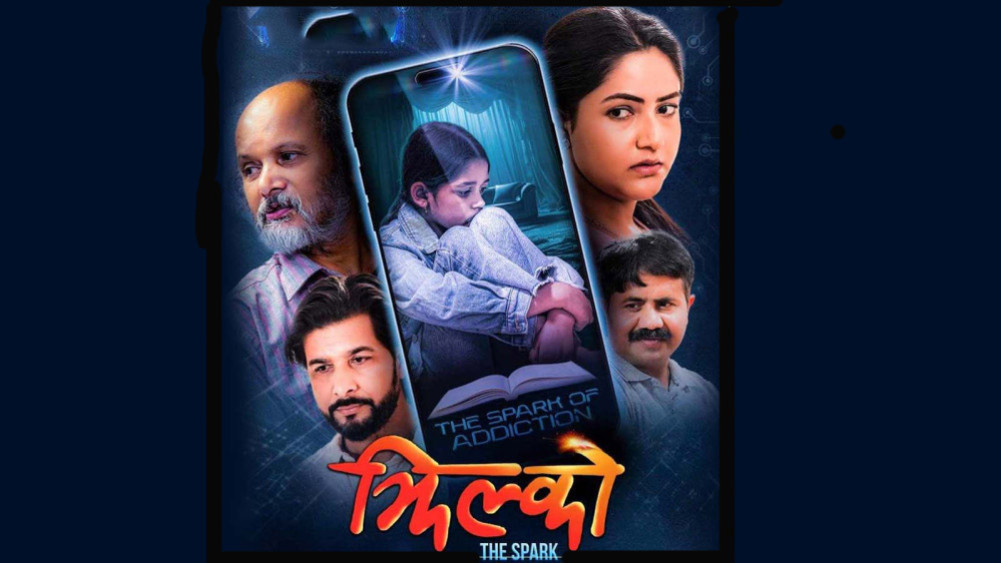
'Jhilko' plays a powerful role in explaining the impact that phones can have on children. And that reason is not you yourself?
We use Google Cloud Translation Services. Google requires we provide the following disclaimer relating to use of this service:
This service may contain translations powered by Google. Google disclaims all warranties related to the translations, expressed or implied, including any warranties of accuracy, reliability, and any implied warranties of merchantability, fitness for a particular purpose, and noninfringement.
Are we driving the technology or is the technology driving us? Are we parents or digital mothers? Use the digital splash as a fire or destruction as a wildfire? The movie 'Jhilko: The Spark', which is being screened from Friday, is a garland of these questions.
We are attracted to things that are directly or indirectly connected to our experiences, feelings and thoughts . We like to say 'like me', 'like me'. Saying 'It's like in our house...' gives a different feeling . Jhilko is a film that gives such an experience.
In today's digital age, smartphones have become an integral part of our lives. But how is this technology affecting our children and families? Jhilko has tried to find an answer to this question. Jhilko raises the serious issue of mobile phone culture and leaves a flicker of question in the mind of the viewer. Directed by
'Jhola' director Yadavkumar Bhattarai, the film revolves around Aastha (Ayushi Dhakal), whose life revolves around her mobile . Mobile when you wake up in the morning, mobile while eating, mobile until late at night before going to sleep, mobile as soon as you come home from school . Mobile even at school!
The little child didn't eat . What to do? Stop mobile . the child cried . What to do? Stop mobile . This is how most children grow up now. To show this, Aastha, who is addicted to mobile phones, is shown from the beginning of the film . Symptoms range from not wanting to go to school, not wanting to mingle with friends, to being lonely. Anyone who has seen the movie can understand the effects of mobile addiction.
What is the perception of mental health in Nepali society? That's what has been done in the film . The most important thing is that Nepali society has a negative understanding of going to a psychologist or counselor, the producer has put this thought in the film.
For viewers who are not used to watching films based on mental health and psychology in Nepali cinema, there is also a problem like 'nomophobia' i.e. no mobile phone phobia. How does smartphone addiction affect children? A study was published in the National Library of Medicine, Frontiers in Psychiatry journal in 2021 about the effects of excessive smartphone use on adolescents and young adults. It has been mentioned that excessive smartphone use is associated with depression, anxiety, OCD (obsessive compulsive disorder), ADHD (attention deficit hyperactive disorder) and alcohol consumption.
Some studies even say that the Internet and drugs work in the same way. According to University of Southern California (USC) Dornsife College of Letters, Arts and Sciences professor and neuroscientist Antoine Vishara, the brain works in the same way as cocaine and Internet addiction. "The Internet and cocaine produce dopamine, the neurotransmitter that makes you feel happy. Which keeps pushing us to find that happiness again and again . Vishara noted in a USC Today article published in 2017 on smartphone and drug addiction.
Many problems related to phones are seen and experienced by us every day. But there is no debate or discussion about the impact it will have. The film has tried to fill this gap. Through the film, the director has also shown the process of how notifications work on our brain, why sometimes our attention goes to the phone unintentionally and how the sound of any notification affects our brain .
The process by which we become addicted to anything is linked to the dopamine cycle. This same feel-good chemical, dopamine, is also produced by new notifications on the phone. Simply put, the phone produces dopamine and draws us to the screen again and again. Jhilko brings this concept to life through the story, which inspires the audience to think about their own technology use .
Children's psychology and mental health are not only shown in the film in connection with the phone's popularity . It can also be seen in the film that neglect of parents towards children, relationship between parents also plays an equal role in children's psychology and mental health. Every scene of
Jhilko makes Khulduli . Makes you question or think about yourself from time to time . Another question for every peeping parent is, how much time do you spend with your kids? Is your child's favorite friend your smartphone?
Being a student of psychology, I watched this film from the point of view of psychology. In the film Jhilko, it is shown that the child ran away by pulling other people's phones when he did not get a mobile phone. Which is the scene we see every day . Some time ago, Anu Adhikari, Principal of Kids Campus Monteshwari in Ratopul, Kathmandu, also narrated her experience to me. He said that one day a boy saw him using the phone inside the school and immediately that boy ran to him and asked for the phone. She told the incident that the student cried and had to be reminded by the other teaching staff of the school that she should not use the phone in school. The same scene as narrated by him is also shown in this film .
Parents who use their phones all the time can explain to parents that they themselves are role models for their children. Seeing the effect of the phone in the film helps the children to be aware .
However, there are other issues that need to be critically interpreted about the film . The girl suddenly disappears from home . Where does she go? Why does she disappear? The film does not answer that. However, the audience demands an answer to that. In this film, there is a feeling that women's rights and feminism have been presented lightly. Which looks a bit unnatural in the scenes . Likewise, in some places, there is a feeling that the dialogue and unnatural scenes have slipped.
'Zhilko' plays a strong role in explaining the effects of phones to their children. And that reason is not you yourself ? Makes you think .