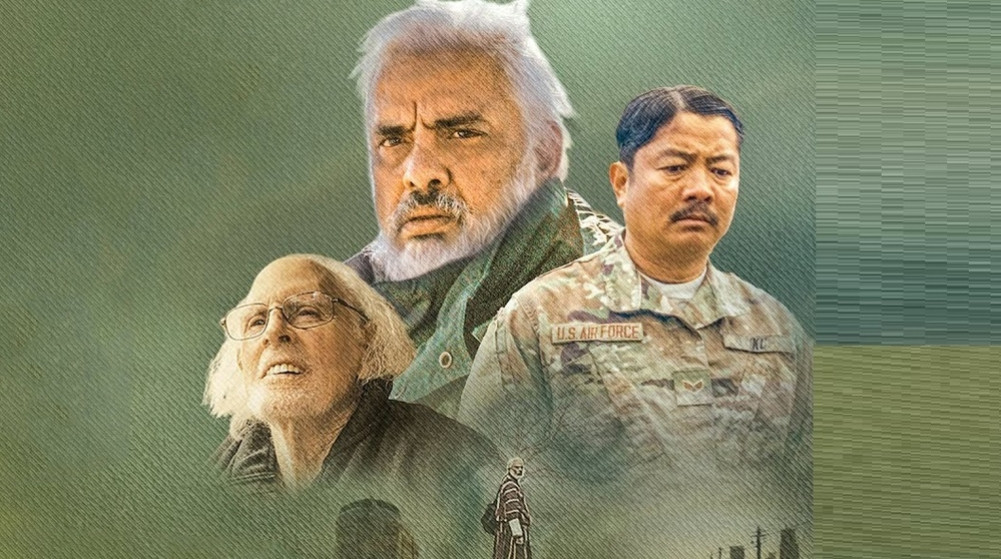
As the audience is not able to walk in the emotional journey of the main character, some images of the film make us feel sad
We use Google Cloud Translation Services. Google requires we provide the following disclaimer relating to use of this service:
This service may contain translations powered by Google. Google disclaims all warranties related to the translations, expressed or implied, including any warranties of accuracy, reliability, and any implied warranties of merchantability, fitness for a particular purpose, and noninfringement.
This is old, what is it to bring? To dieLife is here, it is not immortal Suitable for soil...
When the pastor (Bimal Subedi) sings this bhajan with the music group in the church, the body of Bishnu Bahadur KC (Harivansh Acharya) who wants to touch the soil of Bhutan until his last breath, is about to leave the world . Vishnu means Nepalese Bhutanese refugee . He is also a national football player of 1988 and is waiting anxiously to get a visa to Bhutan until the last day of his life. In the 10th year he arrived in Akron, USA, he applied for a visa 10 times, but every time Vishnu's request was rejected. The story of 'Bhuthan' continues with the death of Vishnu, who is dragging his physical body to America with the desire to touch the soil of Bhutan.
Burning or burying his earthly body? The story of the film proceeds from this conflict between two families with religious beliefs.
As in the song sung by the pastor, Vishnu's body is lying in a coffin to be mixed with soil, but which soil ? The living do not care! Will Vishnu's body be buried in the soil? What is the theoretical difference made by burning the intestines that have not touched Bhutanese soil? After all, immortal life has left the earth.
The story of 'Bhuthan', told in a 'non-linear' style, sometimes reaches the present, and sometimes the past reaches the grave . This style of the film keeps the audience tied to the story of a family that believes in two religions, a growing up granddaughter and Vishnu who keeps chanting the name 'Bhutan'. Vishnu's first wife is a Hindu, the second is a Christian!
The first wife wants to cremate her husband's body according to Hindu religion, standing up to her right to be the eldest. The Christian wife wants to be buried in the ground according to religious rules. The film starts with the conflict between two families who believe in different religions regarding Vishnu's funeral. Gradually, the film begins to measure the depth of Vishnu's struggle, waiting and haste to go to Bhutan. In the
film, there is not only a mismatch between families who believe in different religions, there is a fight for existence, different cultures and beliefs. There are complex relationships . There is also a sweet relationship between Baje and the granddaughter. There is Nepali society, there is women's rights. Most of all, the Vishnu character is eager to set foot on the land of his country.
The story of the film is not in a 'linear' style, so the camera filming Vishnu's coffin shifts to the fast past to his persuasion/submission with the visa officer for the visa. This style of storytelling has made 'Bhuthan' look like an 'abstract' painting drawn on a large canvas . From philosophy of life in many letters, about aspects of existence It digs into the dark side of the life that is being lived in poverty. Vishnu's story sometimes makes the audience laugh and sometimes brings tears to their eyes. Most of the scenes convey a heavy meaning. Director Vinod Poudel has proven himself again in the style of telling stories through the use of
images. In most of the scenes of the film, there is a single tree standing. Desolate this tree is old, like Vishnu character . The sadness within Vishnu is an image of the character's state of mind and situation, this tree . A tree will never grow a tree, the greenery has said goodbye to this tree . This tree standing in the middle of the cold ice is a representation of Vishnu, a character living a cold life with a cold heart. The mirage to go to Bhutan has given him the strength to stand and fight alone in this cold weather.
Most of the dynamic scenes show a life that is stuck somewhere . For example, a moving train jumps to reach its destination . The sound of the train always collides with Vishnu, or this sound always resonates in his world . However, even the same train does not take Vishnu to Chorang village in Bhutan . There is a continuous flowing river, which calmly runs to its own destination . Between work and daily life in America, Vishnu's life is as calm as water, but it is motionless, stuck in Akron . Vishnu cannot reach the simal tree of the village by running away. There is a powerful scene in the
film . Where the pastor is preaching about another event in the Bible. One day the biblical character Nicodemus came to the Lord Jesus and asked about the second birth, 'How can a man be born when he is old? Can he be born a second time in his mother's womb ?' As the pastor's sermon fades into the background, the camera pans to Vishnu . There are many such strong scenes in the film, which speak a lot from one scene . To break the story, Vishnu has been born for the second time as an American citizen. In front of the visa officer, he repeatedly testifies that he and his family have become American citizens. But, was Vishnu born as an American citizen? The answer to this question asked by Nicodemus can be found in what his grandfather told Vishnu, his grandfather told him - 'A tree firmly rooted in one place should not be moved to another place.' That's why Vishnu's life, which is rooted in Bhutan, is not green even after moving to America.
How many parts of the film are sad because the audience cannot walk on the emotional journey of the main character. Why does Vishnu want to return to Bhutan? His connection with Bhutan is shown only in dialogues, some certificates and the rest of the football . However, it is not visible in the scene what Bhutan was like. Chorang village is not included since the abandoned Dauntri. Therefore, the wait he did for the country, the yearning of that soil is not felt any more . He only talks about Bhutan in dialogues, why does Vishnu want to go to Bhutan while living in a city like America? If the subject had been established in the scene, the feelings and despair in him would have touched the hearts of the audience.
actor Harivansh Acharya's performance is the strong point of the film. Harivansh's face shows deep pain all the time . The eyes are waiting for something, the extreme despair in them is stuck in those eyes . He rarely laughs in the film . The comedian's transformation of acting in this kind of role is really beautiful . 'Open Ending' has strengthened the story of the film . Director Paudel has given the viewers the responsibility to investigate the topic that had sown the seeds of conflict between the two families.
The beginning of the film is the funeral of Vishnu according to the method of which religion? It starts with . At the end of the film, there is the same identity. The Christian family wanted to put Vishnu in a coffin and bury it in the ground, while the other family wanted to burn it according to Hindu beliefs. Vishnu is shown neither burnt nor buried ? One scene in the film answers both of these . Vishnu is seen carrying a burning coffin on an eternal journey . Is that eternal journey towards Bhutan ? One day the pastor said, 'Jews used to bury the dead with the hope of resurrection.' Is Vishnu on the way to resurrection? After watching the movie, your heart will give you the answer!