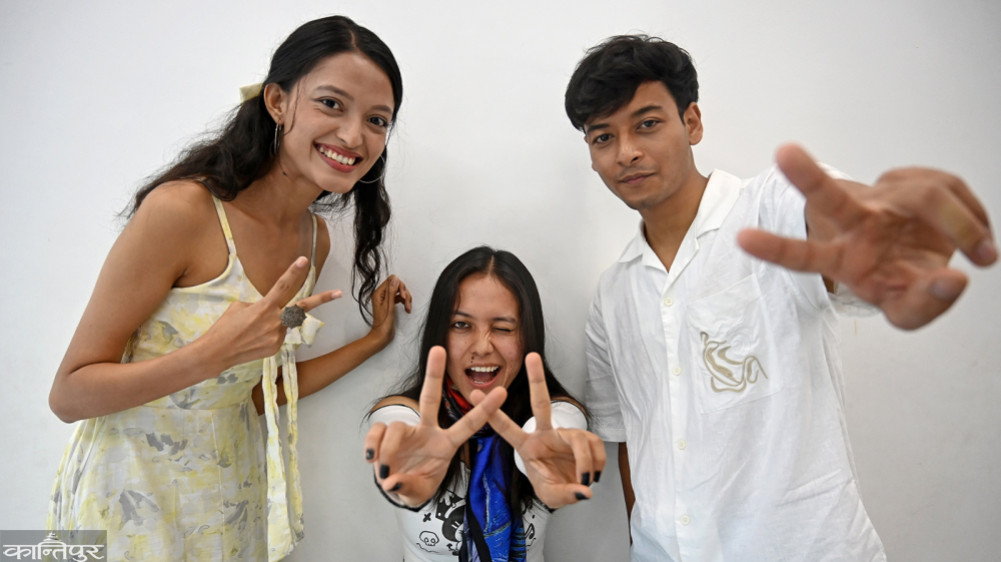
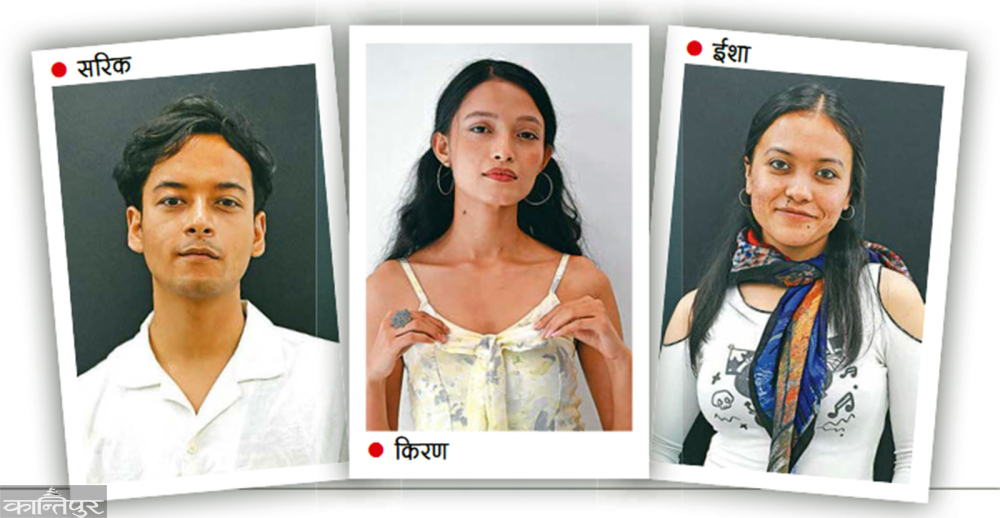
The Nepali society that considers 'artists who can't read' or 'stage/films as gimmicks' is becoming more liberal recently, while the idea of making it a career is also increasing in the latest generation of studying film, among them are Kiran, Isha and Sarik.
We use Google Cloud Translation Services. Google requires we provide the following disclaimer relating to use of this service:
This service may contain translations powered by Google. Google disclaims all warranties related to the translations, expressed or implied, including any warranties of accuracy, reliability, and any implied warranties of merchantability, fitness for a particular purpose, and noninfringement.
In school life, most of the people answer, "I will become a doctor, engineer or banker." During the student period, most of them do not think of becoming a filmmaker or an artist. Our society does not think that there is a future in film making.
Some people do not consider this profession to be fast. That's why those who are interested in the film industry and dream of a career in this field cannot say openly.
Born and brought up in Dhangadhi, Kiran Shahi was also interested in acting from an early age. But she could not openly tell anyone about the subject of her interest. "Because I was afraid that I would be ridiculed rather than an actor in the future," she says. But Kiran did not give up on her goal. Instead, she came to Kathmandu and enrolled in Oscar College, where she studied film. She is currently pursuing an acting course here.
Isha Sinjali had a special fondness for films. She thought, 'I will also become an artist in the future.' But her father flatly rejected this wish. "It is not good to be an artist," his father advised him to choose another field. However, Isha did not give up her determination to become an artist. She is also currently doing a course in acting. In the case of Sarik Vishwakarma, it was not difficult like that of Kiran and Isha. His father instilled his passion for films. At that time it was very popular to bring a CD player home and watch movies. Dad used to bring movies on CD. "I loved watching movies but I was not interested in how to make a movie or how to act," says Sarik. When I was learning drama, I felt as if I could study this subject.' He enrolled after learning that there is a film college in Nepal.
'While studying in college there, we also opened a production house together with friends,' added Sarik, 'because we felt that we should create our own opportunities.' Although she had a strong interest in artistry, Kiran had doubts about two things. One, to be an artist, one must have a well-matched appearance, which one does not have. Secondly, it seemed that there was no place for formal film education or training in Nepal. But, one day Dai cleared her doubts and said, 'There is a film college in Nepal, study it.' And the approach was. Later, when I started reading films, that understanding and thinking changed. After starting reading films, she learned to respect the 'space' of others, to do things that do not affect others, to think liberally and to normalize everything. While doing film courses, you will not only understand acting, filmmaking process, direction, sound, lighting etc. Isha says, "You get a chance to understand the aspects of society and life in a different way. While watching a film, we only see or watch the actors. But the way of looking at life is also different.' In order to understand the
film, it is first necessary to understand the society. "While reading the film, I learned how to present it to the society," Sarik says They are representing some society. They have surname, gender, religion and background. "Now, while telling the story of that character, it is necessary to understand how to present the society within it," adds Sarik. While taking a
film course, Sarik was given a list of 100 films by his teachers. How to watch a film is more important than how to make it. Recently, the debate on Nepali films is positive, according to those studying it. The film can be interpreted and discussed from many angles. However, there is no single universal formula that says this is how a film should be made. Kiran says, "A film has its own beauty, which the maker should be able to present in his own way." "We argue that we should make films with Nepaliness, but we don't stop following Bollywood," she says, "We are learning from what Bollywood does." We really don't even know what Nepaliness is?'' She says that when watching a Nepali action film, it is ambivalent whether it is Nepali or Bollywood. Kiran doesn't think it is so strange to see the influence of Bollywood somewhere in Nepali films. Our film started by being close to Bollywood. In the beginning, Nepali films were made by keeping most of the actors, technicians, and technology there,' she adds, 'Now our films should find their own identity rather than imitating Bollywood, and only then will our films reach the world.'
Our films and content can be isolated and interesting among international audiences. Be it our architecture or lifestyle. Comparatively, the level of Nepali films has increased recently. Be it in terms of professional statistics or achievements, some expectations have been met with results. From making the world market to competing in the world's prestigious festivals, the work has been done. Kiran squeezes, "It's gradually getting better. However, it has not yet happened at the speed it should be.'