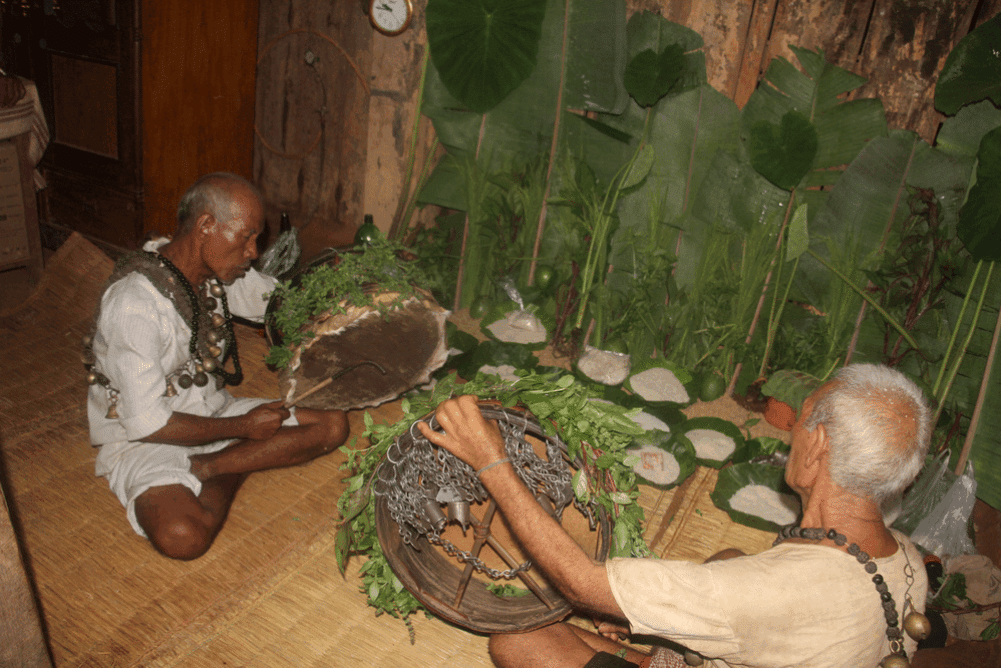
The Chepang people who live at the head of the river and at the bottom of the forest have a custom of eating food and fruits produced in the Pakho and steep land in Chonam or Nwagi.
We use Google Cloud Translation Services. Google requires we provide the following disclaimer relating to use of this service:
This service may contain translations powered by Google. Google disclaims all warranties related to the translations, expressed or implied, including any warranties of accuracy, reliability, and any implied warranties of merchantability, fitness for a particular purpose, and noninfringement.
All castes have their own language, religion, culture and tradition. That is also the identity of caste. That is why it eventually disappears. According to the researchers, the tribe called 'Fri' living in Kulekhani Indrasarovar area of Makwanpur is now extinct.
Among the 59 tribal tribes listed by the government of Nepal, the Chepang community is a marginalized community in the country. The leaders of Chepang community, who are identifying themselves as nature worshippers, have been taking initiatives to revive their language, religion and culture for a decade. But their efforts have not brought results qualitatively . Encroachment on their religion and culture continues. At the same time, their language and culture has reached an endangered state.
After the change of 2046, conscious young people of Chepang community organized and established Nepal Chepang Association. The third session of the Union in 2054 in Chitwan decided that 'we are not citizens, we are Chepang, now everyone will write Chepang'. Earlier, the chief guest of the first comprehensive Chepang conference held in 2034 at Manhari Jamire, Makwanpur, and the then central president of Nepal Red Cross Society, Princess Prinsep Shah said, 'From now on, you are not Chepang, you have become citizens', and the Chepang community was reduced to citizens.
Even though the Chepang community write their own surname, they are moving away from their language, culture and tradition. Although there is a language, their script is not . In order to protect its identity, the Chepang Association has also been conducting language classes in villages/villages. Not only that, Chonam (Nwagi), the only important religious festival of the Chepang community, has been celebrating collectively for the purpose of preserving culture and identity. Every year on August 22, Chepang leaders gather at one place and celebrate Nwagi in a meaningful way. This year there is a program to celebrate Nwagi in Ichchakamana rural municipality-5 Kalikhola of Chitwan.
President of Nepal Chepang Association Govindram Chepang said that Nwagi Festival has been celebrated in every district through houses, tolls and villages with the aim of reviving their religion, culture and customs. He also said that it is difficult to preserve language, religion and culture due to the encroachment of other religions. The Chepang tribe, known as nature worshippers, has a 22-year pedigree. That's why President Govindaram said that on August 22nd, Nwagi Parv or Chonam started to be celebrated. The association has been celebrating Nwagi collectively for a decade.
Bagmati state government has been giving a public holiday in three districts of the state for two years on the day of Nwagi, an important cultural festival of the Chepang community. The provincial government has given holidays in three districts namely Makwanpur, Chitwan and Dhading. Chepang community is densely settled in all three districts. According to the demand of Nepal Chepang Association, the Cabinet of Bagmati Province Government has decided to give a public holiday on August 22 every year in the three Chepang-dominated districts of the province on 9th March 2078 and published it in the provincial gazette.
The Chepang community has a religious belief that they should not eat new fruits and grains without worshiping their ancestors. On the day of the said Nwagi festival, rice, pindalu, nibua and fruits of Ghaiya paddy are offered to the land and ancestors. It is customary to dance and enjoy the whole night.
Marginalized Chepang community who have been living by eating wild tubers for at least nine months a year, change their faces by eating sweet and smooth on August 22. This caste who lives in Bhirpakha, as fruits such as corn planted in Pakhapakhera ripen in August, they celebrate Nwagi festival with pomp and nbsp; on that day. The Chepang community calls the day of eating new grain Chonam. Tilak Chepang, principal of Shankhadevi Secondary School located in Dhading Benighat Rorang-9 said that Chonam festival is also connected with the identity of Chepang community.
During the Chonam festival, Pande Jhankri, a priest of Chepang, bangs a drum and recites mantras and offers new food to the gods and ancestors and they also eat it . Chonam festival is celebrated by the Chepang people as a bigger festival than Dasain/Tihar. In this festival called Chonam in Chepang language and Nwagi in other languages, villages and settlements gather together and celebrate collectively.
Govind Chepang, who is also a member of the Constituent Assembly, said that this is the biggest festival of the Chepang race. It is customary for the Chepang people who live at the head of the river and at the bottom of the forest to eat corn, rice, pindalu, giraunla and various sour fruits produced in the flat and steep land. On the day of Chonam, the Jhankris chant the mantras by hitting one-sided drums.
71-year-old Pande Chandra Bahadur Chepang of Raksirang Gapa-7 Damrang said that there is a legend that if the drum is not hit and the mantra is not chanted on the day of Chonam, the ancestors and gods will get angry. According to him, the way to eat new grains and fruits will be opened only after this method is completed. He said that if one eats new grain without fulfilling the law, the father and the gods will give pain.
The Chepang community is a resident of Raithane around the Mahabharata mountain range rising north of Rapti River and east of Trishuli. West of Makwanpur, north of Chitwan, south of Dhading, there is a thick settlement of Chepang community. Chepang is bound by social and cultural boundaries rather than geographical boundaries.
The rulers from the past to the present have been dividing Chepang administratively. The Chepang community, which is located in the extreme areas of the northern and southern parts of the Mahabharata mountain range, has been divided into one rural municipality, one district and one province. "We have not been allowed to be strong and organized, as a result of which we have been deprived of the opportunity to choose people's representatives who will work for the benefit of our community," said Sant Bahadur Chepang, the former state minister of Bagmati province, "on the other hand, religion from outside is putting the identity of the Chepang community in crisis."
Chepang tribals have their own historical background. Chepang's Thatthalo may be a constituency in itself for the parliamentary elections, but the complaints of Chepang leaders are that by scattering it in Chitwan, Dhading, Makwanpur, Gorkha districts, Chepang will never be able to send elected representatives. The lives of the Chepangs, who have been making their homes in the remote and scary dark areas of the district near the capital, are still horrible. No regime and system has been able to make a fundamental difference in their lives .
The Chepangs, known as the sons of the earth, are living in a wild age in their own land. The existing system in the country has not reached even around them. Those who got the opportunity from this and similar arrangements and systems, they could not remain essentially Chepang . They became Chetri/Bahun within Chepang .
According to the 2078 census, the Chepang community lives in 31 districts from Jhapa to Kanchanpur. In terms of numbers, there are 84 thousand 364 Chepang community in the country with 42 thousand 758 males and 41 thousand 606 females.