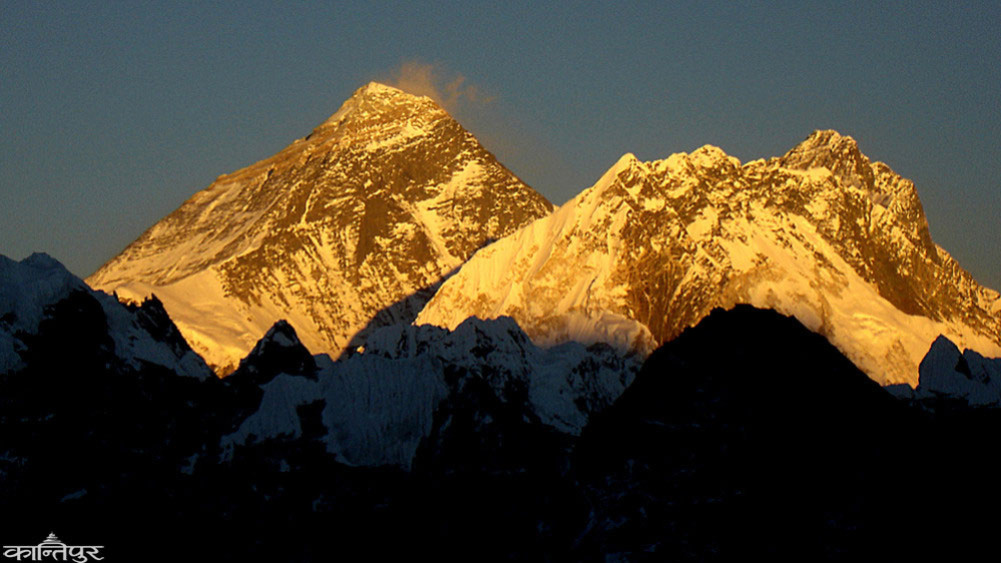
Most of the history of Mount Everest is drawn from a Western perspective. Somewhere there is no attempt to tell the stories of Nepali Sherpa's ability, sacrifice and dedication, and some where they are not accepted as partners in history. Now its history needs to be written from Nepali point of view and mind.
We use Google Cloud Translation Services. Google requires we provide the following disclaimer relating to use of this service:
This service may contain translations powered by Google. Google disclaims all warranties related to the translations, expressed or implied, including any warranties of accuracy, reliability, and any implied warranties of merchantability, fitness for a particular purpose, and noninfringement.
While the Everest dialogue was going on in Kathmandu, there was talk of climbing Everest in the Khumbu region. I went to Everest base camp along with senior government officials affiliated to the Ministry of Tourism and leading professionals in the field of mountaineering with the aim of interacting with the climbers and climbing helpers, especially the Sherpas, to understand the conditions and problems of climbing.
Coincidentally, the Home Minister also reached the base camp at the same time. Congress General Minister Vishwaprakash Sharma was at the base camp for a few days to climb Mount Everest. The day's discussion and interaction in the courtyard of Everest focused on the proud history of Everest and the impact of the rising global temperature on the mountain and mountain people's life.
Despite being the highest peak of Nepal, the harsh reality of a long time being a powerful country and a big mountaineering company in the field of mountaineering has now changed. At present, Nepal is able to operate its mountains completely based on its own manpower, conditions, meaning and scale. The current base camp, which has been improving for more than six/seven decades, has been established as a symbol of Nepali glory and prestige.
The Nepali Sherpas have not only shown their rare skills as guides in that mountain corner that the world has neglected, but they have taken ownership of our mountains as true representatives and guardians of the state of Nepal.
Commander Sherpa
Whether the first Everest climbing team in Nepal was British, Swiss, Chinese, American, Indian or French, Sherpas always remained an inseparable part of them. But the Sherpas did not get the credit they deserved for their important contributions.
After the year 2046, the rules of ascension were relaxed. The Sherpas were able not only to help others but also to hold their command of the mountains over a wide range. Currently, Sherpas are not only mountain porters or guides, they have been able to take Nepali mountaineering to new heights as the owners of climbing companies capable of providing world-class services.
The leap made by the Nepali mountaineering sector in professional climbing has made the dream of reaching the highest peak possible even for the middle class of the world. In addition to this, the number of people dreaming of reaching the once-in-a-lifetime dream is also increasing, even though it is limited to the tent settlements that are set up for three months every year at an altitude of about 5,300 meters.
Tenzing Norgay Sherpa, along with Sir Edmund Hillary, was the first to reach the summit of Mt. It was not only Tenzing's personal glory, but with that achievement he established the identity of Sherpa at the global level and gave an unforgettable song to the Himalayan race.
The Sherpa generation after him, who started climbing the mountains with that legacy, have not given a chance to question their skills, integrity and leadership on the world stage. Nepalese Sherpas are the first choice not only for mountain climbing in Nepal, but from the 14 highest mountains in the world to the highest peaks of seven continents. Once cited as a so-so number helping foreign climbers, the Sherpas are now revered as the greatest climbers in the world. This is a golden time for Nepali mountain climbing when the footsteps of Nepali Sherpas are spreading globally.
Arriving at the base camp, the attraction of the place is the hustle and bustle of tent settlements, war-level preparations and alluring scenes of weather adaptation exercises. Kamirita Sherpa, Padwa Sherpa, who have climbed the summit several times, and many record-setting Sherpas are also found around there.
Everest trekkers line up at Namche Bazar to meet the youngest Sherpa, the only surviving member of the first successful Everest climbing team. They are truly human legacies of the mountaineering world. Staying among the renowned Sherpas is a truly lively opportunity for regular climbers.
In Nepal, such rare heritages have appeared every time before and after the successful climbing of Mount Everest. The contribution of countless Sherpas like Pasang Lhalmu Sherpa, Babuchiri Sherpa, Angrita Sherpa, Tenjen Lama Sherpa, who have passed away after making great history, is a subject that should be strongly written in history.
All those who seem like talismanic characters of history are sagas that could become world-famous books or movies. Now many new generation sherpas are adding many colors to mountaineering by becoming new skill and technology friendly. At present, every climbing company in Nepal has one or the other Sherpas who hold rare records and have demonstrated high courage in one form or another. This is our special property.
ideal climbing and improvement efforts
The responsibility of owning the world's symbol peak is also very heavy. Nepal should understand it as a guardian of the Naso left by nature and history rather than as a possession. Everest has a deep connection with people living in every corner of the world. They will continue to be added. Our policy rules should be made in such a way as not to offend the feeling that Everest belongs to them too.
At one time, climbing Mount Everest was considered possible only at the state level due to the huge expenses and the ability to mobilize the required manpower. If we look at the preparation of the British, American or Italian climbing teams seen in Nepal between the 1950s and 1970s, we can read a history that is no less than a big war.
At that time, climbing Mount Everest was a matter of national prestige. But now a common middle class climber can dream of it. It should never be understood that anyone can climb the mountain to reach the dignity of Mount Everest.
In the last few years, there have been complaints of overcrowding due to the increase in the number of climbers eager to reach the summit by overburdening only the Sherpas. According to foreign climbers and Sherpas, the overcrowding is due to the large number of unprepared people. Another painful situation is when someone dies in the mountains.
Nepal government is always aware that the dignity of Mount Everest should not be degraded in any form in the mountaineering world. Keeping this in mind, the Nepal government has prioritized the policy reform of mountaineering. Mountaineering regulations have been revised. Mountaineering has been given priority in the Tourism Policy and Tourism Act. The process of making policy arrangements for climber welfare fund targeting climbers and Sherpas has been advanced.
mountain 'brand'
The Everest we have is an immovable and immovable property. The Llama-Llama trail, where you can trek in the lap of the Himalayas, is a beautiful gift given to us by nature. But if you don't understand their value, it doesn't mean that they will always remain like that. It is unthinkable that the Sherpa community will now continue to carry on the mountain climbing legacy of the Raithane skills left behind by their forefathers.
It is necessary to develop and expand state-of-the-art mountaineering training centers within the country so that they can acquire new skills and technology. Our mountains themselves are excellent schools of climbing. Who else could be a better coach than a Sherpa? Keeping this in mind, the government has prioritized the development of the skills of organizations like the Nepal Mountain Training Institute, Nepal Mountaineering Association.
Although the fate of mountain climbing is unavoidable, it is now essential for the Nepali climbing community to have high standards of training and skills to deal with the risks that have increased with climate change. It should not be too late to learn lessons from the avalanche that killed 16 Sherpas at the Khumbu Icefall in 2014 and another avalanche that hit the base camp in 2015 that killed 22 Sherpas and tourists.
Sherpa is no longer just a race, it has become a prestigious profession. Sherpa is our specialty brand. Appreciating that there can be no other reliable helper like Sherpa, even in the G-20 organization of rich countries, their main staff who help the heads of state and government are addressed by the name 'Sherpa'. Foreigners know them as Sherpas.
Sherpas are the guardians of the mountains. Just as we rely on the Sherpas to build a route on the Khumbu Icefall or rope up the summit, we can treat them as equal stakeholders in mountaineering operations as the government. In order to increase this value and dignity, the integrated support of the tourism world is necessary from policy clarity.
Sagarmatha 'soft power'
Through the Sagarmatha Dialogue, this time Nepal tried to take international leadership in the issue of climate change. For Nepal, this highest peak is its 'soft power' weapon.
The world is watching very carefully the group gathering on Mount Everest. Following the trend of previous years, people from more than 50 countries gathered in the tented settlement erected on the Khumbu glacier this year alone. Nepal's mountains and climbing have been prioritized by the international media like hardly any other topic. So it is also the power that we can be seen and heard on the world stage.
As the issue of climate change continues to be complicated in the contemporary world, we can take the lead in this issue under the guise of Everest. The effects of climate change are not seen as clearly and quickly in the mountains as elsewhere. And, this issue is not only a matter of concern for the Himalayan region. The global community should not be slow to realize the harsh reality that the melting of the ice range, also known as the 'Third Pole', will extend to the seas below. There is no room for Nepal to delay taking a leadership role in this issue under the guise of its mountains and the world community gathered by those mountains.
At the end,
After seven decades of successful climbing of Everest, Nepal has earned its original reputation globally and a community that loves Nepal very much. But until now, most of the history of Mount Everest has been drawn from a Western perspective. Sometimes the stories of Nepali Sherpa's ability, sacrifice and dedication are not told, and sometimes they are not accepted as partners in history. History is written by the victors. Nepal is also the champion of mountaineering in its own environment and rhythm. Coming out of the colonial commentary, we need to understand the mountains of our Kakhai. The highest peak we call Everest is named by the Tibetans in honor of the goddess Myolangsangma.
says 'Chomolongma'. The rest of the world knows it as Everest, named after George Everest, who first scaled it. It also means that everyone can have a different impression of this mountain from their own point of view. Its history now needs to be widely written from a Nepali point of view and mind.
A famous saying that 'Only Everest can decide to reach the top' shows how vulnerable humans are to nature and how abstract and challenging climbing is. Similarly, Everest should not be a place where one's pride, frustration or prejudice can be expressed in any form. We need a community of Mt. Everest that understands its sanctity and does real climbing only through mutual cooperation and respect, no matter how specific form professional climbing takes. Anything that endangers the lives of Sherpas in the name of luxury tourism cannot be expected from another person who respects the mountains.
It is a field of adventure tourism but it is also the most suitable place to compete with yourself. Here, the struggling life of those mountains has given birth to tolerant Sherpas. The religious-cultural beliefs there have taught to respect and care for the mountains, and history has been written by the actions of the Sherpas who selflessly put their lives at stake in different periods of mountain climbing.
On top of that, generations of Sherpas have kept that reputation alive. At the very least, we should honor it by gathering those great climbers of ours in history so that they will never be forgotten.
– Pandey is the Minister for Culture, Tourism and Civil Aviation.