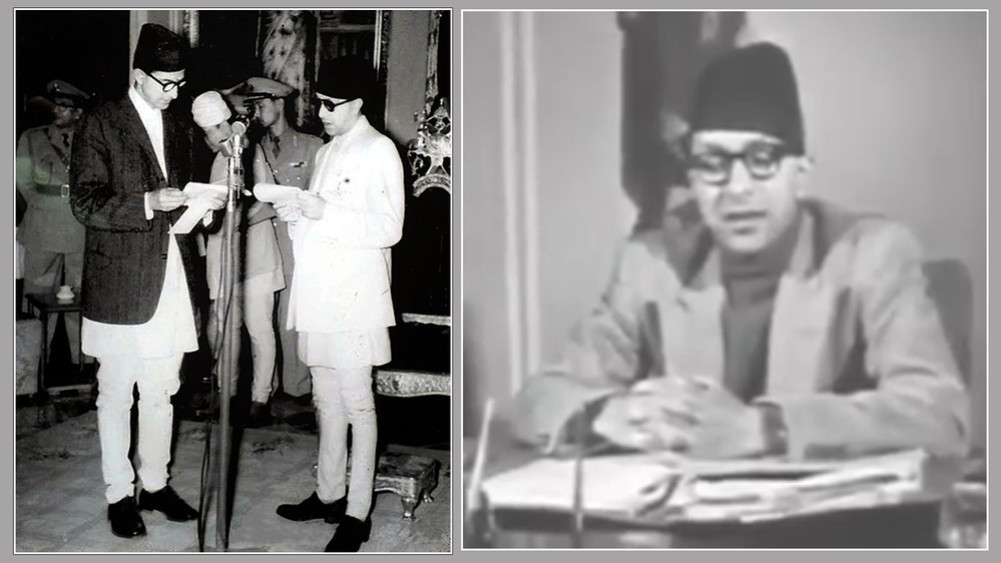
Mahendra did not want the parliament to last long. He called the first meeting of the first parliament at 11:45 midnight on June 16, 2016.
We use Google Cloud Translation Services. Google requires we provide the following disclaimer relating to use of this service:
This service may contain translations powered by Google. Google disclaims all warranties related to the translations, expressed or implied, including any warranties of accuracy, reliability, and any implied warranties of merchantability, fitness for a particular purpose, and noninfringement.
On January 1, 2017, the then King Mahendra Shah deposed the first elected Prime Minister, BP Koirala. Using military force, he arrested the Prime Minister and threw him in jail. Also, Parliament was dissolved to nullify the parliamentary practice that had started the previous year.
Widespread arrests were made against political leaders and workers. The fundamental rights of citizens provided in the constitution were suspended. Banning the parties, he started the independent governance system. As a result, political figures were either imprisoned or exiled. After being exploited by the Rana for 104 years and 7/8 years after the revolution of 2007 under the dupes of the kings, Mahendra took a negative view of the multi-party competitive democratic governance system that started in the country within a year and a half. The country returned to a closed society.
The democracy lovers criticized King Mahendra's move with sharp words. He argues that it is not only because of Mahendra that the democratic system has not flourished in the country, but the pace of development has also been blocked. In this article, we will present a possible assessment of what could have happened if Mahendra had allowed the parliament and the government to work for a full term in accordance with the 2015 constitution without a coup, and periodic elections had been held. Since Mahendra's coup is critical, this material is only focused on assessing some possible and positive results that could have happened if there had been no coup at that time.
Mature and effective parliamentary system
The Parliament formed after the first election for the Parliament in 2015 was a new practice for Nepal. However, that parliament played its role effectively. The then Prime Minister BP Koirala himself had assessed that Parliament was running very well and was no less than the Indian Parliament of the beginning. (Vishweshwar Prasad Koirala's autobiography)
Prime Minister BP Koirala worked hard and encouraged the development of parliamentary practice. The Congress, which has two-thirds of the seats, used to train the MPs continuously. Books and reports on the proceedings of the British and Indian Parliaments were kept in the library. BP used to tell MPs to read a lot. He reminded that parliamentarians have a role to make the parliamentary system effective. (First Parliament/Jagat Nepal)
If the then Parliament had been able to work for a full term, a strong foundation of parliamentary practice would have been laid. Subsequent parliaments would follow suit. Not only that. In our country, the size of the Parliament was debated and decided from the very beginning. How to reflect the diversity of Nepali society in the parliament was also unclear. However, it could be discussed only after 2063.
On the other hand, issues such as which people can be represented in the parliament, what their work and priorities should be, could also be decided. As now there are reports of 'conflict of interest', contractors have become parliamentarians, businessmen have become parliamentarians, and there are reports of manipulation by sitting in the relevant parliamentary committees. The debate on whether MPs should be made ministers has just started. Because, many argue that the facility of allowing MPs to become ministers has brought distortions. If parliamentary practice had continued since 2015, many of the current debates would have been resolved. The
topic can be assessed without looking at the topic separately, when the same system was continuous, it was also known to purify itself, it also matured. Experience and tradition play a major role in parliamentary system. Many issues that are not directly addressed by laws and regulations are used as rules based on parliamentary tradition. If the parliamentary practice started at that time could have continued, our parliamentary system would have been prosperous. Parliamentary democracy would have been strengthened. But elections could not be held for a long time after Mahendra's coup. There could not be a multi-party competition. As a result, the 2015 exercise could not be continued.
Along with democracy and monarchy,
Mahendra had started many scams before the 2015 elections. For example, in Article 13 of the 2015 Constitution granted by the then King Mahendra, it was provided that the Prime Minister can be appointed by the King at his discretion. As a result, the prime minister was dependent on the king's discretion rather than the power of internal selection of parliamentarians approved by the people.
Even after the completion of the parliamentary elections, his focus was not on allowing the parliament to function effectively. Even before the election was over and the new parliament started its work, he had issued his own laws. He called on BP Koirala to form the government only after putting the red seal on the military law with the provision of keeping the army under his command. (First Parliament/Jagat Nepal) Likewise, just four days before forming the government under the leadership of BP Koirala, the king had given several birtas in the name of his brothers and sisters. (First Parliament/Jagat Nepal) Before convening the first session of the Parliament, the King issued laws regarding the expenses of the royal palace and the service conditions of the palace employees. (First Parliament/Jagat Nepal) Through such activities, he wanted to show himself that the institution of people's elected officials is bigger than the parliament and the government.
He did not want the parliament to last long. He called the first meeting of the first parliament at 11:45 midnight on June 16, 2016. He did so on the advice of astrologers that if the meeting was convened at that time, the Parliament would not last long. (First Parliament/Jagat Nepal)
He was ready for the election only after he came to the conclusion that the majority of the Congress would not come. After the Congress won two-thirds majority in the elections, BP was delayed in appointing him as the Prime Minister. He tried to play as much as possible for the Prime Minister within the Congress by not calling the meeting of the Parliament for months. His efforts to replace BP with Suvarna Shamsher as Prime Minister failed. As none of the measures worked, more than a month after the election ended, on May 1, he called on BP to form the cabinet within 15 days. Accordingly, BP became the Prime Minister on May 13th.
Many leaders who were associated with Mahendra at that time wrote and spoke that King Mahendra was jealous of BP's personality. Especially Mahendra felt that BP's personality was overshadowing his personality. It was not acceptable for Mahendra to have his role subordinated to someone else. Although he did not want to appear anti-democratic, he had a strong desire to run the country under his own guidance. But Mahendra had already come to the conclusion that his wish cannot be fulfilled as long as BP remains the Prime Minister. (From Revolution to Revolution/Vinod Sijapati)
Vishwabandhu Thapa, who left the Congress after Raja Mahendra's move and joined Mahendra, says that Raja is afraid of BP. Thapa says that as long as BP remains the prime minister, Mahendra will not be able to become the king of all things as he wants. (From revolution to revolution / Vishwabandhu Thapa)
Even after BP became the prime minister, the king did not fully support him. They started creating a scenario to remove the Prime Minister. BP began using leaders close to it to spread rumors of a coup and increase pressure for resignations. An organization called Karmaveer Mahamandal, with the help of the king and the courtiers, organized an attack on the government offices in Gorkha by inciting local landlords and farmers. (First Parliament/Jagat Nepal) Yogi Narharinath, who was the catalyst in the same incident, was arrested by the government.
On the one hand, the arithmetic of the parliament was not as he expected, on the other hand BP remained as the prime minister was not acceptable for Mahendra. Amidst this background, he started preparations to tread the safe path of becoming an uncontroversial and universally accepted king and ruling through the Prime Minister. He wanted to lead the government himself. He wanted to be involved in daily government ups and downs. So he took steps like a coup. Parties approved by the popular vote of the people and mainly Prime Minister BP Koirala were jailed without charge and without judicial trial.
Mahendra's coup established the comment that the kings of Nepal do not want to follow the universal norms of monarchy-based democracy, but instead seek ways to impose autocracy. It was further confirmed by the actions of King Gyanendra on 18 October 2059 and 19 January 2061.
If Mahendra had allowed the 2015 Parliament and the then government to work for the entire term, it would have respected the people's vote, and the monarchy would have become an acceptable institution. It would have been the basis for a respected monarchy like in Britain today. The kings after him may have led a dynasty without controversy and without governmental ambitions. In the long run, monarchy and democracy could go together in Nepal.
BP's image on BP's successor
Many obstacles were created before and after BP became Prime Minister. But after he became the prime minister, he was able to do long-term important things at one speed. Birta eradication is one of them. This step was taken to establish the rights of tillers over the land. In response to that, BP said that they have taken a biased policy towards the poor and the oppressed and because of that some rich people have suffered and they cannot do anything about it. (First Parliament/Jagat Nepal) But this effort was not liked by the court. Even after both Houses of Parliament passed it, the Palace only months later The bill was red-stamped.
Similarly, that government started a scientific tax system. Before that, the tax collection system had not been established. The government imposed taxes on real estate and income. The government initiated the socialist policy of taxing the rich and providing facilities such as education, health, transportation and employment to the poor from the revenue raised. That government started remarkable works in various fields like education, health, road construction.
was not only popular in domestic politics, but also BP's international image. During BP's 18-month tenure, diplomatic relations were established with 16 new countries. (Diplomacy and Politics / Rameshnath Pandey) Diplomatic relations with Israel are still discussed. He is praised for extending the contacts and relations of Nepal to countries far beyond the two neighboring countries. Also, it is discussed as a decision-making power different from neighboring countries. This decision has been discussed by some as an extraordinary and daring step.
Some small but important works are also discussed. Like, the monthly salary of the Prime Minister was reduced from 2500 to 1500. The monthly expenses of the Prime Minister's Office were also reduced. Maintained transparency in expenses. His style confirms that he did not enter politics to sit in a big comfortable chair. (First Parliament/Jagat Nepal)
Overall, BP was a smart personality from many angles. His image and broad consciousness were enticing. He was clear about his aims and beliefs. He had unconditional faith in democracy. He was also clear about the achievements to be given to the people in a democratic governance system. That is why every Nepalese who managed to run the government for 15 years had the confidence to make the financial situation of a middle class family. (Vishweshwar Prasad Koirala's autobiography) King Mahendra himself also said that he had made many Prime Ministers, but there was none as worthy and worthy of showing the world as BP.
The foundation that BP laid and tried to lay as Prime Minister. If he had been able to work for the full term or if he had been able to work for a few more terms according to his wishes, it would have prepared the basis of a developed Nepal. Because, at that time, Nepal had got an intelligent and committed Prime Minister for democracy. Certainly, if we could work according to the then system, we would have helped in the production of leaders like BP within the parties. Those who worked with BP learned motivation and commitment from him. There was a transfer of skills. There was a transfer of consciousness. If that was possible, the belief that qualified people would rule would have developed. Not only people's choice, those who wanted to become the Prime Minister developed their abilities.
But by keeping BP in jail or forcing him to go into exile, the then kings started appointing random people as prime minister. Due to the lack of the people, he was naturally reacted not to get enough reaping that the king had not been eleven by the people. Delivery Profit Development In 2017 BRAK 2017 years, King Mahendra dissolved the parliament, the Prime Minister raised and banned the parties. With the step, the parties were not an option of struggle. Because in the moving political diary, the king suddenly brought up turbulence. He created an enemy and friend. That is, the king moved himself to sit on the house of glass and filling them stone from outside. Many leaders workers were in prison with
. The prison began to think about the ways to fight the king. Communists began to advocate for the republic. For that, the organization began to expand. Started training. The Congress also emphasized on the struggle against the king. Even the armed struggle were also prepared. Building organizations he did too. Whether so be within the country or exile, the parties forced the parties to struggle with the king. Delived the multi-party competition and the debates of parliament, struggle and debate began. Our political parties spent almost thirty years of fight against the following years. There was enough. The last leaders were trained for years. This effect has now been completed. Because today, the image of the parties today is the total number of days to struggle but Delivery.
, if the then parliamentary system was running, the parties did not need to develop the capacity of the struggle against power. According to only the parliamentary system, it would have developed delivery capacity. It was ready to train the activists. Who is able to give delivery days, which have new plans, would be a situation to be elected from the people. The generation of the Panchayatikal struggle would not be ready to be ready. Because if Mahendra did not cover up, it would have no law and conflict.
next thing, the parties represented different views. Vicoraright was represented by the ideology in the different parties. Various thinking was represent people. They had the opportunity to deal with different signs, language, gender, singers, ideology from Parliament, from different signs, gender, religion, ideology, and struggle to struggle for thinking from thinking from the parts of the parliament. The rainbow society was mature, it was to endure, tolerant and helpful. He also played a role in pursuing ahead. But the king began a partless rule. Repreciation began in the party -less reign and the same thinking. That is, after the year 2017, the reign of those wondered began. It created the interruption of our understanding and the development of the understanding.
, another important thing, the parties had to stay underground or to extend. That group did not play in the development of the country. History, development, institutions here did not get involved in many components. Because they had to walk to build an organization. Had to sit underground. Struggle to struggle. As a result, the original and energetic group of country is not included in the original flow of development. Important to the party and opposition to people also were divided into the side of the system. Dissatisfaction and outrage became created by taking the law in the society.
If the Congress and Communist Persons did not have banned, they would have the same-lawful power. Their role and eganda received energy in the law and eventually. Because those who were taking in the group were in front of consciousness. The more democratic consciousness was ahead. Overall society should not be play as part of the law or against the law. They were engaged in their profession. He used to benefit the country. Story Development
of the Constitution is being taken and then periodic elections are being taken and then the parliamentary practice is believed that there is a difficult practice and weaknesses. Similarly, it can be believed that the constitution also developed development.
Mahendra not cried and if the Constitution of the 2015, 2015, the 2015 context would be discovered in the constitution. The constitution could be amended on its basis. The characteristics of the parliament, representation of the parliament, could be changing in the basis of practice of its own experiences and other countries in the world. For example, the 2015 included parliamentary not envisioned parliament. But after 2063 BS, he became the practice of inclusive parliament in Nepal. If the constitution of
2015 was established, the practice of amending the needs of time and debate on the basis of the debate, the practice of amending the constitution was established. It is possible to make timely amendments for years in many world countries. There is also more than 100 times more than 100 times in India. But in 2017 Mahendra's Coo, Kohan Mahendra's Coo did not allow such positive custom in Nepal. In 2015, 2015, in 2015, 2015 was tractuated by himself. And there were the new constitution for autocratic governance. Unveiled that the constitution is amended in thirty-year phenomatics. But it happened for the easier of the king.
was drafted with the success of Jana Andolan of 2046 to 2047 BS. The constitution of 2047 BS was revoked and the Interim Constitution issued. Another debate was made to write a constitution in Nepal. For that, two of the Constituent Assembly had taken the Constituent Assembly in 2064 and 2070. Eventually a new constitution promulgated in 2072.
Nepali democracy is a few of the democracy in each of the constitution. However, it is unnecessary creases to the then time and the source. Every part in the society has become confused for a while. As the term of 2064 to 2072, the constitution was the writing of the country, and the rest seemed to be the second priority. If the 2015, the 2015 would be established and the constitution amendment process was continuously. He played a role to make the speed of society certain and naturally.
overall, Mahendra in the beginning of the democratic system, Bitoa. Along with, Nepal is also in unnecessary political conflict. As a result, the natural motion and method of prospering and prosperity is also blocked. These are all of this to declicate decades. Mahendra and his 'Coch' should be seen in the critics of all these situations.