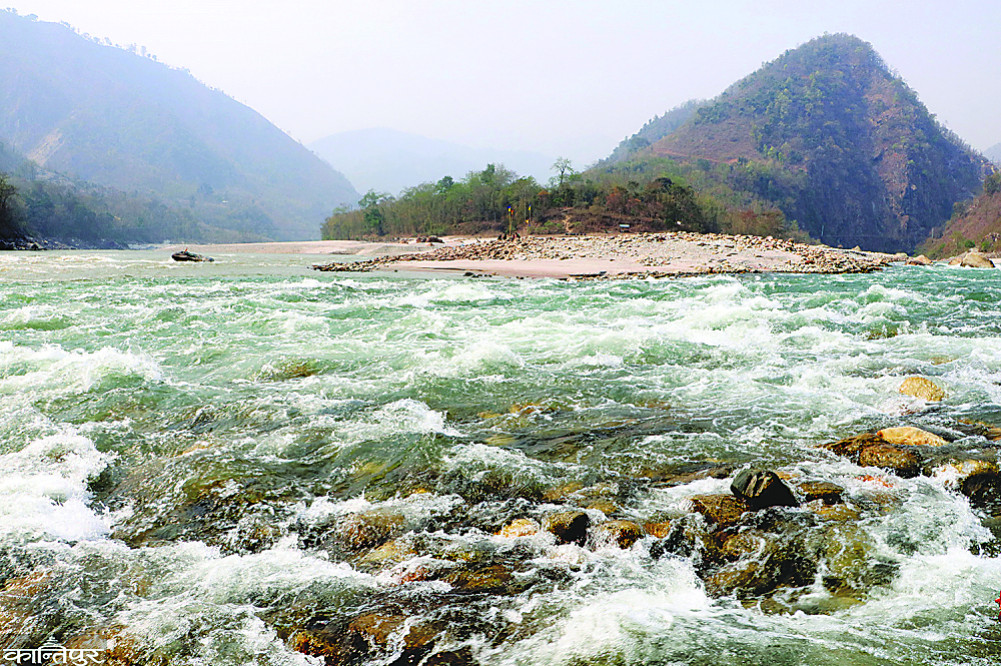
Kaushiki river of Nepal is not mentioned in Ramayana but it is mentioned in Skandapurana. It was written by an Indian. They probably came from the Indus coast. When Roshi reached the place where Sunkoshi joins the river, he must have been fascinated by the Sunkoshi flowing from the north. That river must have looked like Kaushiki river in Uttarakhand, India. Like Almora, there is Kaushiki in geography, Sunkoshi is also in geographical structure.
We use Google Cloud Translation Services. Google requires we provide the following disclaimer relating to use of this service:
This service may contain translations powered by Google. Google disclaims all warranties related to the translations, expressed or implied, including any warranties of accuracy, reliability, and any implied warranties of merchantability, fitness for a particular purpose, and noninfringement.
First, the story of the chicken and the egg is not only in Nepal, it is a story all over the world. To find the answer to these questions, we must turn to the evolution of organisms. Scientific belief says that about 300 million years ago, reptiles evolved from amphibians living in both water and land.
After about 15-16 million years, birds evolved from the same reptiles. Birds that evolved at first were reptile-like, i.e. featherless and cold. Such a group of birds is called Archeopteryx. About 120 million years ago, feathers and feathers began to develop in birds.
Male and female reptiles were and are separate. Hence male birds evolved from male reptiles and female birds evolved from female reptiles. The ancestor of the domesticated chicken is the wild goose (Gallus gallus). The loon evolved from a somewhat different ground-dwelling bird in South and Southeast Asia about 2.6 million years ago. Humans started domesticating lynxes about 11,000 years ago. At that time, the female lays the eggs. A chick would emerge from the egg.
Indus, Sultez and Yarlung Sangpo
There is another story like the egg and the chick—the Himalayas first or the river! I used to think that first the Himalayas were formed and then the rivers. Mountain and Himalaya are also thought to be synonyms. However, mountains and Himalayas are different in terms of origin and geography. The Eurasian plate and the South Asia tectonic plate collided with each other about 50 million years ago, the Himalayas and the mountains that emerged before that.
About 7 to 75 million years ago before the formation of the Himalayan region, when the Indian tectonic plate was approaching the Eurasian plate, the magma under the Tethys Ocean began to collapse. The hard part above the magma, unable to compress the huge Eurasian plate, folded itself up and formed the highlands of Tibet. In some parts the volcano went away, in some places it formed a tall and steep figure.
The highlands became covered with snow due to the cold and became mountains. Kailash Mountain was formed at that time. Mansarovar Lake was formed during the rise of Kailash Mountain. Thus, the present-day Indus, Sultez and Yarlung Sangpo rivers arose from around Kailash Mountain, rather than the Himalayan region. Similarly, Nepal's Arun, Trishuli and Bhotekoshi Himalayas were formed about two to two and a half million years ago during melting (Mike Searle, 2017: Colliding Continents, page 361-362).
Ganges River
A popular mythological story in South Asia as well as elsewhere is the Ramayana. In its Balkanda 91 sarga, it is mentioned that there was a king named Bado Pratapi Sagar in Raghukula many generations before the birth of Lord Rama. He organized an ashwa (horse) sacrifice with the aim of expanding the kingdom. From the yagna, the horse was released to go anywhere freely. As far as the horse could reach, the territory of the Yagya performer was determined. Archer Maharathi Anshuman was assigned to protect the horse (Valmiki Ramayana 2079, page 143).
Indra, the king of heaven, takes the form of a demon to abduct horses left for sacrifice. And hides the horse near the place where sage Kapil is performing penance. Later he is distracted thinking that the horse has been stolen from sage Kapil. Due to the sage's rage and anger when the attention is suddenly distracted, all the army including the princes present there are destroyed. The souls of princes cannot attain salvation. They are reduced to ashes without being cremated. This brings a never-ending curse on their descendants. Later, a grandson named Dilip became the king of that kingdom. He died while doing penance to free the family from sins. His son, King Bhagiratha also performs severe austerities to rid the clan of sins and eventually succeeds in obtaining the boon. At that time there will be river Ganga which washes sins away in heaven.
After giving a boon to the king and ascetic Bhagirath, Brahma wants to make the river Ganga descend to earth from Kamandula. Lord Shiva took the river Ganges in his jatta and made it land safely in the Himalayas, as the river Ganga could cause terrible destruction when it fell from heaven to earth. Thus, according to the Ramayana, the river Ganga descends to earth. Finally, Bhagirath's children are freed from the curse by bathing in the river Ganges.
Actually the river Ganga originated from the Gangotri Himalaya two and a half million years ago. Ramayana was written about 2200 years ago. According to scientific data, Vedic Aryas (introducers of Hinduism) arrived in South Asia from Central Asia only about 3500 years ago. The Indus civilization had merged about 500 years before the arrival of the Vedic Aryans.
According to the material obtained from the Indus Civilization excavations, it is hypothesized that an early form of Lord Shiva was prevalent there. However, since the script of the Indus civilization could not be understood, it has not been possible to be certain. Similarly, Lord Shiva's early form is similar to the ancient Greek god Dionysus. While composing the Rigveda, the Vedic Arya envisioned Lord Rudra as an early form of Shiva based on those same gods. Rigveda contains more than 1 dozen names of Gods including Indra, Rudra. The same Rudra was later transformed into Lord Shiva in other Vedic material.
Kaushik aka Koshi Nadi
There is a story in the Ramayana that Rama was told by the sage Vishwamitra that he was the son of a Kshatriya king named Kushnava. There is also a story that he received the title of Brahmarishi Rishi from God after doing severe penance. Similarly, there is a verse in which Vishwamitra's sister Satyavati reached heaven alive in Ekta. Vishwamitra belonged to the Kush dynasty. Men and women of the Kush dynasty were also known by the surnames Kaushik and Kausiki.
Lord Satyavati aka Kaushiki landed safely in the Himalayas named Kaushiki River. There is no context of Shiva and Brahma in this story. Rigveda is considered to be the most ancient scripture of Hindus. Shiva, Parvati, Brahma, Vishnu are not mentioned in Rigveda. The reason for not adding his context may be that it is a story before Ramayana was written. Some indications of this are found in the book 'Valmiki and Vyasa: Comparative Anushilan' written by Devi Prasad Subedi. He writes that Valmiki's original version of the Ramakatha was a popular folk tale in India before then (2074, p. 16). The story of the origin of the river Ganga must be Valmiki's imagination. Because it is connected with Shiva and Brahma.
In the world, in Valmiki's Ramayana's Balkanda, in canto 34, verse 10, there is a story that says that he sometimes goes to the banks of the Kaushiki river and meditates very regularly (Valmiki Ramayana 2079, page 133). The river is today in the Almora district of Uttarakhand state in northwestern India. which initially descends towards the south-west and merges with the river Ramganga and flows towards the south-east to join the Ganges. Kaushiki river in India is called Koshi river today. The Kaushiki River is dammed in the Nainital district of northwest India. That dam is also named Koshi Barrage.
Nepal's Kaushik River
Kaushiki river of Nepal is not mentioned in Ramayana but it is mentioned in Skandapuran. Skandapurana is considered to be the oldest Purana. This Purana was originally written in Northwest India. It formerly consisted of the belly expansion of religious sites in the Himalayan region of northwestern India. Historian DR Regmi in his book 'Middle of Nepal (1965)' has estimated that it was written at the end of the 16th century AD. However, the writers were Indians. They may have come to Kathmandu Khaldo along the Sindhuli coast from Terai.
When they arrived at the place where Sunkoshi joins Roshi river. They must have been fascinated by the gold rush flowing from the north. They must have thought that the river was like the Kaushiki River in Uttarakhand, India. As Almora is Kaushiki in geography, Sunkoshi is also in geography. Hence, they named the river Kaushiki as it joins the Roshi east of Kathmandu. He added that Rishi Vishwamitra also lived on the bank of Kaushik. A cave at the confluence of Sunkoshi and Roshi is today named Vishwamitra Cave. Sunkoshi was taken to the equivalent of the Ganges River as bathing in the Kaushiki River washes away sins.
In the course of adding material to the Purana in different periods, the Nepal Mahatmya was included in the Skandapurana and published for a few hundred years. Nowadays, Nepal Mahatmya is separated from Skandapurana. It was first published in Hindi by Prabhakari Company, Banaras in 1901. In 2012, Yogi Naraharinath and others wrote Himavatkhand Upapurana in Sanskrit with the same Nepal Mahatmya including other religious places in the context of Nepal.
Kaushiki has been added to it after the names of many rivers in eastern Nepal. Like: Arun Kaushik, Tamer Kaushik, Tamar Kaushik. Himavatkhand Upa Purana was translated into Nepali with the original Sanskrit text by Venimadhava Dhakal in the year 2075. In this Upapurana, there is a story that God was present in all the mountains and rivers of Nepal. The Upapurana also has the origin story of Kaushik. According to which once Goddess Parvati performed sun worship (penance) in the Himalayas. During that time, due to the heat and heat of the sun, sweat leaked from his feet, from there the river Kaushiki originated (Emergence of the river Kaushiki in Chapter 40).
It has been 4-5 hundred years since the Vedic Aryas arrived in Eastern Nepal. However, in the Himavatkhand, written about 70 years ago, it was hypothesized that the gods and goddesses of Hinduism had reached there before the river Kaushiki aka Koshi. Emphasizing this, Yogi Narharinath in his book 'Hamro Deshdarshan' is proud of having succeeded in keeping the Koshi region as a memorial to Rajarshi and Brahmarshi Kaushik alias Vishwamitra. Hindus used the name Hindujanya instead of the local river names that existed earlier.
At that time, the state adopted a single Hindu religion policy and imposed restrictions on the religion and script of others. The more they met, the more they were afraid. Over time, the name of the river, the region and now the state is evidently named Koshi from the surname Kaushiki of the female offspring of Kushanava in the mythological story Ramayana. However, some leaders who passed the name of the province to Koshi have said several times that Koshi is a Kirat word. It can be said that the leaders are confused about the etymology of the word Koshi.
The longest river of Saptakoshi river is Arun. 70 percent of this river is in Tibet. Arun river originated two and a half million years ago. At that time only animals like monkeys but without a tail were evolved. Animals that closely resemble humans today include chimpanzees, bonobos, gorillas, orangutans, and gibbons. They separated from the ape-like group of animals in Africa two and a half to three million years ago. The ancestors of humans evolved in Africa about one and a half million years ago. No fossils have been found before that.
Gorillas and chimpanzees separated from human ancestors 90 and 70 million years ago, respectively. The oldest fossils of humans or Homo sapiens were found in the northwest African country of Morocco in 2017, dating back to 315,000 years ago. This suggests that humans had already evolved in Africa. Two million years ago, Homo sapiens moved from Africa to Europe and Asia. Homo sapiens arrived in Dang-Deukhuri 60-70 thousand years ago. Apart from the Chure area in Nepal, 8-10 thousand years old man-made materials have not been found. Mustang is the oldest human civilization site from the north.
Humans entered the eastern Himalayan region after the introduction of agriculture in the Yangtze and Yellow River valleys of China. However, the Vedic Aryas reached there only sporadically 3-4 hundred years ago. It was clarified above that the story of the origin of Kaushiki river written in Himavatkhand by Yogi Narharinath, who reached eastern Nepal about 75-80 years ago, is a myth.
Hindus still believe that story is like if the earth is flat, the sun, moon and planets revolve around the earth. On the other hand, the state should not hinder the propagation of any religion. However, the state itself should not follow religion. If the state follows religion, our society will be stuck in the proverbial egg first.