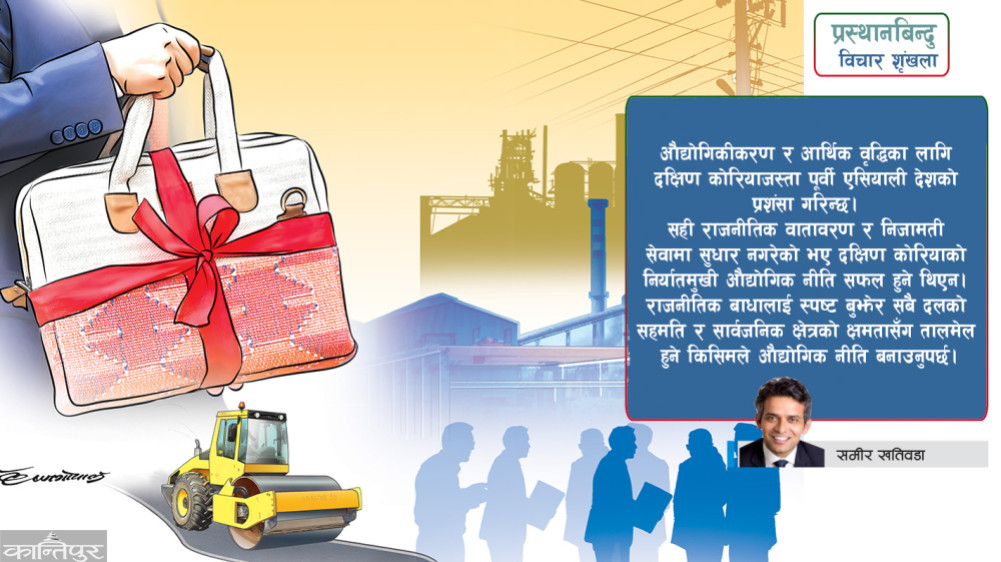
East Asian countries like South Korea are praised for their industrialization and economic growth. South Korea's export-oriented industrial policy would not have succeeded without the right political environment and civil service reform.
We use Google Cloud Translation Services. Google requires we provide the following disclaimer relating to use of this service:
This service may contain translations powered by Google. Google disclaims all warranties related to the translations, expressed or implied, including any warranties of accuracy, reliability, and any implied warranties of merchantability, fitness for a particular purpose, and noninfringement.
Various measures to promote industrial development have been included in the budget announced by the government recently. These include 'Make in Nepal Campaign', 'Development of Special Economic Zones', promotion of 'Economic Triangle (Bharatpur-Butwal-Pokhara)' and 'Promotion of Economic Corridors'. The budget also mentions that the government will amend laws and policies related to investment and industry.
If these announced measures are implemented, then Finance Minister Varshman Pun's goal of increasing domestic production and productivity as well as creating more employment opportunities will be fulfilled. This will increase investment and promote industrialization. But, will these measures be implemented?
To answer the above-mentioned question about implementing measures, let us first examine the key lessons for the success of industrial policy. A recent paper by Rekajuhas, Nathan Lane, and Dani Rodrik prioritizes the following three points in industrial policy.
1. Political environment: Policy makers must carefully assess how industrial policy fits into the domestic political environment. Who benefits from these policies? Who gets hurt? How do announced and implemented policies change the future political environment? Will the next government or finance minister support these measures or not?
2. Ability to implement: The ability of countries to implement industrial policy can vary greatly. This capacity depends on the administrative and financial capacity of the respective country. Will the 'Make in Nepal' campaign succeed according to Nepal's capacity? Can special economic zones and economic corridors attract private sector investment? Can investment and industry laws and regulations be adopted? Answers to such questions alone determine whether the industrial policy will succeed or fail.
3. Investment in administrative capacity: In order to succeed in the industrial policy, the state needs to invest in the administrative capacity of the employees. Can the government make a plan to strengthen its administrative capacity? Will the provisions on good governance announced in the budget be implemented? Will the government succeed in adopting a zero-tolerance policy on corruption? Can it establish certain standards of predictable transfer, promotion and career development?
Nepal's current industrial policy was introduced in 2011 with the aim of promoting sustainable and broad industrial development through effective, coordinated partnership between the public, private and cooperative sectors. The aim was to increase the export of industrial products and increase the contribution of the industrial sector to the national economy. It emphasized the establishment of Special Economic Zones (SEZs) and industrial estates. The policy also identified priority areas for industrial promotion such as agro-based industries, tourism, hydropower and information and communication technology. The policy included fiscal measures to support export-oriented industries and incentives to set up manufacturing plants in special economic zones.
Despite the high goals, Nepal's Industrial Policy 2067 has not achieved the expected results in terms of industrial growth, competitiveness, employment and exports. Nepal's industrialization efforts have stopped and exports are continuously decreasing. The manufacturing sector, which contributed 5.36 percent in 2015 and 4.98 percent in 2019, managed to contribute only 4.86 percent in 2022 to the Gross Domestic Product (GDP). In a comparative analysis of 2022, the share of manufacturing sector in GDP was 21.7 percent in Bangladesh, 13.35 percent in India and 19.59 percent in Sri Lanka.
Compared to other countries in the region, there has been a significant decline in exports of goods and services. Exports of goods and services declined from 7.78 percent in 2019 to 6.76 percent in 2022. In 2015 it was 10.21 percent of GDP. Comparing exports of goods and services as a share of GDP in 2022, it was 12.88 percent in Bangladesh, 22.79 percent in India and 21.48 percent in Sri Lanka. Remittances play a major role in Nepal's economy. This is also confirmed by the fact that the ratio of the country's GDP is 22.76 percent. However, over the past two decades remittances have increased resulting in a contractionary effect on the trade sector and the productivity sector as a result of the strong exchange rate effect. Currency appreciation makes domestic goods more expensive than foreign goods, reducing the competitiveness of Nepal's exports. This type of currency appreciation favors imports over exports. Also, Nepal's tax system further encourages imports, taxes are levied at the border, which helps in collecting important revenue for the government.
Nepal has made significant progress in improving its business environment despite its struggles with industrialization. In 2020, Nepal was ranked 94th out of 190 economies, it has made significant progress in trade facilitation and has managed to place Nepal in the list of top 100 economies. This progress reflects the government's continued efforts to enhance the investment climate in Nepal by improving areas such as obtaining construction permits, taking loans, cross-border trade, obtaining electricity and enforcing contracts. These reforms have streamlined processes, reduced administrative barriers and created a more conducive environment for business operations, demonstrating the government's commitment to facilitating private sector growth.
There are constant challenges in Nepal's industrial sector. One of the main problems is the complexity of the tax system. Paying taxes is a significant challenge for entrepreneurs, contributing to a burdensome business environment. According to the World Bank, firms in Nepal pay 46 taxes per year, which is significantly higher than the South Asian average of 26.7 and the OECD high-income average of 10.3. This high frequency of tax payments adds to the administrative burden, requiring businesses to spend an average of 377 hours per year on tax-related activities.
On the one hand, Nepal has made strides in improving its regulatory framework, attracting foreign direct investment and promoting entrepreneurship. On the other hand, critical infrastructure, particularly the transport and energy sectors, remain vulnerable, which hampers business operations and increases costs. According to the 2023 World Bank Enterprise Survey, one of the most important constraints for companies in Nepal is access to reliable electricity. Data from this survey shows that 75.8 percent of firms experience power outages an average of 13.6 times per month.
Such disruptions lead to increased operational costs, lower productivity and greater losses. Due to disruptions in the business environment in Nepal, private sector growth and productivity have also been negatively affected. Political instability was cited by 41 percent of firms as the top business constraint, significantly higher than the South Asian regional average. This volatility creates an unpredictable business environment, deters investment and disrupts long-term planning. Among business barriers, 12 percent of firms cited access to finance as another important issue. Access to finance has limited the ability of businesses to expand and innovate.
Nepal's export index is increasing visibly. Which means Nepal is limited to few exportable items. This may appear to reflect specialization in comparative advantage, but this effect is limited to niche items in the absence of diversification. A limited commodity exporting country's economy is more sensitive to fluctuations in the demand of the importing market. Another dimension of this issue for Nepal is the geographical situation. India is Nepal's largest trading partner. Nepal exports 77.6 percent of its total exports to India and imports 62.5 percent of its imports from India.
Nepal's low export competitiveness is partly explained by its underdeveloped logistics facilities and infrastructure. Nepal is ranked 114th out of 160 countries in the World Bank's 2018 Logistics Performance Index. The overall score improved between 2016 and 2018, but the country scored poorly on infrastructure-related sub-indicators. Nepal lacks information on integrated planning, comprehensive demand analysis, sector-specific Public-Private Partnership (AAA) guidelines, facilitation of private investment and available logistics facilities. Lack of logistics facilities and infrastructure has prevented businesses from flourishing, particularly SEZs, due to limited market access, high transport costs and inadequate participation in regional and global value chains.
Provision of industrial policy in the budget
Among the various aspects of economic policy, industrial policy is directly linked to politics. Industrial policy has clear winners and losers, so their allocation is fraught with political angst. This can promote corruption as various industry associations seek to benefit from financial incentives. An effective industrial policy may be politically controversial, as it may threaten the large business houses operating in Nepal.
Finance Minister Pun announced various measures to promote new industrial development will be successful? For the good of the country I hope, yes, it succeeds. However, I doubt whether early identification of problems (upstream diagnostics) was done to understand the factors hindering Nepal's industrial development. Does Nepal lack enough industrial parks, SEZs and economic corridors? Do all political parties agree on these root causes that explain the lack of industrialization? Is Nepal's public sector capable of managing and promoting industrial development?
The success of industrial policy is directly linked to the country's politics. Global evidence has shown that industrial policies have had a major positive and transformative impact. But it has also failed miserably in many countries. When industrial policy fails to keep pace with the constraints of political economy, it tends to fail. In the 1960s, when South Korea decided to promote large-scale industrial development in the country, the world community did not believe it. At that time, even the World Bank was not ready to invest in South Korea's large-scale industrial development. However, this policy of South Korea achieved great success by increasing production and exports. South Korea's political climate in the 1960s favored export orientation. The South Korean government also invested in making its government bureaucracy more competitive and efficient. Industrial policy would not have been successful if there was no investment in the public sector at that time.
If Nepal is serious about industrial development, the piecemeal measures included in the budget will not matter much. First of all, the government needs to revise the industrial policy of 2067. As mentioned in the budget, industrial laws such as Industrial Business Act, Direct Sale of Goods Act, Labor Act, Industrial Area Operation and Management Regulation, Forest Act, Land Acquisition Act, Company Act will have to be amended.
I recently led a USD 250 million loan agreement from the Asian Development Bank to develop an economic corridor in India. This year, I am preparing a $120 million industrial development loan in the state of Tripura, India. In both these programs, the Indian government had done a lot of homework over the past few years before investing in the development of economic corridors and industrial parks. Similarly, this year I am preparing another USD 350 million loan agreement with the Government of India on behalf of the Asian Development Bank for the development of the logistics sector in support of the Pradhan Mantri Gatishakti program, which has been prepared after several years of planning and design. Both the Industrial Corridor Development Program and the Prime Minister's Gatishakti Program are emerging as major successes in India. However, it is a reflection of the preparation and planning that went into their initiation and implementation.
India has undergone major changes in the last 10 years, due to political stability and policy certainty. Both are lacking in Nepal. We have both political instability and policy uncertainty. Professor Nick Bloom of Stanford University said - "Political uncertainty is the most harmful to economic growth." Dr. Prakasharan Mahat was the Finance Minister for only one year and the current Finance Minister Barshaman Pun has been in office for only a few months. Every time Nepal's budget is announced, tax rates change, sometimes dramatically. This only increases policy uncertainty and makes the business environment more difficult.
East Asian countries like South Korea are praised for their industrialization and economic growth. South Korea's export-oriented industrial policy would not have been successful without the right political environment and civil service reform. Economic performance India's economic workpadadan proves the fact that the industrial policies has been worked by the past 20 years. Making an industrial policy will be improved by clearing the political barrier and the capacity of all political parties and Nbsp;
has increased by 7 percent in between India's average GDP Fiscal Year 2010 and 2021. This is the management and excellent economic policy of an effective mass of the rich epilepsy. This increase has made important contribution to poverty reduction. India's GDP growth rate has been estimated at 8.2 percent in 2022-23, which was only 72 percent in 2022-23. Modi government has succeeded in maintaining strong economic growth for the past decades for economic growth and education creation. There are some major reasons why not
reforms. Infound, such as: roads, railways, airport, ports and power plants. In a pactone, the production sector was also in the production area, especially in the initiative of Meek India. Information technology developed through the program like Digital India, Skill India and Smart Citizen. The process of producing skilled manpower and production and access, such as biotechnology and digital economies. These and other initiatives have had a positive effect on India industrialization, as they have increased investment, production and exports of construction sector. According to the Department of
Industries and Internal Trade Promotion Performance, direct foreign-investment in the production in the production in the products, 16.16-14 has increased from 16.20 in 2016 billion. In addition, according to the Ministry of Commerce and Industry, Production production increased by 5.7 percent in 2018-19, and the production exports increased from 298 billion in 2013-14 and 330 billion in 2013-14.
-economic progress is significant under the leadership of Prime Minister Modi, because the country has had a lot of improvement and initiatives in their economies and social change. India's experience has taught the important lesson to Nepal in industrial policy. When Industrial Policy, where the industrial policy is made between local political and administrative obstacles, in Nepal is invested in civil service and its administrative capacity, only the industrial policy is likely to succeed. Otherwise, there is only limited to the speech, which has no meaning.