Although records were set in remittances and foreign exchange reserves, the expected improvement in capital expenditure, revenue collection and foreign aid and subsidies could not be achieved: Rashtra Bank
We use Google Cloud Translation Services. Google requires we provide the following disclaimer relating to use of this service:
This service may contain translations powered by Google. Google disclaims all warranties related to the translations, expressed or implied, including any warranties of accuracy, reliability, and any implied warranties of merchantability, fitness for a particular purpose, and noninfringement.
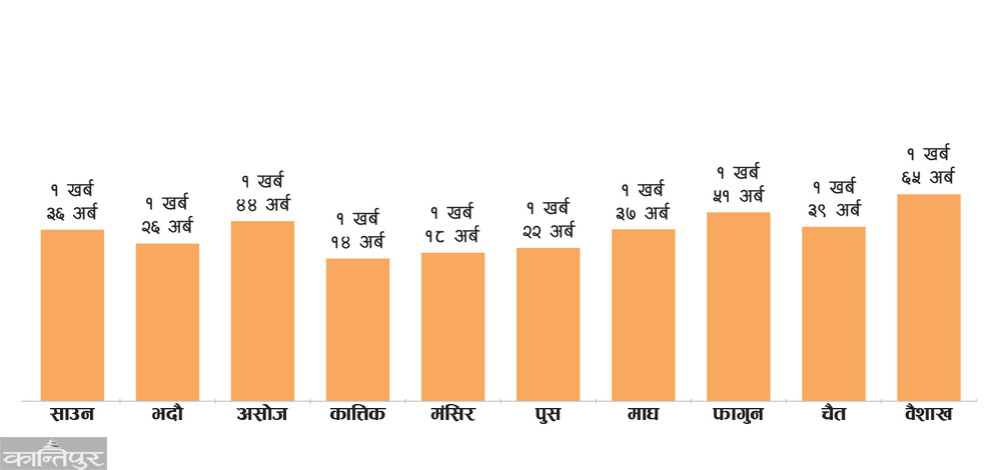
The remittances sent by Nepali abroad have set a record again. According to the monthly report released by the National Bank on Tuesday, only 1 trillion 65 billion 300 million rupees of remittances have been received in last Baisakh. On a monthly basis, the remittance inflow in Baisakh is the highest ever. Earlier, most remittances were Rs 1 trillion 51 billion in February and Rs 1 trillion 44 billion in October.
In the 10 months of the current financial year, 13 trillion 56 billion 61 crore rupees have been received through remittance. This is an increase of 13.2 percent compared to the same period last financial year. Remittances increased by 16.9 percent by April of last financial year.
Economist and former executive director of Rashtra Bank Nar Bahadur Thapa said that due to the increase in the number of young people leaving, the remittance inflow has also increased. He said that the increase in the number of people taking work permits for foreign employment in the 10 months of the current financial year compared to the last financial year has also seen an increase in remittances.
In the last 10 months, 685 thousand 924 people have taken work permit for foreign employment. 4 lakh 5 thousand 610 people have taken the final work permit (institutional and individual-new) and 2 lakh 80 thousand 314 people have taken the labor permit again.
In the same period of the last financial year, 69,705 people took permission for foreign employment. During that period, 373 thousand 307 people took the final work permit (institutional and individual-new) and 236 thousand 398 people took the work permit again. Experts say that along with the increase in labor approval, remittances have also increased.
10 months in data
- research difference 4 trillion 38 billion in savings
- remittance 13 trillion 56 billion
- Import 13.1 and export 72.7 percent growth
-Total foreign exchange reserves 25 trillion 12 billion
-Deposit collection 6.2 and loan expansion 7.3 percent
Even if you look at the data of a decade, it seems that remittances have increased every year. In the financial year 2071/72, 6 billion remittances have reached 9 trillion 71 billion rupees by 2077/78. According to the data of Rashtra Bank, in the financial year 2078/79 remittances reached 10 trillion 7 billion rupees, in 2080/81 it reached 14 trillion 45 billion rupees.
Although there is no expected improvement in the main sources of foreign exchange earnings including exports, tourism, foreign investment, the external sector of the overall economy is becoming stronger as remittances continue to increase. The economic and financial report of Rashtra Bank last May showed that foreign exchange reserves, current account and other external indicators are becoming stronger.
But economists say that we should not be happy just because remittances have increased. Economist Thapa says that the government is complacent because remittances have increased without making any effort to make the economy sustainable. The external sector of the economy has become stronger. It's not because of us. Remittances have increased because the foreign economy is good," he said. "Other than remittances, there are no other indicators of the economy. In 10 months only 7 lakh youths have left the country. This is not a good sign," he said.
Thapa said that although the economy looks good from the outside, the 10-month data indicates a bad situation inside. The monthly report shows that the stagnation in the economy is not over yet. Prices have barely dropped. The price did not increase because the overall demand did not improve. The rate of price growth has fallen further to below three percent.
This shows that there is no improvement in the demand,' said Thapa, 'It seems that the three-level government has 3 trillion 60 billion in the bank. Through taxes and loans, the government took money out of the market but did not send that money into the economy. Due to this, the income of citizens has not increased, so the market demand has not increased.'
There has been no change in the interest rate during that period. The growth rate of total credit is limited to 5.4 percent. Last year, the growth rate of total loans was 6 percent. However, the growth rate of loans to the private sector is 8 percent. Experts say that this shows that there has been no improvement in the overall demand and the government has not taken proper initiatives for that. The growth rate of revenue is also around the same as last year, it has not increased. Thapa informed that the mentioned figures show that the economy has not become viable even if the revenue is not collected as per the target.
Similarly, foreign exchange reserves have been continuously setting new records for 32 months. Last April, such reserves reached 25 trillion 12 billion 95 crore rupees. Compared to last June, it has increased by 23.1 percent. At the end of June 2081, the total foreign exchange reserves were 20 trillion 41 billion 10 million rupees. "Such reserves have increased by 20.5 percent to 18.44 billion US dollars at the end of April 2018, compared to 15.27 billion US dollars at the end of June 2081," the report of the National Bank said.
The National Bank claims that the foreign exchange reserves held by the banking sector will be sufficient to support 17.4 months of goods imports and 14.6 months of goods and services imports based on imports up to 10 months of the current financial year. In the current financial year, the National Bank has set a target of maintaining foreign currency reserves of at least 7 months.
Likewise, the current account is in surplus by 2 trillion 55 billion 93 crores and the current account (balance of payments) is in surplus by 4 trillion 38 billion 52 crores. During the same period of the last financial year, the current account was in surplus by Rs. Despite high remittance inflows and record foreign exchange reserves, the economy as a whole is not doing well. The report pointed out that the expected improvement in capital expenditure, revenue collection and foreign aid and grant collection has not been achieved.
Experts say that the country's economy has not become viable because the government has not spent. As of last April, 3 trillion 60 billion 98 crore rupees have been stored in the treasury of Rashtra Bank. Total domestic credit growth rate is only 5.4 percent. In the same period last year, this growth rate was around 8 percent. According to experts, the government is happy that the private sector's credit has increased by 7.3 percent, even though the balance has accumulated in the treasury because the state has not spent. They argue that the growth rate of aggregate domestic credit expansion is critical and this is a clear indication that citizens do not have money in their hands.