Current economic situation - More than 6 billion rupees are deposited in banks and financial institutions
We use Google Cloud Translation Services. Google requires we provide the following disclaimer relating to use of this service:
This service may contain translations powered by Google. Google disclaims all warranties related to the translations, expressed or implied, including any warranties of accuracy, reliability, and any implied warranties of merchantability, fitness for a particular purpose, and noninfringement.
The five-year tenure of Rashtra Bank Governor Mahaprasad Adhikari is ending on 24 March. Although there is a legal provision to appoint a new governor one month before the post of governor becomes vacant, the government has not formed a recommendation committee. There is also concern that the government will not be serious in selecting the governor when the economy is unfavorable and Nepal is on the FATF's "grey list".
Economic indicators are now contradictory. On the one hand, indicators such as remittance flow, foreign exchange reserves, current account balance, and other indicators are strong, while on the other hand, more than 6 billion is sitting in banks and financial institutions.
Even though the interest rate is decreasing, the loan flow has not increased. Although the Ministry of Finance and the National Bank have repeatedly tried to make policy reforms, the overall economy has not been able to run. On top of that, the Financial Action Task Force (FATF) has put Nepal on the 'Grey List', so Nepal's reputation in the international arena is at stake. A new governor of Nepal Rastra Bank, who will be in a leadership role to address all these problems, is being appointed.
Experts in the financial sector have publicly and MPs raised their voices in Parliament saying that there may be self-interested manipulation for the executive head of the National Bank. The former finance minister, former governor and economist are also cautioning that a person capable of performing independently and impartially without being pressured, influenced or tempted by anyone should be made the governor.
Deputy Prime Minister and Finance Minister Bishnu Paudel proposed the formation of a recommendation committee for the appointment of the governor in the Cabinet meeting on February 22, but the Congress ministers disagreed saying that it is going to be a unilateral committee. This matter was not discussed in the subsequent cabinet meeting.
Stakeholders are also interested in who will be in the recommendation committee to be formed for the appointment of the governor. According to the law, the coordinator of the committee is the Minister of Finance. According to the leaders of the ruling party, there is an agreement to keep Vijaynath Bhattarai from among the former governors in the committee and Vishwa Paudel, the former vice-chairman of the National Planning Commission, as an expert member.
In the cabinet meeting of 22 February, Prime Minister Oli proposed Bhattarai from among the former governors. "Soon after that, Home Minister Ramesh Akhtar disagreed saying that advice is yet to be done," said a minister. There is a legal provision that the
committee should recommend the names of three people including one person from the Deputy Governor and one person from the fields of economic, monetary, banking, finance, commerce, management and commercial law. The top leaders of the alliance are in discussions to make political contributions to the governorship by mixing it with other government appointments. Experts are concerned that the economy will be in crisis if a weak leadership is elected.
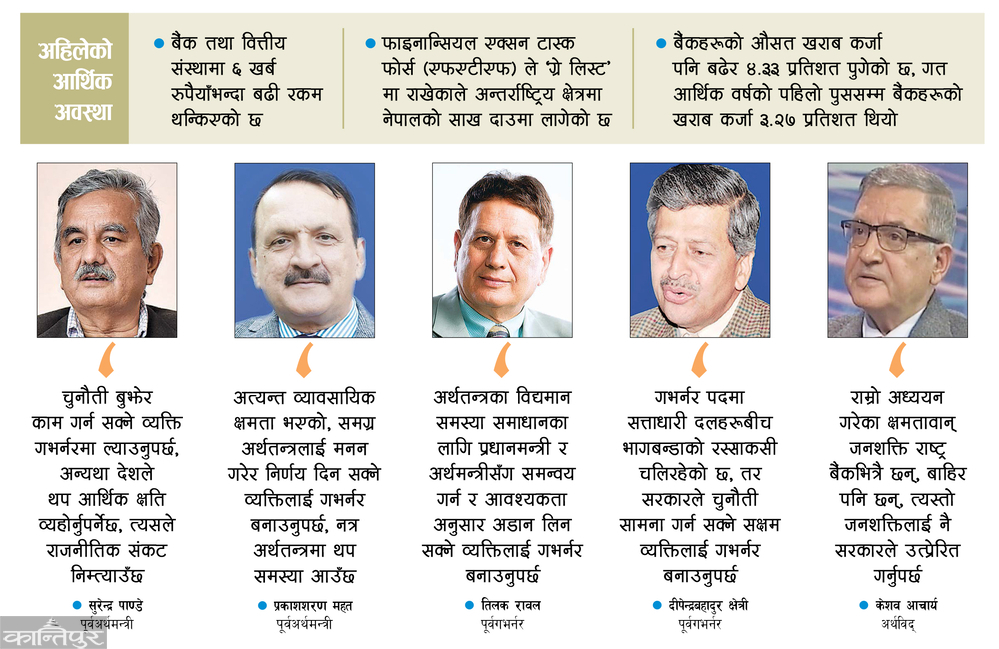
Former finance minister Surendra Pandey says that if the governor is selected without understanding the current economic situation and the despair that is prevalent in the country, the country will be in a more serious situation. "Whenever there is a crisis, the common people have to suffer. Due to the current economic situation, the common people have also been killed. Therefore, the relationship between the Prime Minister and the Finance Minister, the Governor and the private sector, during the term of office of the Governor Officer, remained bitter and fluctuating due to the current election.
Economist Keshav Acharya emphasizes that the governor should not be politicized like in the past and should appoint a person who can work. "A capable person who has no party interests should be made the governor," he says. The government should motivate such people.
Deputy governor, executive director, board member, ex-employee, chief executive officer of commercial bank and economist are trying to get a new governor appointment. Various interest groups are also doing 'lobbying' for 'persons of their choice'. There are suspicions that the same thing will happen to the governor when there are accusations of being dominated by interest groups, financial transactions, and choosing controversial people rather than good ones in the recent appointments made by the government.
Stakeholders are also expressing concern that the government is not serious about the current state of the economy due to the delay in the process of appointing the governor. In eight months (July to February) of the current financial year, two trillion 82 billion rupees of deposits have been added in commercial banks. This is 4.90 percent more than last June. This year, the government has set a target of extending credit by 12 and a half percent. But commercial banks have provided additional loans of only 2 trillion 80 billion rupees in eight months. Based on the progress so far, it seems that achieving the annual target is not possible. As of February, the average loan-to-deposit ratio of commercial banks is 79.29 percent. This means that the banks still have around 6 trillion rupees of investable (loanable) capital. On the other hand, the profit growth rate of commercial banks has been negative by 4.36 percent in the first six months of the current financial year (from July to December). The financial situation of banks and financial institutions has been affected due to the inability of economic activities to continue. Average bad loans of banks also increased to 4.33 percent. The bad loans of banks were 3.27 percent till the first month of last financial year.
The NEPSE index, which measures stock turnover, has not improved. Governor Adhikari had imposed a limit of Rs 4 crore (individual) and Rs 12 crore (institutional) on share loans. By revising the said policy, a limit of 150 million has been set for share loans taken by individual investors, while there is no limit for institutional investors. Governor Adhikari is criticized among investors due to unstable policies.
The five-year tenure of the officer who was appointed as the governor on 24 Chait 2076 was very up and down. When the financial policy (budget) could not address the impact of the covid epidemic on the economy as expected, the governor officer brought various relief policies through the monetary policy. He brought a relatively tight monetary policy in the following years, but he became somewhat flexible in this year's monetary policy. However, he was criticized by the business community due to the guidelines on current capital loans and restrictions on share loans.
The government decided to suspend the Governor Adhikari on 25 Chait 2078 on the recommendation of the then Finance Minister Janardan Sharma. The officer was suspended in retaliation for refusing the 'instructions' given by the then finance minister Sharma to reveal undisclosed funds from foreign sources. However, the Supreme Court gave an interim order in the first week of May 2079 not to implement the suspension decision. According to the same order, the officer was able to work for the entire period after returning to the National Bank, but his relationship with the then finance minister could not be improved. The conflict between the finance minister and the governor also affected the economy.
On the other hand, although banks and financial institutions want to expand credit in the productive sector in recent years, they have not been able to invest enthusiastically because there is no overall credit demand. If the loan interest rate was once very high, now it has decreased to single digits.
In the early years, foreign exchange reserves were adversely affected by the Covid pandemic. For this reason, the government imposed a ban on the import of 10 items, while the National Bank also arranged for cash 'margin' on LCs (promissory notes). This decision reduced imports, reinvigorated foreign exchange reserves and reduced risks. Now every month the foreign exchange reserves are continuously increasing and a new record has been set for 30 months. Due to the increase in foreign exchange reserves, current account balance and current account balance are very strong.
Despite the improvement in the external indicators of the economy, the economic activity has not become viable due to the expected improvement in the government finances. In such a situation, former governor Dipendra Bahadur Chhetri says that the government should appoint more capable and experienced people as governors than their workers.
He said that the government should appoint a person who can solve the problems of the entire financial system, including the microfinance sector, and move it on the right path. There is a tug-of-war between the ruling parties for the governorship post. But the government should appoint a person as governor,' he says, 'If the governor is a person who can take a stand for the interests of the country and give right suggestions at the right time, the government cannot remove him.' "A person with great professional ability, who can make a decision after thinking about the overall economy, and who can maintain a coordinating role of financial policy and monetary policy should be made governor," he says, "otherwise there will be more problems in the economy."
Experts say that another qualification of the governor should be the ability to raise Nepal's degraded image at the international level. They say that the new governor should play a role in bringing out the "grey list" of FATF, an international organization that monitors money laundering and terrorist activities. Nepal has got two years to get out of the 'grey list'.
It is certain that international cooperation, credit, export etc. will be affected as it has been included in the gray list. The governor will also suggest to the government what programs can be included in the budget of the new financial year to escape from the gray list. In general, the plan to get out of FATF's gray list will be led by the governor," says former governor Chiranjeevi Nepal, "therefore, at such a time, a person who understands the economy and can work steadfastly for the interests of the nation at the international level should be appointed as the governor." Former Governor Tilak Rawal says that a person who can coordinate with the Prime Minister and the Finance Minister and take a stand as per need should be appointed as the Governor to solve the existing problems of the economy. "When the internal and external stability is disturbed, the governor should be able to take a stand in the interest of the state, even if his position is at stake," he added, "When the internal (inflation) and external (reduction) stability is correct and other indicators are also favorable, the governor should be able to support the government's development work and achieve the target economic growth rate."
The Parable of India
About 12 years ago, India's economy was in dire straits. The reverse position was in high losses. Inflation was high while foreign investment was low. On the one hand, the Indian currency became weak, on the other hand, the bad loans of the banks increased. In such a situation, the then Prime Minister Manmohan Singh appointed economist Raghuram Rajan as the Governor of the central bank 'Reserve Bank of India (RBI)' in September 2013.
Rajan rejected political pressure and took ruthless steps to stabilize the economy and reform the banking system. Inflation, which was 9-10 percent when he was appointed governor, fell to 4-5 percent during his tenure. Rajan adopted the policy of price control by raising interest rates.
When Rajan became governor, the exchange rate of the Indian currency was continuously depreciating against the US dollar. He introduced a special deposit scheme to attract foreign investment, allowed Indian banks to deposit in foreign currency, introduced a policy to increase foreign exchange reserves. Due to these policies, Bharu became somewhat stronger. The financial system was stabilized, including the introduction of asset quality assessment (AQR), identification of non-performing loans.
Experts say that a fearless, knowledgeable and 'visionary' person like Rajan should be made the governor to bring Nepal's economy into a rhythm.
ooo
when the governor?
The first governor is Himalaya Shamsher Jabra. He became the Governor on 14 Baisakh 2013. At that time, Gunjman Singh was the finance minister. On 25th January 2017, Laxminath Gautam became the Governor after Jabara's term ended. He worked till 3 June 2022. At that time, Hrishikesh Shah was the finance minister.
The tenure of the third governor, Pradyumnlal Rajbhandari, was from 4 June 2022 to 19 July 2023. After that, Bhesha Bahadur Thapa was the governor till 11 July 2024. The term of fifth Governor Yadav Prasad Pant was from 12 Baisakh 2025 to 16 Baisakh 2030. Surya Bahadur Thapa was the finance minister when he was governor from Rajbhandari to Pant.
Kulshekhar Sharma became the governor from 17 Baisakh 2030 to 27 Mansir 2035. At that time, Finance Minister Kirtinidhi was in a state of disarray. The tenure of the seventh Governor Kalyanvikram Adhikari was from 30 May 2036 to 23 November 2041. At that time Surya Bahadur Thapa was also the finance minister. Ganesh Bahadur Thapa became the Governor on 12 Chait 2041 when Prakash Chandra Lohani was the Finance Minister. His tenure was till 8th May 2047. Harikrishna Tripathi held office as Governor from 26 July 2047 to 3 January 2051. Devendraraj Pandey was the finance minister at the time of Tripathi's appointment.
When Bharat Mohan Adhikari was the finance minister, Satyendrapara Shrestha, who was appointed on 4 January 2051, served as the governor until 3 January 2056. Then on 4th January 2056, Tilak Bahadur Rawal became the governor. Rawal was dismissed by the government after the corruption case. After his dismissal, Dipendra Purush became the governor of Dhaka from 13 August 2057 to 14 Baisakh 2058. Rawal, who was acquitted in the case and reinstated, was the governor until January 4, 2061.
Vijayanath Bhattarai was the governor from 18th January 2061 to 16th January 2066. At the time of his appointment, Bharat Mohan Adhikari was the Finance Minister. Dipendra Bahadur Chhetri was appointed as the governor on 21st December 2065 when Governor Bhattarai was dismissed due to a corruption case. At that time, Baburam Bhattarai was the finance minister. Chhetri's term lasted only till 11 July 2066. The tenure of Vijayanath Bhattarai, who was acquitted and reinstated, was till 16th January 2066.
Yuvraj Khatiwada is the 15th Governor of Rashtra Bank. Khatiwada was the governor from 9 Chait 2066 to 5 Chait 2071. At the time of his appointment, Surendra Pandey was the finance minister. After Khatiwada, Chiranjeevi became the Governor of Nepal. He became the governor on 5 Chait 2071 when Ram Sharan Mahat was the finance minister. Then Mahaprasad Adhikari was appointed as the 17th Governor on 24 Chait 2076. Yuvraj Khatiwada was the finance minister at the time of his appointment. His five-year term is till March 24. People who can understand them and work should be brought to the governorship,' he says, 'otherwise the country will have to suffer more economic losses, it will cause a political crisis.'

