We use Google Cloud Translation Services. Google requires we provide the following disclaimer relating to use of this service:
This service may contain translations powered by Google. Google disclaims all warranties related to the translations, expressed or implied, including any warranties of accuracy, reliability, and any implied warranties of merchantability, fitness for a particular purpose, and noninfringement.
Ganesh Giri of Mugu's Khatyad rural municipality-8 used to grow grain that would last the whole year 5 years ago. He grows food crops on about 10 acre of land and has become worried after the decline in production due to droughts and hailstorms.
"Neither apples grow well nor other crops," he said, "this year it snowed more sporadically, the crops started drying up due to drought, now we are worried about what to eat in the rains."
'When there is no snow, the mountains are bare, before it snowed until it reached the crops and we had enough to eat all year round,' he said, 'Snow brings drought and famine to us, when the snow falls on the hills, it takes water to reach the ground, apples, crops, grasses are all withered, if there is no snow, everywhere is desolate, the crop is empty and we are worried about what to eat.'
Now the Himalayan districts of Karnali are waiting for snowfall. "Without snowfall, the grass on the side has dried up. If there is no grass, how can we raise livestock?," said Chhewangdolmu Tamang of Dolpobuddha Rural Municipality-3 in Dolpa. According to him, there has been no rain in Dolpobuddha since the second week of December this year. "If it rained, it used to snow, until 4/5 years ago, it used to freeze until February," he said, "now we have to wait for snow even in the mountains." Due to the long drought, the farmers are disappointed that there will be a shortage of food after the wheat and barley planted in the fields start to dry up. Dhan Bahadur Budha of Tilagufa-4 in Calikot said, "When there is no snow, the production of grain crops has stopped. "After the reduction in grain production, we have to face the white rice of the Tarai." According to him, Chinu, Kaguno and Maas have stopped growing in the fields of the village due to no snowfall. He said that last year, the production decreased by half last year.
Kamal Shahi of Tilagufa-3, a local farmer, said that even if he planted grain without snowfall, the outbreak of disease insects would be seen. "If it snows and rains in the village, it will be good," he said. "Fertile land is becoming barren every year," he said, "Farmers who are independent from food crops are also forced to buy food from outside."
After the heat has started to increase without snow in the Himalayan settlements, the crops produced in the plains have started to grow towards the lake . In many villages of Mugamkarmarong rural municipality, which receives the most snow, paddy field has started to grow now . 71-year-old Ranchand Baduwal of Mugamkarmarong rural municipality-9 said that rice has started growing in the village where even millet does not grow because of the cold.
"Earlier we used rice from outside," he said, "After 7 years, paddy has started to grow in our village." According to him, paddy is now growing in the hilly fields that grow grains such as millet, sugarcane, and corn.
He said that tomatoes and cucumbers have started to grow in the village. In Chitaigaon of Mugamkarmarong, which received the most snowfall in the district until a decade ago, the local residents were surprised when chillies, tomatoes and okra began to grow in the last 2 years . "The chilli that grows in the lowlands has now started to grow in our fields," said Serapsangmu Tamang, a local, "but Kaguno and Chino have moved higher." Farmers who stopped planting grain after the apple failed to grow have started planting grain crops again . Chhatt Rawal of Chayanatharara Municipality-5 said that the plants had to be cut and thrown away after the apples did not grow.
'Apples are not growing, they are not growing, only one-third of the apples have grown in the afternoon,' he said, 'It is difficult to protect the grown apples from diseases and insects.' According to the District Agriculture Development Office, 38 metric tons of apples were produced in Mugu 5 years ago. According to the office, only 21 metric tons of apples were grown last year.
Parvati Bham of Bhambada in Mugu said that the water springs have also dried up due to lack of snowfall. According to him, after the water springs have dried up, there is a shortage of water in the villages. A decade ago, there were nearly 300 water springs around Raratal. Birkh Rokaya of Murmagoon said that about half of the spring has dried up due to drought. "After the water springs have dried up, the settlements have started moving to the side of the river," he said. "After the springs have dried up, most of the villages have started demanding plans for drinking water," he said, "in some villages there has been a shortage of water due to drought". According to village chairman Shahi, there was a big drought in 2072 as well as this year. After the drought, most of the youth went to India for labor, he informed.
'Subikal did not come to the village when it did not snow,' said Tek Bishta of Soru Rural Municipality-7, 'This year, all the crops started drying up when there was no snow in the village.' Nanda Bahadur Khatri, technical assistant of the agriculture branch of Kankasundari Rural Municipality, said that although it snowed 3 times in Jumla this year, it did not last a day. According to him, until 5/7 years ago, it used to snow continuously for 3/4 days in the municipality, while once it snowed, it would last for at least a week .
'Now it lasts for 2/4 days without snow, the snow freezes and reaches the ground and the ground is cold for some time,' he said, 'The biggest impact has been on apples when there is no snow, the farmers here prune and fertilize the apple plants during the winter season from October to February. He says that there is a risk of reduction in the production of beans, wheat, barley, etc. after it does not rain.
In Jumla, nearly 3,000 hectares of land are now being cultivated. "There is no access to irrigation in all areas," said Dhruvraj Giri, head of agriculture branch in Gutichour rural municipality, "Farmers are worried about how to irrigate apples after no snowfall." Giri said that if there is no timely snowfall and rain, the production of apples will decrease this year too. "Now is the time to prune apple plants, apply Vodopest, plant new plants," he said, "all work stopped when there was no snow." "After pruning, the plants need irrigation," he said, "since there is no snow, alternative arrangements have not been made." In Jumla, about 16,000 households are self-sufficient from syakukheti . Hari Bahadur Rokaya of Simkot Village-7 of Humla said that he was worried about livelihood due to lack of snow.
'Snow has given us everything, the environment is clean when it snows, the water springs don't dry up, the grain production is enough to eat, but this year it was a problem to stay here and raise the family because there was no snow,' he said, 'now there is no option to go to India.' He says that although it has snowed 4 times in Humla, the snow fell within 1/2 day. According to him, most of the villages in the rural municipality do not have irrigation facilities.
He informed that farmers who planted potatoes at this time last year did not plant potatoes this year due to drought. Jun Bahadur Rokaya of Simkot-1 said that the moving apple will not grow until there is snow and rain. "After the drought, I am worried that the apple trees will dry up," he said.
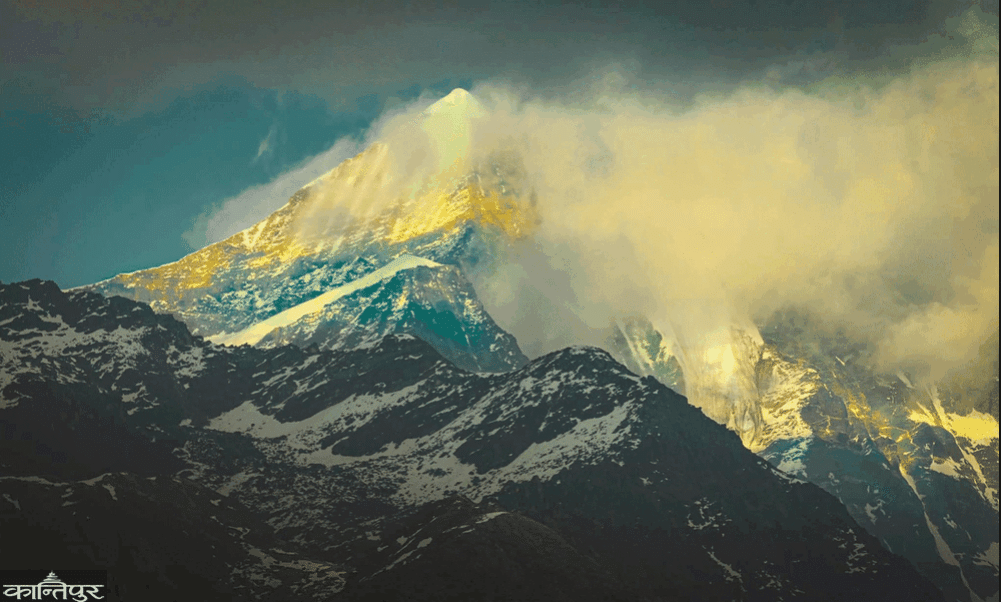
Environment expert Laxman Sharma says that due to the effect of climate change and the change in temperature, the snowfall in the Himalayan region has decreased this year . He said that the mountains like Kanjirwa and Sisne in Karnali and surrounding areas are now snowless. According to him, this happened because the winter rainfall was much less than the average for the last 3 years.
"When there is no rain, the temperature of the Himalayan region increases and if the existing snow melts, a new snow system cannot develop," he said. According to the Ministry of Land Management, Agriculture and Cooperatives of Karnali Province, 339 thousand 900 metric tons of food grains are produced in 299 thousand 339 hectares of agricultural land in Karnali.
According to Dhan Bahadur Kathayat, spokesperson of the ministry, irrigation facilities have reached only 68 thousand hectares of that area. "The long drought is seen to have a big impact on grain and fruit production this year," he said, "farmers are waiting for snow in the mountains and rain in the mountains."