After both sides are ready to put the words 'Technical Support and Aid Financing Modality' in talks on Wednesday, signing the BRI framework, aid (assistance) means both loans and grants, thus paving the way for its interpretation as needed.
We use Google Cloud Translation Services. Google requires we provide the following disclaimer relating to use of this service:
This service may contain translations powered by Google. Google disclaims all warranties related to the translations, expressed or implied, including any warranties of accuracy, reliability, and any implied warranties of merchantability, fitness for a particular purpose, and noninfringement.
After China rejected Nepal's proposal to take only subsidy from the 'Belt and Road Initiative' (BRI), an agreement was reached, leaving the way to take concessional loans open.
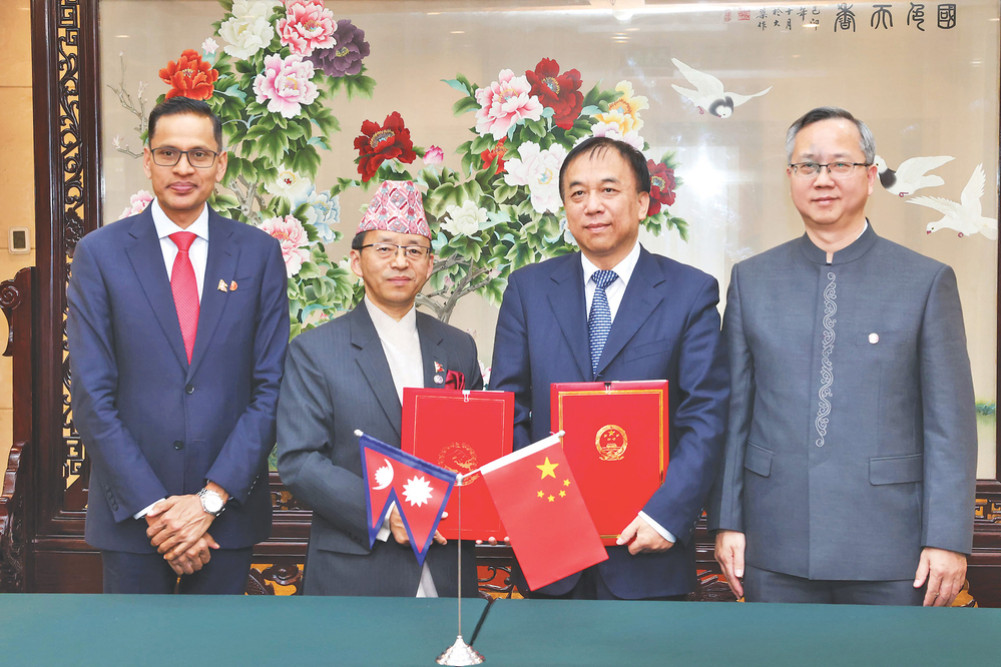
After a series of informal two-day talks between high officials of Nepal and China in Beijing, the 'Framework for Belt and Road Cooperation' was finally signed during Prime Minister KP Sharma Oli's visit to China. The
framework was signed by Amrit Rai, Permanent Secretary of Foreign Affairs on behalf of Nepal, and Liu Sushe, Vice Chairman of the National Development and Reform Commission, on behalf of China.
In the agenda related to BRI, Nepal sent a proposal for cooperation related to 'grant'. But China prepared a proposal of 'cooperation'.
After the Nepali side disagreed saying that 'cooperation' does not mean grants or loans, the high-level talks held on Tuesday failed to reach an agreement regarding the BRI. However, the signing was made possible after both parties were ready to hold the words 'Technical Support and Aid Financing Modality' after negotiating on Wednesday. Then another program outside the tour schedule was signed on Wednesday .
Nepal and the Chinese side have not officially issued a statement about the signing. After the high-level meeting, Nepal-China has already issued a joint statement on Tuesday.
Prime Minister Oli did not discuss anything about the framework even in the two big important events held in China after Wednesday's agreement. Officials involved in the visit did not want to clearly disclose what is meant by the 'ad financing modality' mentioned in the framework.
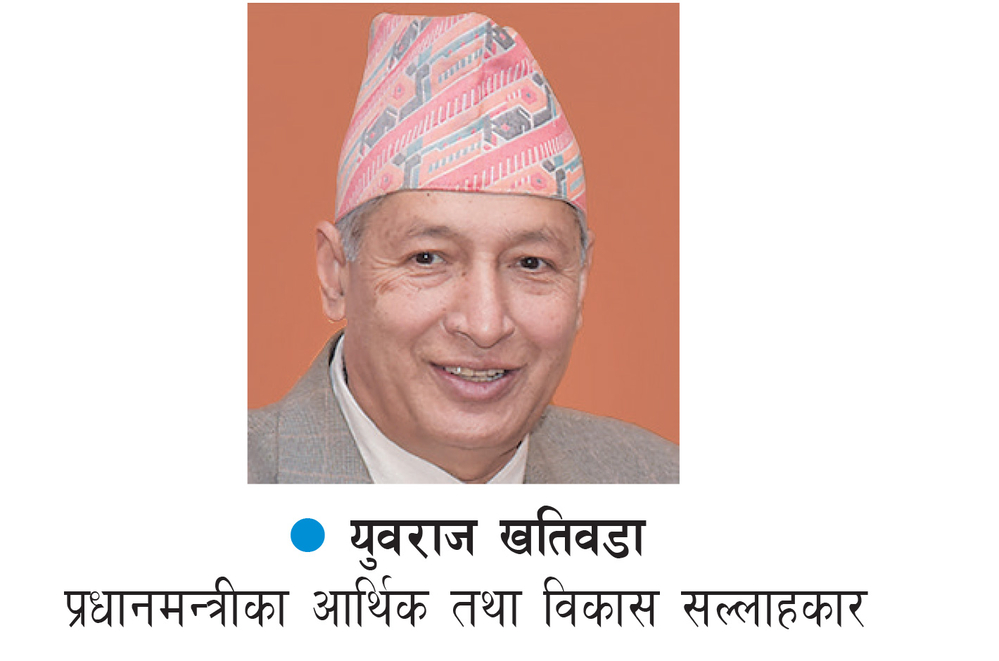
Prime Minister's Economic and Development Advisor Yuvraj Khatiwada has also indicated that the loan door is open. Ed is a soft language. BRI is not just a government-to-government relationship. This is also a business-business relationship. We don't use government-to-government loans now, someone else has opened the way for us to take loans as a project," he said. "The door of subsidized loans has been kept open, but we have to see for whom. It was not necessary to write that our country does not take loans from any country.'
Nepal and China came to an agreement at the end of the Prime Minister's visit after Nepal was ready to make a statement that it would be able to take loans in the future.
Bilateral informal talks that started on Tuesday morning ended on Wednesday. "Both sides have agreed to sign the BRI cooperation framework," said a high-ranking government official who was in dialogue with the Chinese team to Kantipur in Beijing. After that, the Chinese side removed the word grant and returned the draft to Nepal by keeping only the assistant financing modality. However, in the end, the Nepali side offered aid assistance financing rather than grants or assistants, and it was signed." . "Ad financing modality can also mean subsidized loans or grants," he said, adding, "According to our policy, we do not take commercial loans. That's why the loan is concessional.'
As soon as Prime Minister Oli's visit to China was decided, experts and political parties in Nepal were polarized on BRI, loans and grants. In particular, the Congress had taken a stand that the documents related to BRI should not be signed and if they were signed, only subsidies should be taken. China sent a proposal of 'BRI Implementation Action Plan' to Nepal along with the loan.
Congress General Minister Gagan Thapa, Prime Minister's Chief Advisor and UML Deputy Secretary General Bishnu Rimal and Prime Minister's Economic Development Adviser Yuvraj Khatiwada did their homework to reach an agreement in that regard. Semant Dahal, an expert in international law, did his homework as an expert member.
After a long tug-of-war, instead of the title of 'BRI Implementation Action Plan' proposed by China, a common opinion was decided to make an agreement under the name of 'Framework on Belt and Road Cooperation'. As China did not accept it, the important meeting of the Prime Minister could not be signed. Sources claim that Prime Minister Oli held a telephone conversation with Congress President Sher Bahadur Deuba from China after he had to return from his visit without signing.
"After Deuba was ready to put the word ``ad financing modality,'' claims a government official who participated in the visit. The Congress has said that it will review the issues of the framework.
For that, the leaders say that they will hold a 'briefing' and review with Foreign Minister Arju Rana Deuba as soon as Prime Minister Oli lands in Kathmandu. "Congress's stance of not taking loans and now that the agreement is in place should be reviewed once the way to take loans is open," said a Congress leader, "but we will not act hastily to hijack this agreement." We will review the possible scenarios in the future. After that, the Congress is ready to announce its official opinion.
Semant Dahal, an expert who edited the draft on technical and legal matters in the agreement between the Congress and UML leaders, also did not want to clarify about loans or grants. He responded that it was an important achievement for financial and project development.
"This framework can play an important role in establishing a strong economic and project development partnership between the two countries," he said, "It will address the confusion about infrastructure projects implemented under BRI and clarify the issue of project implementation through aid finance." It is believed that establishing the principles of implementing the project will make it clear that it should be economically, financially, technically and commercially feasible.'
10 projects in the BRI framework are also mentioned. In the 'BRI Cooperation Framework', Nepal has proposed a dozen projects related to road infrastructure, urban development and industry-trade to the Chinese side, 10 projects have been included in the framework. Nepal's proposed Kathmandu-Hetaunda podway and Kathmandu valley transmission line upgrade were not included in the consensus list.
Besides Tokha-Chhare tunnel, Hilsa-Simkot road project, Kimathanka-Khandbari road and bridge, Geelong-Kerung-Kathmandu cross-border railway, Amargadhi city hall at Dadeldhura, Geelong-Kerung-Rasuwagadhi Chilime 220 kV cross-border transmission line, Madan Bhandari University , Kathmandu Scientific Center and Science Museum, China-Nepal Industrial in Damak Mitrapark and Jhapa Sports and Athletics Complex have been placed in the framework.
'
Consensus of Nepali parties on one China principle' Prime Minister Oli, who is on a visit to China, said on Wednesday in a speech at Peking University in Beijing that 'all political parties of Nepal are unanimous on the one China principle'.
Oli said that as a reliable neighbor and an unbreakable partner, the two countries will cooperate closely in various fields of mutual interest. He praised President Xi's visionary initiatives like BRI in the spirit of shared prosperity and successful cooperation.
'China has lifted its 800 million people out of poverty. And has set an inspiring example of 'prosperity with happiness'. Where development encompasses welfare and equality, Oli said during his speech.
He said that Nepal has learned valuable lessons from China's miraculous economic development to embark on its own development journey. Nepal and China can envision a future of shared prosperity and lasting friendship. which is inspired by mutual respect and the pursuit of a better world for all,” he said.
Similarly, Oli discussed old and new democracy during the speech. He mentioned that while advancing the idea of democracy, there was a debate about its class character. Oli made it clear that these debates often lead to differences between old and new democracy.
In the old democracy, the privileged class took the lead. which is also known as Bourgeoisie. While the struggling people are oppressed in the entire process of political transformation. "There was a
," he said, "on the contrary, the new democracy saw the class working together with the oppressed and exploited groups at the forefront." He asked for cooperation.
At the beginning of the speech, Oli thanked the president of Peking University for the invitation. He said, "This opportunity to live in a university with a glorious tradition of patriotism has moved me deeply."
Oli said during his speech that he had read about the inspiring journey of Peking University in his youth. He mentioned that in 1919, the fourth anti-imperialist and anti-feudal movement started in that university. He said, 'That movement was an important turning point in the history of modern China. And, it is my privilege to stand here today in this institution with a rich and long history.'
You participated in making the agenda of the Prime Minister's visit to China, reaching agreement between the parties and the visit, how was the visit overall? Most of our agenda on the
China visit has been agreement, understanding and agreement. The Prime Minister's visit was a success. The situation of agreeing and understanding but not implementing some issues of bilateral relations has come to an end. There have been achievements especially in trade, investment, technology transfer, information technology, social development and connectivity. Within
connectivity, we have included communication, transmission line, transportation within the BRI framework. A little more emphasis is placed on promoting public relations. The people-to-people relationship means that the prosperity of one country can be transferred to another country. It means that it can be expanded through tourism, technology and entrepreneurship. The Prime Minister's visit has opened the door for that.
The prime minister's visit was an important event on Tuesday. From the Chinese Prime Minister to the President, meetings and various agreements were signed. The main agreement i.e. the document related to the BRI framework was signed only on Tuesday. Political leaders from Nepal and China were not present at the signing ceremony. Why did this happen? A draft related to the
framework was being exchanged. We gave the draft prepared by us to the Chinese side only the day before the departure of the Prime Minister. That draft was just our type. They asked for two days to study it. So it was signed the next day. This is just a technical matter.
Before the Prime Minister's visit, it was said that we will not take loans from China, we will only take grants. That was the draft you mentioned. The Chinese side did not agree to that and finally, it has become public that an agreement was reached when Nepal was ready to put the 'ad financing modality'. In particular, how was it called 'ad financing modality'? What does it mean?
First of all, the negotiation is word-by-word. After we signed the MoU (Understanding) on BRI in 2017, China wanted to go ahead with its implementation plan. But we said whether to call it cooperation or not. They agreed. Some words are upside down. Thus it takes time to agree on some words. We have said that it would be better not to put some words in terms of our security sensitivity, geographical location.
It would be better if our current psychology grants were organized, we can't take loans, so we have to have grants. They also have to. They have many neighbors. They say that not all grants can be given, loans are also projects. But on the whole, we do not take loans now, so the word 'Aid' is used. Help is a soft language.
BRI is not just a government-to-government relationship. It is also a business-to-business and government-to-government relationship. Currently, we do not use government-to-government loans, if someone else says to take a loan as a project, the way should be opened. It is not a matter of not taking loans from this or that country. But the government's priority is not to take loans now. As soon as possible, we questioned Khantwar Khanal, as soon as possible, as a result of the agreement on the convenience of Nepal's foreign aid policy, Nepal's foreign aid policy. He said that the path to concessional debt is open. This means that the way to take a borrower to the BRI agreement, isn't it?
kept the door of concessional loans open but look for. We are saying that we have 'contracts and prioritizing grants and technological assistance in the royal level. We have made our preferences agreement. But it is right to close the door that we do not take loans to any country? That is not. But we are now saying that our priority grant is now. If we need to take a loan in the future, then in the future.
did not write to be loans with our country. Incorrectly to develop by its own ability, not getting debt and donation depends on our priority. So we do not take it if you write about the loan. The doors of the door as possible is still open. The future gate should not be closed. There is also what you mean. The language of the government is in agreement, not in a loan, the grant.
signed in various projects on Tuesday between Nepal and China. The 10 projects are also mentioned in BRI framework. Is there a different nature in these projects?
is nothing different. Until 2025 to 202, BRI's Panch-year plans have a section. Bri got massive zone. But all projects will be under BRIA. But the project will be different behavior. We have argued that projectly end to invest in the agreement. The Prime Minister of
Nepal and Chinese President have announced assistance of assistance. How does that budget be achieved? Where is the use?
we must prepare a project for that. That provides budget available. This is the budget, grant. The project that is being made by that grant will also be under Bri.