We use Google Cloud Translation Services. Google requires we provide the following disclaimer relating to use of this service:
This service may contain translations powered by Google. Google disclaims all warranties related to the translations, expressed or implied, including any warranties of accuracy, reliability, and any implied warranties of merchantability, fitness for a particular purpose, and noninfringement.
68-year-old Bhajana Damai of Sahidbhoomi rural municipality-3 Panchkanya is still haunted by the incident of four and a half decades ago. At that time, she was holding her son Som Bahadur while following the sound coming near the house, her husband was brutally murdered.
The scene stands before the eyes. Damai's husband Dhanveer Darji was killed by the then ruler in the incident on October 27, 2036. He was shot because he was active in the underground movement to change the Panchayati governance system.
Bhajana expressed her complaint that even though the system has changed due to the people's movement after 2046 and 2062/063, the condition of the martyrs' families who lost their lives in the movement for change is difficult. "My husband gave his life to change the system, but the family's agony never went away," she said. Bhajana added, 'I still don't understand why my husband did such a rebellion and protest in this society, Salik was kept, but the family was never sad.' Jana was killed by the then ruler. During the last week of November 036, the entire village of Chintang was covered in blood. Their lives were lost when the then panchayat ruler oppressed the entire village for being against the system. The incident is known as the Chhintang massacre. Gopal Bahadur Bhattarai, the author and professor of the book 'Chintang's Political Murder', said that after the Chhintang incident, security-police was deployed in the village and anyone with the name of communist was targeted.
In that incident, Shrimaya Rai, also known as Hankhima Saili, who was in labor, and 14-year-old Kesharman Rai, who was studying in the 7th grade, were also killed by police torture. Most of the family members of the martyrs have one question, 'We have lost the head of the family, after all we spent our whole life in poverty, what did we get? The government kept changing. The leader kept changing. However, the situation of the affected families of martyrs who sacrificed their lives to change the system in the famous Chhintang massacre in 2036 has not changed yet. Most of the series of murders took place in a period of one week (November 24 to 29). The Chintang massacre took place during the reign of Surya Bahadur Thapa, who represented the district five times and became the Prime Minister (2036). In the book written about Thapa, it is mentioned that the incident happened because of the communist movement in Jhapa. In the work of Anadi Thapa, it is written about the Chhintang incident - "When the national referendum was going on in the country, 16 people lost their lives in the security operation of the state in Chhintang, which is considered very remote and backward in Dhankuta. The communists called the incident the use of class struggle and farmers' movement.
"National Martyr" lost 1 million?
The government had declared the people killed in the Chhintang massacre as 'national martyrs' seven years ago. Even though the 'National Martyr' was declared in December 2074, the family has not received even the 10 lakh rupees that was supposed to be provided by the state. Balram Rai, president of Shahid Parivar Sarokar Samaj, complained that the relief provided by the federal government has not yet been provided. He said that despite the decision to give relief of Rs 10 lakh per family, they did not get it.
Even though service facilities are given in the name of martyrs based on political influence, Rai says that the martyrs of Chhintang who died fighting for system change are ignored. Balram, who is also the son of the martyr's son Thulung Rai, expressed his complaint that he was limited to the names of 'martyrs' lives or children'. He says that the condition of most of the martyrs' family members is miserable as they do not get livelihood and other opportunities. His father was killed as a 'communist and rebel'. According to him, "the current rulers have forgotten about their father, who was killed as a communist, and other families.
After the advent of democracy, during the Girija Prasad Koirala government, Janahi Shahid Parivar was given Rs 1 lakh and during the time of the then Chief Minister of Koshi Province Sherdhan Rai, Janahi Parivar was given Rs 500,000 by the state government. When Madhav Kumar was the Prime Minister of Nepal, Rs 25,000 was given to Janhi family. The family members complain that the government is not interested in employment.
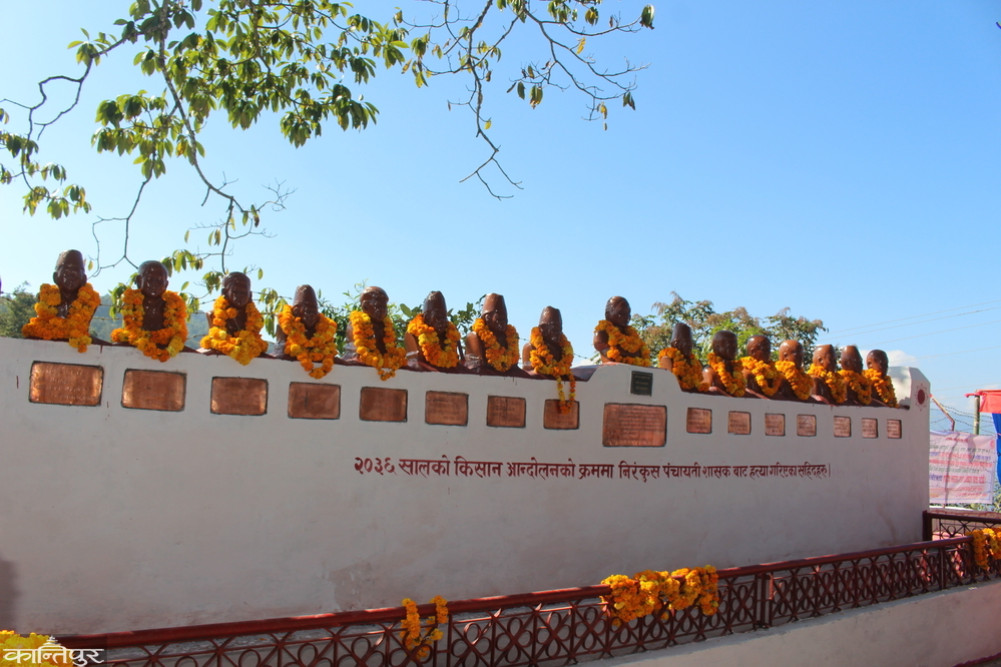
Shahid Park and Salik were established in Chintang in 2052 in memory of martyrs. Ruplal Rai, President of Shahid Memorial Foundation, Chhintang, says, 'Leaders are saving their seats by doing unnecessary selfish politics in the name of martyr families.' Says, 'But now even 1 rupee has not been allocated for this title and purpose.'
Khoku, Chhintang and Ankhisalla (Khalsa) areas have been named Sahidbhoomi rural municipality after the martyrs. There is a complaint that despite the demands of the declaration of national martyrs, relief, employment for the family, technical and professional skills training, identity card for the family of the martyrs, the state is apathetic in this regard. CPN-UML and Maoist Center Party have been organizing different programs at that place in the last week of November.
2036 list of martyrs of Chhintang massacre
1. Gopalanand Rai (murder: October 24)
2. Bhairav Bahadur Khaling (November 26)
3. Bal Bahadur Khatri (November 26)
4. Chandra Bahadur Damai (November 27)
5. Gambhirman Darzi (November 25)
6. Ganga Bahadur Rai (November 25)
7. Tank Bahadur Vishwakarma (November 27)
8. Dhanveer Damai (November 27)
9. Lakhman Sadhu Rai (November 27)
10. Kesharman Rai (November 28)
11. Ganesh Bahadur Vishwakarma (November 28)
12. Putraman Thulong (November 29)
13. Shrimaya Rai (Hankhima Saili) (November 29)
14. Jagendra Rai (January 18)
15. Ramkumari Rai (November 29)
16.Randhwaj Puma Rai (November 27)