Having already spent 32 months in prison, 28 months of imprisonment are yet to be served, and the MP will be stripped of his post in a written verdict
We use Google Cloud Translation Services. Google requires we provide the following disclaimer relating to use of this service:
This service may contain translations powered by Google. Google disclaims all warranties related to the translations, expressed or implied, including any warranties of accuracy, reliability, and any implied warranties of merchantability, fitness for a particular purpose, and noninfringement.
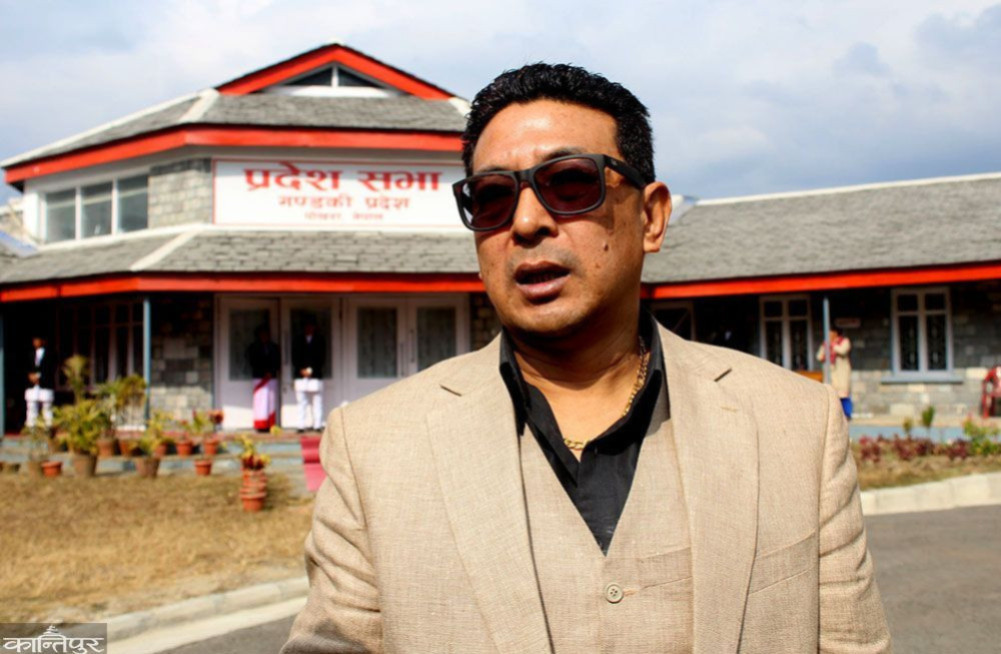
Deepak Manange (Rajiv Gurung), Member of the Provincial Assembly of Gandaki and former minister, was sentenced to five years imprisonment by the Supreme Court after finding him guilty of murder. The court gave its final verdict on Tuesday after 20 years of the trial against Manange on the charge of murdering him by striking a sword in a fight between two gangsters.
The Supreme Court of Justice Nahkul Subedi and Tek Prasad Dhungana upheld the five-year prison sentence handed down against Manange 12 years ago by the Appellate Court of Patan. Manange will have to serve the remaining 28 months after the verdict, as he has already served 32 months in prison twice. According to the spokesperson of the Supreme Court, Achyut Kuinkel, the written judgment is yet to be issued by the Supreme Court. Behora, which will be written in the judgment, will decide what will happen to Manange's MP post.
Section 13 of the Provincial Assembly Member Election Act 2074 has 10 provisions regarding the disqualification of the Provincial Assembly member. Among them, the provision of sub-section (d) seems to be applicable in the case of Manange. In sub-section (d) 'corruption, extortion, human trafficking and trafficking, sale, distribution and export or importation of narcotics, money laundering, passport misuse, kidnapping related offenses or other criminal offenses involving moral turpitude, or any offense punishable by life imprisonment or twenty years or more' It is mentioned that a person who has been sentenced to more imprisonment cannot be a member of the Provincial Assembly.
 Legal experts say that the court's decision will be the final decision on whether the crime of Manange, who was convicted in the killing industry, falls within the category of "other criminal offenses of moral turpitude" or not. "Without seeing the verdict, there is no way to say that he will not go," said senior advocate Shambhu Thapa Since it is not, the matter will be decided by the court's decision.
By abusing political connections, Manange has been preventing the case against him from being settled for a long time. Recently, the Supreme Court has implemented the fifth five-year strategy for speedy disposal of old cases, according to which five years old cases have been kept under the 'campaign field' and a policy of speedy disposal has been taken. "This year, we are in a campaign to reduce the eight-year-old case to zero, as part of that campaign, this case has also been resolved," said Kuinkel, the spokesperson of the Supreme Court.
Manange's current guilty plea dates back to 31 Baisakh 2061, the day Manange cut off his rival gangster Nike Chakra Milan's left hand with a sword. At that time, Chakra had reached the hospital carrying Milan Chine's hand. The incident is mentioned in the court report prepared by the police on June 6, 2061. After 12 days of preparing the bond, the complaint was filed by the post office and the police registered it only two months after that. Two and a half years after the
case was filed, on January 7, 2063, the Kathmandu District Court sentenced Manange to 2 years in prison on charges of assault. He was then jailed. Dissatisfied with the decision of the Kathmandu District Court, the Public Prosecutor's Office filed an application in the then Appellate Court of Patan for the crime of murder. Six years after the appeal was filed, on July 28, 2069, the Patan court ruled that Manange committed suicide and sentenced him to 5 years in prison. Even after the verdict, the police did not arrest him. Manange also did not appeal.
Once he became an independent candidate from Manang 1 (2) in 2074 and was elected as a member of the Provincial Assembly, the prison sentence received by Manange was discussed, news came in newspapers. Police arrested him in the list of absconding accused in May 2075. Dalil Manange submitted that he did not know that he had pleaded guilty to the court and filed a petition against Patan's decision in the Supreme Court saying that he had appealed within the deadline of 14th Baisakh 2075.
His case was registered in the Supreme Court on January 17, 2075. Soon after, he filed a petition in the Supreme Court to be freed from jail on bail. The Supreme Court immediately ordered his release. For two years after it was registered in the Supreme Court, the case did not go to trial. Technically, Manange continued to enjoy power by keeping the case in 'pending' status for a long time. He repeatedly became a member of the state assembly and became a minister six times. Two years after the
case was registered, Manange's case was heard in the Supreme Court on January 7, 2077. Before his case was decided on Tuesday, the 12th of the following year, the case could not be heard on any other day except on 15 June 2079. On 15 June 2079, the bench of Justices Kumar Regmi and Hariprasad Phuyal ordered that Jhagdia should appear before the court for the fourth time since the case was filed. Even after that, the case was going on and on. This year alone, the case was brought up to court four times. On Tuesday, the court closed Manange's old missile forever.
6-time minister, resigns after not getting chosen ministry
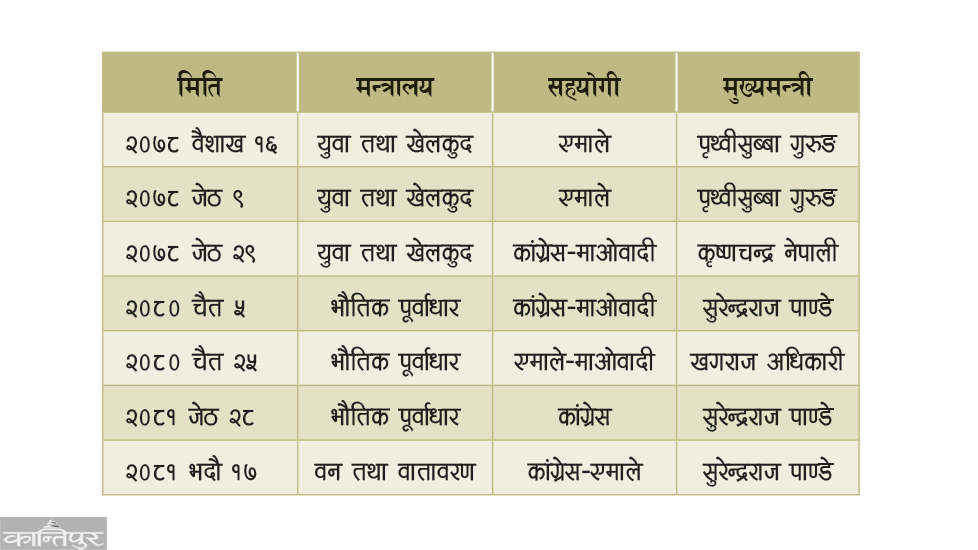
Manange Gandaki, an independent MP elected twice from Manang 1 (2), became a minister three times each in the first and second terms of the state government. As he has been decisive in the power equation since the first term of the state assembly, he had the opportunity to become a minister many times.
In Gandaki, he is the only member of the state assembly to have the privilege of becoming a minister in the cabinet of four members, Prithvisubba Gurung, Krishna Chandra Nepali, Khagraj Adhikari and Surendraraj Pandey, who have been the chief ministers so far. After the recent alliance between Congress and UML, he was transferred to the Ministry of Forests and Environment. Then he resigned saying that he did not get the chosen ministry.
After the CPN split in 2077, the Maoist Center withdrew its support to Prithvisubba Gurung. Gurung gave the Ministry of Youth and Sports to Manange on May 16, 2078 to protect the government. When Gurung resigned and became the Chief Minister as a large party, Manange became a minister again on 9th June 2078. After the fall of Gurung's government, on 29th June 2078 Krishnachandra Nepali of Congress became Minister of Youth and Sports for the third time with the help of Nepali Pokharel.
Manange was elected unopposed in the 2079 state assembly election. Then he joined the United Socialist Party due to the minister's greed. UML's Khagraj Adhikari was elected Chief Minister with the support of Maoist Center, RPP and Manange. But he did not make Manange a minister. The Maoist Center withdrew its support to the officer and supported Congress' Surendraraj Pandey as Chief Minister on 14 Baisakh, 2080. Even then, Manange did not get a chance to become a minister. Pandey's government fell into a minority in March 2080 after the equation at the center changed. Pandey handed over the physical infrastructure ministry to Manange on Chait 5 to protect the government. The day after he left the United Socialist Party, he got an opportunity to become a minister.
After the Maoist supported the officer, Manange rejoined the UML-Maoist coalition government with the Ministry of Physical Infrastructure. On March 25, 2080, the then Chief Minister Adhikari gave Manange the charge of the Departmental Ministry and later the Physical Ministry. According to the Supreme Court's order, the officer lost the post of Chief Minister. Surendra Pandey came again as Chief Minister. In Pandey's government, he was again appointed as the Minister of Physical Infrastructure and Transport on 29th June 2081.
After the Congress-UML alliance, Pandey gave the ministry to UML and appointed Manange as Forest and Environment Minister on August 17. Manange submitted his resignation on the same day saying that he did not get the ministry he chose.