Appeal to local administration and local levels to exercise vigilance in coastal areas
We use Google Cloud Translation Services. Google requires we provide the following disclaimer relating to use of this service:
This service may contain translations powered by Google. Google disclaims all warranties related to the translations, expressed or implied, including any warranties of accuracy, reliability, and any implied warranties of merchantability, fitness for a particular purpose, and noninfringement.
Various hydropower projects and human settlements in the lower coastal area of the Dudhkoshi river have been put at risk since the ice dam in the upper part of Solukhumbu's Khumbu Pasanglhamu rural municipality started breaking.
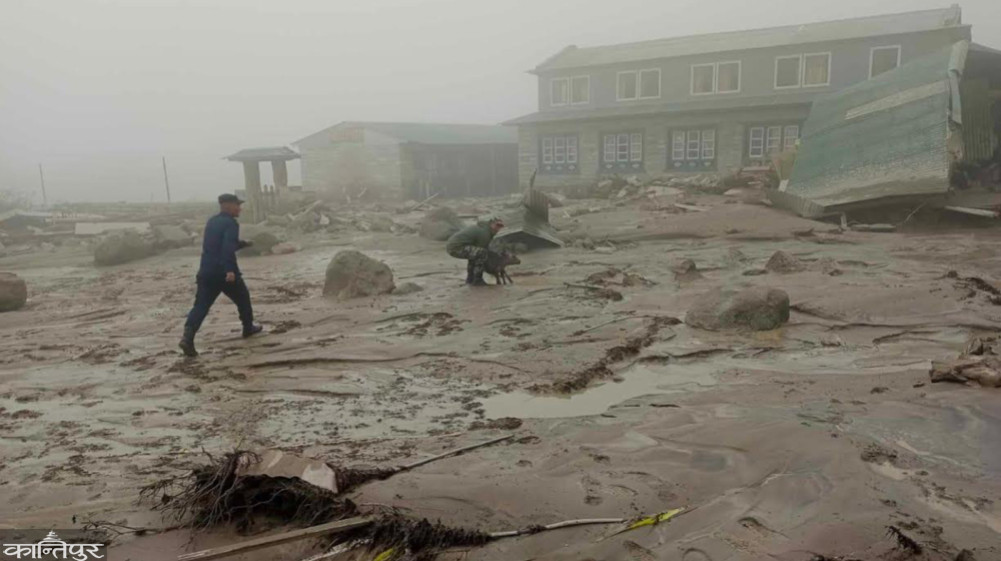
After 2 ice dams in Khumbu area burst and flooded the local river on Friday afternoon, the entire village of Khumbu Pasanglhamu Rural Municipality-5, Thame was swept away, increasing the risk of other ice dams in the area also bursting, and its impact on the human settlements and physical structures of the lower coastal area via the Dudhkoshi River is also seen. ; There are 5 glaciers within a day's walk above Thame.
2 of those lakes burst on Friday and flooded the local Thamekhola (locals also call it Bhotekhola) and washed away the Thame settlement in the coastal area . Due to the flood in Thame River, the water level has also increased in Dudhkoshi.
According to the chief district officer of Sokhukhumbu, Devi Pande Khatri, 2 of the 5 Himalayas above Thame have burst and 2 more are at risk of bursting, and the residents of the lower coastal areas have been asked to move to safer places. Physical structures including schools, hostels, medical clinics, local houses and hotels have been destroyed in the flood of Thame. According to Prajia Pandey, 20 houses and hotels, 3 hostels and schools, 1 medical clinic and the dam of the Thame hydropower project have been destroyed by the flood. 55-year-old Nuru Tudu Sherpa, a resident of Thame, is missing. The Nepali Army and Nepal Police have taken the vulnerable locals to a safe place in the damaged area.
Chief District Officer Pandey informed that the mechanism of army and police is active to recover the physical property left by the flood and search for the missing persons. After the Solukhumbu administration warned that other lakes that are at risk may also burst, various local levels of Solukhumbu, Okhaldhunga and Khotang along Dudhkoshi river coastal areas have deployed public information and public representatives to inform the locals to go to safe areas.
Defense Minister Manvir Rai, Chief Executive of National Disaster Risk Reduction and Management Authority Anil Pokharel, Solukhumbu Chief District Officer Pandey and other security chiefs of the district and people's representatives of Khumbu Pasanglhamu Rural Municipality went to the scene by helicopter on Saturday to understand the situation after Himtal burst and washed away the settlements in Thame. After realizing the situation after Thame's village was washed away, Defense Minister Rai and officials including Pokharel, the chief executive of the authority, have returned to Kathmandu after observing the situation of Himtal from a helicopter.
After the Thame flood, manpower has been deployed from Namche-based Gulm and Nepal Police's local units for search and rescue. An officer of the army headquarters informed that the 18 Bahini headquarters in Udaipur has mobilized the mechanism to take extra vigilance for the protection of physical structures including settlements and hydropower in the coastal area of Solu, Okhaldhunga and Khotang in view of the risk of a possible disaster in the Dudhkoshi river coastal area .
'With the bursting of 2 glaciers above Thame, we understand that nature has warned that Dudhkoshi and other tributary coastal areas are at risk. "We have made a disaster response plan keeping in mind the damage," an officer of the army told Kantipur, "for this, we are working in coordination with the chief district officers of the three districts in the coastal area and the district-based security officers and local people's representatives." And the officer of the unit said that special attention has been paid to the security of the bridge.
Dudhkoshi's total 'aerial space' (aerial distance is 96 km) flowing from the flooded Thame village through Solu, Okhaldhunga and Khotang and Udaipur. It is said that the distance of the river from Thame is more than 150 km. Khumbu region. The Dudhkoshi flows through Solu, Okhaldhunga and Khotang and joins the Sunkoshi and Dudhkoshi Saptakoshi and their tributaries, Sunkoshi, Sindhupalchok, and Ramechhap. , passes through Sindhuli and Udaipur and merges into Dudhkoshi. Then it flows through Saptakoshi River from the east. Electricity is being produced from the hydroelectric project. The 24.88 megawatt hydropower project is located in Khumbu Pasanglhamu Rural Municipality-1. Luzakhola flows into Dudhkoshi. 22 MW Central Hungakhola 'A' and 22.9 MW Central Hunga Khola 'B' Hydropower Project are located in Mahakulung Rural Municipality-3, Bundel . Hunga river is a tributary of Dudhkoshi . Similarly, the 18 MW Upper Solukhola Hydropower Project is located in Solududhakunda Municipality-2, Beni.
The Solukhola is the main tributary of the Dudhkoshi River . Similarly, the water of Dudhkunda municipality-11, Tingla is located in the Dudhkoshi coastal area of Dudhkoshi along with its tributaries Solukhola, Hunga Khola, Ingkhu, Thame (Bhotekhola) and the 86 megawatt hydroelectric power project built in Thulung Dudhkoshi rural municipality-3, Panchan (Makubesi) through a tunnel. All of these have flowed from the Khumbu area. If the snow falls in the Khumbu area or more rain and landslides fall into the river/river, it will adversely affect the sensitive physical structures and human settlements in the lower coastal area.
2042 and 2055 According to Meen Prasad Koirala, a former teacher of Kalikadevi Secondary School in Panchan, Solukhumbu's Thulung Dudhkoshi Rural Municipality-3, the devastating floods in the coastal areas of Solu, Okhaldhunga and Khotang caused thousands of hectares of farmlands and bridges. He recalled that Dudhkoshi was blocked by the flood and after three days when the blocked river opened up and took the form of a flood, it caused a huge loss of material property in the lower coastal area of Dudhkoshi up to Khotang-Udaipur Jortighat .
Even though it was assumed that the flood of Hunga came from the glaciers and avalanches of the Khumbu region, there was no scientific study at that time. Exactly 13 years after that flood, on August 18, 2055, a flood broke out from the estuary of Ingkhu, a tributary of Dudhkoshi. The Ingkhu, which came from Sotang and Bung, blocked the Dudhkoshi river . The August 2055 flood was more devastating than the previous ones and destroyed thousands of hectares of farmland, settlements and physical structures in the coastal areas of Solu, Okhaldhunga and Khotang. Koirala, a former teacher of Panchan, recalled that he had never seen a flood like the one in 2055.
Assistant Rathi Gaurav Kumar KC of the Nepalese Army said that the Thame incident has now sent a message that it is necessary to study the risks that can be caused by the Himalayas in the Himalayan region and develop a monitoring and management system. We keep talking about snow and avalanches. Everyone was interested in the big lakes, but it is not only this, the Thame incident has given a clear message that the small glaciers in the Himalayan region including Khumbu are equally risky from the point of view of disaster," Spokesperson KC told Kantipur, "For this, study, monitoring and management of all types of glaciers. The system should be developed .'
After seeing from various national and international studies that Imja Lake in Solukhumbu is at risk of bursting, only a few years ago, the Nepali Army
imja The army was deployed to make the lake safe . During that time, besides reducing the water level of the lake, the army returned after managing the situation around the lake. Spokesperson Casey said that other lakes that are at risk should be studied and work to be phased out of risk. According to him, human and physical damage can be reduced from such disasters if the high-risk settlements can be relocated elsewhere by classifying the level of risk in the lower coastal areas of the rivers and streams flowing through the lake. Only in Khumbu area
Imja There are dozens of big Himalayas including Gokyo, Dudhkunda. Dudhkoshi, Sokhukhola and other main and tributary rivers flow from these lakes.