The number of households receiving remittances is 51 lakh 15 thousand 526
We use Google Cloud Translation Services. Google requires we provide the following disclaimer relating to use of this service:
This service may contain translations powered by Google. Google disclaims all warranties related to the translations, expressed or implied, including any warranties of accuracy, reliability, and any implied warranties of merchantability, fitness for a particular purpose, and noninfringement.
According to a government study, about 76.8 percent of the 6,660,841 households in the country receive remittances. The living standard survey released by the National Statistics Office recently showed that out of the total households in Nepal, about 51 lakh 15 thousand 526 households are receiving remittances.
Compared to a decade ago, the number of households receiving remittances has increased by about 21 percentage points. A decade ago, 55.8 percent of households in Nepal were receiving remittances. The conclusion of the study is that with the increase in going to work abroad during this period, the number of households receiving remittances has also increased as Nepalis who go out for studies have also started sending money home. In the financial year 1995/96, 23.4 percent and in the financial year 2003/04, 31.9 percent of households were receiving remittances.
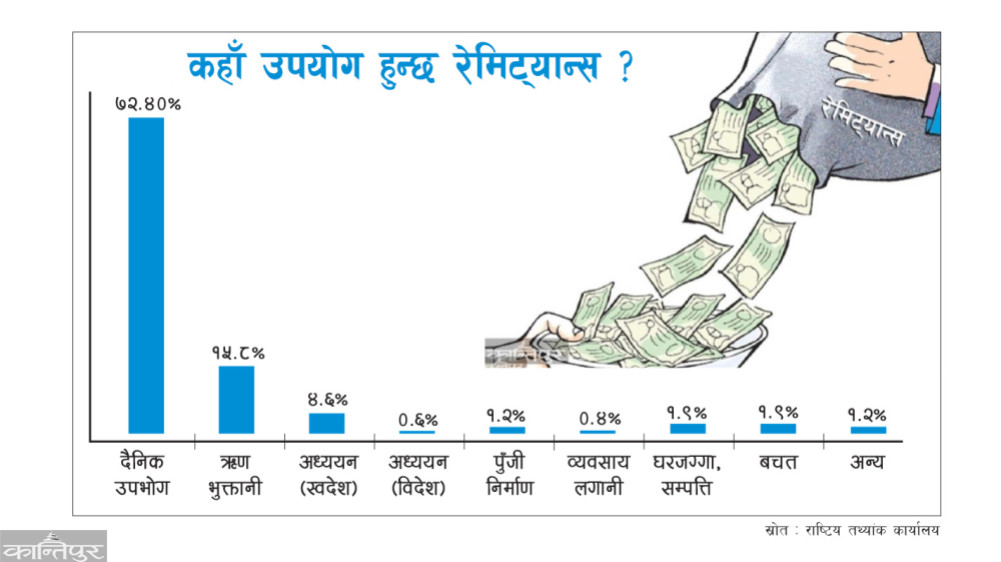
The survey also pointed out that the amount of remittance received per family has increased compared to a decade ago. According to this, the average remittance received by each household is 145 thousand 93 rupees. A decade ago, each household was receiving an average of 80,436 rupees in remittances. The survey pointed out that out of the total remittances coming to Nepal, 21.3 percent comes from India and the rest from other countries. Its share (contribution) in the total income of households receiving remittances is 33.36 percent, while per capita remittances of Nepalis are 51 thousand 438 rupees. Similarly, 72.4 percent of the remittances received by households are used for daily consumption.
15.8 percent of remittances are for loan repayment, 4.6 percent for domestic studies, 0.6 percent for foreign studies, 1.2 percent for capital formation, 0.4 percent for business or investment, 1.9 percent for real estate and durable assets. , 1.9 percent savings and 1.2 percent are being used in other areas, the survey pointed out.
Looking regionally, the largest number of households receiving remittances are from Lumbini province, 89.6 percent, while the lowest percentage of households receiving remittances is 69.3 percent in Koshi province. Similarly, 69.8% of households in Wagmati and Sudurpaschim provinces, 79.1% in Madhesh, 81.1% in Gandaki and 83.9% in Karnali have been receiving remittances.
For the last one and a half years, more than one billion remittances have been coming into Nepal every month. On a monthly basis, out of the 10 months of the current financial year, the highest amount of 1 trillion 37 billion rupees was received in last October and the lowest was 1 trillion 5 billion rupees in last January. According to this, remittances of 1 trillion 16 billion rupees have been received in last Baisakh. This is the reason why the country's foreign currency (exchange) reserves have been making a record even last May. The foreign exchange reserves, which have been reaching new heights every month, have become a new record after reaching 19 trillion 42 billion 400 million rupees till last May.
Although there is a decrease in remittances in Baisakh compared to the previous month (last March), remittances have increased by 23.4 percent this year compared to 10 months of last year. In this way, the inflow of remittances is continuously increasing and due to the improvements in tourism and other sectors, foreign exchange reserves are making new records every month, experts say. According to Rashtra Bank, 11 trillion 98 billion 600 million remittances have been received in 10 months of the current financial year. This is an increase of 19.2 percent compared to last year. Remittances in US dollars increased by 17.1 percent to 9.2 billion.
Similarly, in the last ten years, the number of households that have taken loans has decreased and the number of households that have not yet paid their loans has increased at a high rate, according to the standard of living survey. According to this, in the financial year 079/80, 63.8 percent of households took at least one loan. In the financial year 2067/68, 65 percent of households took such loans. According to the report, 97.3 percent of those who have taken loans are yet to pay. According to the report, about 6.4 percent of households have outstanding loans taken six years ago and the number of households with loans for one or two years is 46.1 percent. There are 47.5 percent of households with loans of less than one year.
Borrower households' means of borrowing are friends, banks and financial institutions, cooperatives, moneylenders. At present, the number of borrowers from Ishtamitra is the highest, 42.5 percent. After that, the number taken from banks and financial institutions is 22.4 percent. 18.3 percent of households taking from cooperatives and 11.4 percent from moneylenders. Ishtamitra, the number of people taking loans from moneylenders has decreased as compared to the previous survey. But that group has not come to banks and financial institutions for loans. Because the number of people taking loans from banks and financial institutions increased by only two percent during this period. The report shows that the dependence of
loans on cooperatives is increasing. A decade ago, 51.1 percent of households took loans from Ishtamitra, 20 from banks, 15.1 from moneylenders and 5.1 percent from cooperatives. According to the latest statistics, 55.8 percent have taken loans for personal expenses, 23.5 percent for running a household and 20.7 percent for business. Similarly, 64.9 percent have taken unsecured loans.
Since the number of people taking loans from relatives and moneylenders is high, it is seen that the number of unsecured loans is high. It seems that the informal means is growing as a source of credit. A study shows that the size of the country's informal economy is 41.31 percent. Last January, a study by the Central Economics Department of the Public Tribhuvan University showed the size of the informal economy in 2020/21.