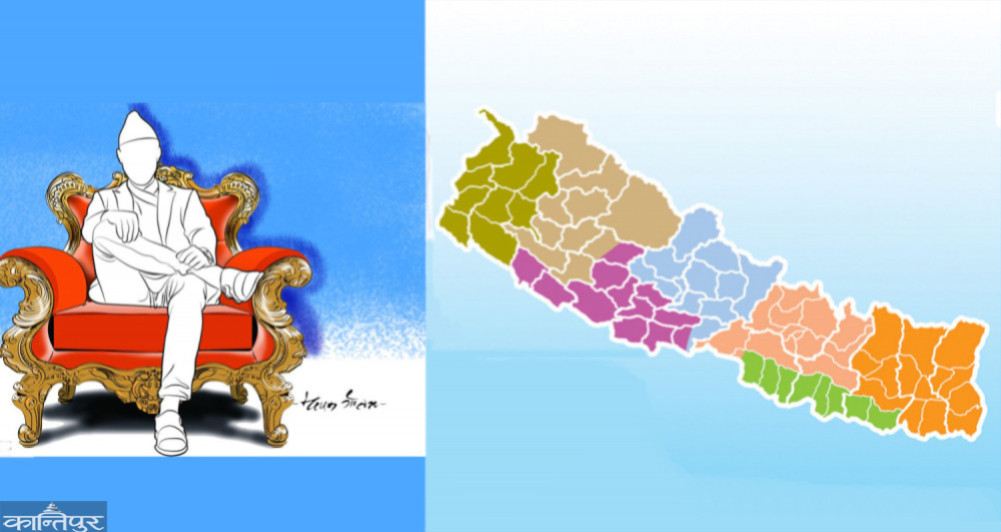
Sixth Chief Minister change in Koshi in 16 months, 3 Chief Ministers and 28 Ministers in Lumbini in one and a half years
We use Google Cloud Translation Services. Google requires we provide the following disclaimer relating to use of this service:
This service may contain translations powered by Google. Google disclaims all warranties related to the translations, expressed or implied, including any warranties of accuracy, reliability, and any implied warranties of merchantability, fitness for a particular purpose, and noninfringement.
With the change of the federal power coalition, its direct impact has also been affecting the formation of the provincial government. In almost a year and a half after the general election of November 4, 2079, the equation of the federal power coalition has changed three times. As a result, the provincial government has also become unstable. Only last Thursday, UML leader Hikmat Kumar Karki was appointed as the sixth Chief Minister of Koshi.
After the withdrawal of support from UML and Maoists, the Madhes government led by Jaspa Nepal has fallen into a minority. While the provincial parliamentarians are busy in the game of making and destroying the government, the work of lawmaking and development is in a state of disarray. The parliamentarians are forgetting in the struggle for power that the principles, policies and programs of the budget for the coming financial year should be discussed. Stakeholders have expressed concern that due to the instability of the state government, distaste for federalism is growing among the common people.
Since the 16 months of the second term of the state assembly, the chief minister has changed for the sixth time in Koshi province. On October 27, Congress leader Kedar Karki became the Chief Minister as a last option according to Clause 5 of Article 168 of the Constitution by 'rebelling' within the Congress and securing a majority of 8 of his own and 39 MPs of the UML. Later, when the remaining 21 MPs from the Congress, 13 from the Maoist Center, 4 from the United Samajwadi Party and 1 from the Jaspa were added, he had almost a two-thirds majority. However, after the change of central power, his chair fell into disrepair.
In December 2079, Hikmat Kumar Karki of Banda UML stayed in Koshi for the first time for 6 months and 6 days. For the second time, he had to leave the chair in 29 days. Congress leader Kedar, who was out of power after the Chief Minister Parshuram Khapung appointed UML parliamentary party leader Hikmat as the Chief Minister using Article 168 (5) for the second time, has refused to grant an interim order to the Supreme Court against the appointment of the new Chief Minister. The single bench of Supreme Court Justice Hari Prasad Phuyal ordered that the issue of the interpretation of the constitution mentioned in the writ petition should be resolved through a full hearing, and the hearing has been fixed on June 9. Karki took the vote of confidence on Monday amid the boycott of Congress MPs.
2079 After the provincial assembly elections held on November 4, UML parliamentary party leader Karki became the chief minister on December 24 last year with the support of Maoist, RPRPA and JSPA Nepal. Hikmat was relieved of his post on June 15, 2080 after the Maoists and Jaspa parted ways. Six days later Congress leader Uddhav Thapa became the Chief Minister on June 21. On July 11, Congress State President Thapa was dismissed from office after the Supreme Court declared it illegal for involving the close Maoist Speaker Baburam Gautam in the election process.
After the resignation of Speaker Gautam, he became the Chief Minister for the second time on July 16, but on August 21, the Supreme Court canceled Thapa's appointment again. After the Supreme Court mandated to appoint UML's Karki as the Chief Minister as per Article 168, Clause 3 of the Constitution, Karki became the Chief Minister for the second time on August 22. He resigned on October 20 after not seeing the possibility of getting a vote of confidence. After that, Congress leader Kedar was appointed Chief Minister with the support of 39 UML and 8 Congress MPs.
The intellectual leader of Biratnagar, Vesh Bahadur Dhamala, said that the unstable political practices going on in Koshi and other provinces are sending a negative message to the common people. "There is a lot of possibility that this kind of activities by the parties will not only hinder the development, but the country itself will be pushed towards the crisis," he said, "It seems that the people have gone to the brink of despair with this practice of federalism." The employees are also surprised by the change of government. According to an employee who has been working in the Ministry of Social Development for three years, it is difficult to make policy decisions due to the unstable government.
Decisions on some important issues going to the Cabinet are being delayed. A total of three laws have been made during this term of the Koshi State Assembly. "After starting a job, the government changes," said Khagendra Khadka, the spokesperson of the Ministry of Internal Affairs and Planning, "There is pressure to start from zero again, and it has become a sad situation." Says it happened. "More than two years later, this much change of power has made even the supporters of federalism think," he said, "it has become an even bigger excuse for those who do not want federalism." He has changed his power partner after taking a vote of confidence. He took the vote of confidence for the third time on Chait 19 and before that he received the vote of confidence on 03 Jan 079 and 080 Chait 10.
3 Chief Ministers, 26 Ministers in Lumbini
3 Chief Ministers and 28 Ministers have been appointed in Lumbini Province after the second election of the Provincial Assembly. In one and a half years, 4 laws have been passed by the state assembly. Out of the four, 2 annual laws, one amendment law and only one original bill have been passed. The process of government change has continued since December 2079, as the government is formed after the coalition and the ministry cannot be distributed. In Lumbini, Leela Giri of UML has led the government for 133 days, Dilli Bahadur Chaudhary of Congress has led the government for 337 days and Jokh Bahadur Mahara of Maoist has been the Chief Minister for 36 days. On December 28, 2079, UML parliamentary party leader Giri was appointed as the Chief Minister with the support of Maoists, Civil Liberties, RPRPA, LOSPA, JSP, Janmat and United Socialists. Giri, who was sworn in with 2 ministers, ended up in the expansion of the government.
Krishna KC, who became a non-departmental minister along with Giri, had to leave without getting the minister's responsibility after there was a dispute about making ministers from Maoists. Giri-led cabinet took a leave after working for 130 days after the alliance changed at the center by combining 8 parties that supported the government and independent MPs. After Giri left on 11th Baisakh 2080, Congress leader Chaudhary was appointed Chief Minister on 15th Baisakh with the support of eight parties. He ran the government for 337 days till 22 Chait 2080. Chaudhary resigned on 22 Chait 2080 after the Maoists withdrew their support. After his resignation, Jokh Bahadur Mahara of Maoist is the chief minister. He is supported by UML, Jaspa, Civil Immunity and an independent MP.
He has been criticized since the formation of the Council of Ministers after he was reduced from 10 ministries to 12. Even Mahara, who managed to expand the cabinet less than a month after becoming the chief minister, has not been able to complete the cabinet. He still retains one of the 12 ministries. He is trying to appoint a Maoist minister in it. However, the Chief Minister, who has only one minister from JSPA and civil emancipation, has been put under pressure by both the parties asking for 2/2 ministers. Spokesperson of the Lumbini government, Interior Affairs and Law Minister Dinesh Panthi claimed that the government has moved forward by focusing on budget creation and speeding up development.
Transparency International Butwal's former president and advocate Mahendra Pandey says that due to the unstable government, development and planning are becoming weak and trust in the system is decreasing and frustration with politics is increasing. "Due to the lack of power of the political leadership, the government has started to change in 3 months, 6 months," he said, "that is a game to weaken the entire system and federalism and make citizens only raiti." He said that people's frustration towards the state has increased and people's desire for development and change has died. "It is weakening the entire system," he said, "such a trend is attacking federalism itself from the political leadership." He said that the election system itself must be changed to improve it.
Gandaki's third government is Confusion of 'majority'
The Supreme Court has ordered the third government formed under the leadership of UML leader Khagraj Adhikari in Gandaki province not to do anything that will have a long-term impact on the province. On Friday, a single bench of the Supreme Court Justice Abdul Aziz Muslim, while hearing the petition filed by Surendra Raj Pandey, leader of the Gandaki Pradesh Sabha Congress Parliamentary Party, gave an interim order to the officer-led government not to do anything that would have long-term effects until the case is settled.
On March 25, the 60-member provincial assembly submitted a letter to provincial chief Dilliraj Bhatt with the support of 22 UML members, 8 including the Maoist speaker and 31 independent MP Rajeev Gurung (Deepak Manange), who appointed Adhikari as the chief minister on the same day. On March 27, the Congress reached the Supreme Court saying that the appointment of the Chief Minister was unconstitutional, based on the claim that the Speaker was counted to achieve the majority. The Supreme Court's order on April 17 cleared the way for the officer to take a vote of confidence.
When the officer took a vote of confidence on May 23, 30 MPs signed in his favour. Speaker Krishna Prasad Dhital, following the order of the Supreme Court, appointed Adhikari as the Chief Minister saying that if the Speaker does not vote out of the 60 members, it will reach 59 and the majority will be 30. Congress leader Pandey again went to the Supreme Court against the Speaker's move. On December 25, 2079, when UML Standing Committee Member Adhikari Gandaki was elected Chief Minister, he had the support of 33 MPs, including 22 UML, 8 Maoists, 2 RPP and independent MP Manange. As the equation at the center changed, the official, who was in the minority, could not get a vote of confidence for the second time on 9th Baisakh, 2080. When the government changed while the pre-budget discussion was going on, he could not formulate the government's policies and programs and budget.
2080 On May 14, Pandey, the leader of the Congress Parliamentary Party, was elected as the Chief Minister with the support of 27 of the Congress, 8 of the Maoists and the independent MP Manange. Chief Minister Pandey resigned on 21 Chait 2080 after the Maoists withdrew support due to a change in the central equation. Pandey estimated that the opposition would not be able to get a majority and as the leader of a large party, he would become the chief minister again. Adhikari got a chance to become the Chief Minister for the second time within a year by gathering a majority of 30 members.
Government did not get perfection in Karnali
UML leader Yamlal Kandel has not been able to complete the Cabinet even after a month has passed since he was appointed as the Chief Minister of Karnali. In Karnali province, which is suffering from shortage of staff, the work has been affected by the government formation confusion. Kandel, who was appointed Chief Minister on March 27, 22 days later appointed 2 ministers and one state minister from UML and 4 ministers from Maoists.
UML's Vinod Kumar Shah, who was appointed as Minister of Agriculture and Cooperatives, did not take oath expressing his dissatisfaction with the ministry. Economist Amar Bahadur Oli said that the performance of Rajkumar Sharma, who became the first Chief Minister in the second term of the Parliament, is also poor. "Since the central power alliance has changed again, all the work of the provincial government is slow, due to which the local people have not been able to feel the provincial government," he said, "even in the budget, the central government also depends on the instructions from above to run the government, in such a situation, how can the work of the province be autonomous?"
Even in the distance the same dense
Rajendrasinh Rawal, the leader of the UML parliamentary party, was appointed the Chief Minister in the Sudurpaschim Provincial Assembly with the support of the Maoist Center, Civil Liberties and Rashtriya Prajatantra Party. In the Far West, where 27 MPs are needed to form the government, Rawal gathered 29 MPs including 10 from the UML, 11 from the Maoist Center, 7 from the Civil Liberties Union and 1 from the RPPA. On the last day of taking the vote of confidence, Rawal was dismissed within 30 days after failing to get a vote of confidence after the civil rights MPs were absent from the state assembly meeting.
On the same day, Kamal Bahadur Shah, the leader of the Congress parliamentary party, the largest party in the state assembly, was appointed the chief minister. On February 11, Shah received 41 votes of confidence, including 19 from the Congress, 10 from the Maoists, 7 from the Civil Immunity Party, 4 from the United Socialist Party and 1 independent. Shah, who was in the minority after the withdrawal of the support of the power partners Maoist and Unified Socialists, decided to take a vote of confidence on 22 March 2080. But as the civil liberties parliamentarians were unable to get a vote of confidence, Chief Minister Shah resigned on the same day. After Shah's resignation, another unstable cycle of government formation began in the Far West.
On the last day of the deadline given by the state chief to submit the claim, two MPs, Lakshman Kishore Chaudhary and Kailash Chaudhary, submitted their claim to the Chief Minister. In Laxmanship claims, Congress, Unified Socialist, and RPP's lawmaker, said, Cailash was supported by UML, Maoists and independent laws. Lakritankhishohar stretched the chief to be the chief chief by the head of the province of the state. Her Ret complete Izzalas have repeated Thursday. The Exporting Shah Municipal Shah Rest minister Shah Municipal Shah Raj Farbadian states that the order of the government is pushing federalism towards the series of federalism. "The pace of the policy and program is not only confusion," he said. "He said," The coordination of the plan is blocked. The nor of the organizations can, nor become a bill. He said that the harvest is now in the far west. '
said that the tendency to decide by the most important decisions and lawfulness. Another---or-agenda Rawal, Rawal Union, says that it is not seen the state is unable to see the states. The Union is looking at the state as a government, not a government, not a government. The fluctuations of the state is not just a provision of provider due to instability, "he said.
(Biratnagar),
s,
s, y Gautam (Butwal) and Krishna Prasad Gautam Sant- Break (Surkhet)