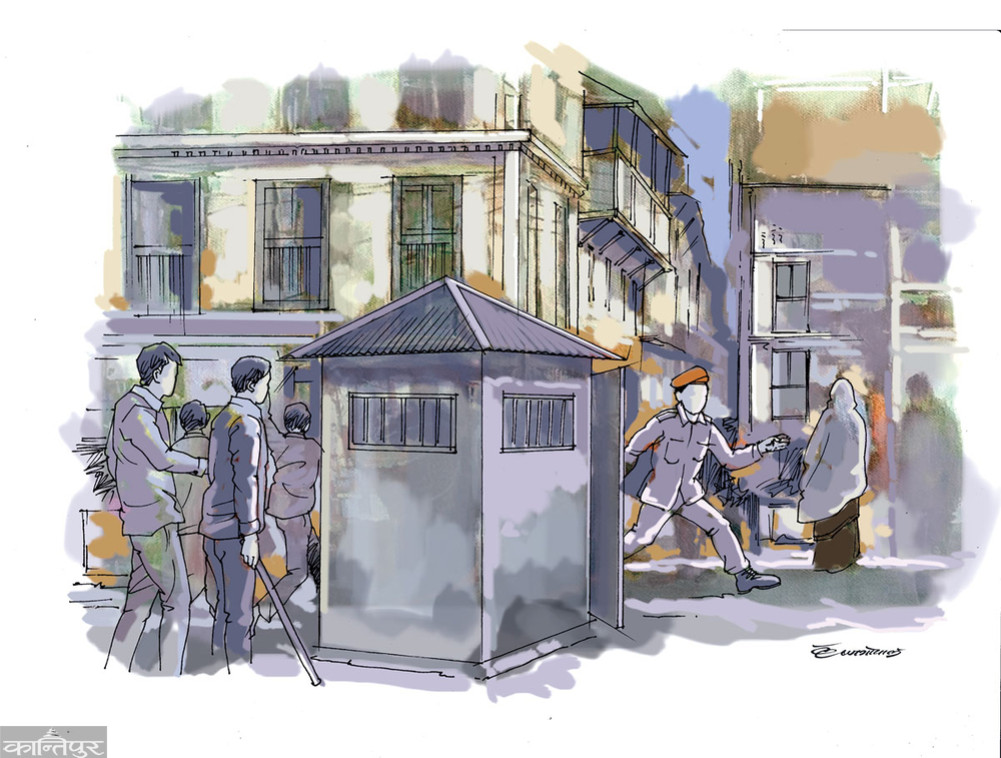
A famous incident in the Nepali communist movement is the 'Sector Scandal'. 39 years ago (May 14, 2043), the then CPN Mashal led by Mohan Vaidya Kiran attacked some police stations in Kathmandu.
We use Google Cloud Translation Services. Google requires we provide the following disclaimer relating to use of this service:
This service may contain translations powered by Google. Google disclaims all warranties related to the translations, expressed or implied, including any warranties of accuracy, reliability, and any implied warranties of merchantability, fitness for a particular purpose, and noninfringement.
Final preparations were underway for the National Panchayat Elections to be held on 29 Baisakh, 2043. Candidates were reaching out to the voters and campaigning for them. The security agencies were formulating a security strategy. In other words, the atmosphere of the election was playing a role in making the summer of Baisakh even hotter.
On the other hand, the then 'NCPA Mashal' led by Mohan Vaidya Kiran wanted to destroy this atmosphere till his end. He wanted to instill distrust in candidates and voters about their own security. He wanted to register his resistance to the Panchayati government. For that he planned to attack the police. Accordingly, on the night of Baisakh 14th (morning of 15th), some police posts in Kathmandu were attacked.
That attack, known as the sector scandal in Nepal's communist movement, did not affect the election much. Instead, it brought upheaval in the party. And, finally, it was instrumental in the rise of a new character who brought upheaval in the politics of Nepal. She is a new character - Pushpa Kamal Dahal 'Prachanda'. At that time he was known by the nickname 'Vishwa'.
The background of CPN Mashal is connected with the Central Nucleus formed in 2028 by Manmohan Adhikari and Mohan Vikram Singh. With the commencement of the Panchayati regime, after the release of jailed leaders, the nucleus was formed by integrating the divided Communist Party and its leaders. However, after differences arose in that party, the leaders of the Singh party held the fourth congress of the CPN in Banaras, India in 2031 and formed the CPN (Fourth Congress) i.e. CPN Chaum. The party formed under Singh's leadership (Secretary) was active as a popular and powerful party in the 30s.
Chaum also could not remain integrated for long. There was a dispute between Singh and Nirmal Lama from the beginning. A series of prosecutions and expulsions continued. Finally, under the leadership of Singh, Chaum split. He formed CPN Mashal in Gorakhpur in 2040. That party is popularly known as Moto Mashal There was a
. Mashal elected Mohan Vaidya Kiran as party leader at its fifth convention held in Ayodhya, India in November 2041. Singh formed a new party called 'NCPA Masal' under his own leadership by holding the 'Fourth National Conference' in Gorakhpur, India in March 2042. That party became popular in the name of Patlo Masal.
Meanwhile, the National Panchayat election was held on 29th Baisakh 2043. CPN Mashal led by Kiran decided to 'actively boycott it along with the program of action'. According to the policy taken by the party, the attack on the police sector/beat was planned by the then Bagmati Bureau, whose in-charge was Dev Gurung. At that time, the party structure below the center was the zonal bureau. The bureau used to carry out agitations in the districts under its jurisdiction, give programs, develop organizations, conduct training.
The party decided to boycott the election in a strong and effective manner, Gurung said, focusing on that, the police beat was attacked. "After consultation with Party General Minister Kiran, the process of action has been taken forward", he said. About a week before the attack on the police beat, the plan was decided in a meeting held in the Mahabuddha room of Dinesh Sharma, the president of the party's workers' organization. However, there was also disagreement within the party towards such a plan. Even if the party's decision to boycott the
election was the same, it could have taken many forms. However, early on, the high profile of attacking the police beat was embraced. Even if such an attack would not cause a huge damage to the property of the state, it would be an attack on a part of the state power. The state responded. Therefore, after implementing such a big plan, questions arose in the party about the subsequent more powerful plans. However, it was said that there is no continuation of such plans.
Sharma recalled that there was a difference of opinion between Gurung and himself when Gurung brought up a plan to attack the police beat in the Mahabuddha meeting and said that it was the party's directive. After he (Gurung) made the proposal, I said that it would be better to do promotional work in the beginning and only then take high-level action. Attacking the police at once is a high-level action. We are not afraid to attack . we do However, after that, there should be a big military program. That's fine too. Otherwise, this action will be counter-productive', Sharma remembered the question-and-answer question about four decades ago, 'then he said, 'You should not ask in an exaggerated way'.' He also says that he had an argument with Yanprasad Gautam (Alok). However, everyone who agreed or disagreed with the plan was forced to implement the party's decision.
At that time, bits were made so that only one policeman could stand on duty in the major places of Kathmandu. A policeman stayed there overnight. The party was prepared to do damage to such bits. Bits made of iron were not capable of causing significant damage. However, plans were made to drive the police away and to overturn bits, crush them, and break windows.
According to Sharma, plans were made to attack the police posts of Asan, Indrachowk and Kshetrapati as they are located in the main areas of the city. According to him, it was decided that Asan would be led by himself, Yanprasad Gautam would lead Indra Chowk (Gautam known as Alok had passed away during the 'Jan Yuddh') and Deepak Mahat would lead Kshetrapati (Mahat, who was the vice president of the student body at that time, later joined the Congress). The officer said that there was also an attack on Sundhara police station and it was led by Toyanath Thapaliya. Each team had 6/7 members. In such a team, workers and party workers from student organizations were selected. However, the chosen ones were not initially informed to each other for fear of revealing the plan. Only in the final preparations were the team members informed about each other.
After deciding to attack on the night of the 14th (4 am on the 15th), preparations were intensified. Although there were no weapons, domestic weapons, stones and sticks were collected.
Dogs barked on the street at night and it was uncomfortable to walk. Officials say that they started feeding the dog in the morning three to four days ago and made it accustomed to not barking while walking, in case the dog would bark and disrupt the plan. The members of a team stayed in the same room on the night of the 14th. As they planned to attack simultaneously at 4 am, they left the room accordingly. The officer who was in the group that attacked Asan remembered - 'The normal movement of people going to worship had already started. However, they didn't get any relief. We got to the police bit. We told the police who were there to run away. We said that if you don't run away, you will succeed. He got scared when he saw materials like sticks in our hands. And, coming out of Bit, ran towards Bhotahiti. Then we fought a bit.'
The attackers shouted slogans like 'Panchayat system death', 'Let's boycott national panchayat elections', 'Labor unity', 'Republic's life', 'New people's revolution life', 'NCPA torch life'. Leaflets with the title 'Succeed the Boycott' were also scattered with calls like 'Let's not vote in the elections'. The policy was not to harm the police, so there was no human loss in the incident, both on the part of the state and the party. After the attack, all the members of all the groups returned to the room where they were staying at night, stayed in the room all day, the police started raiding. The reaction after the
attack was probably under-estimated. There was no long-term strategic plan. Rather, it was a contingency plan made in the context of actively boycotting the national panchayat elections. Some success was achieved in the message that was tried to be conveyed through the scheme. "When the NCPA Mashal took action in the police force, candidates and voters became afraid", Sharma said. Those who shouted slogans and spread leaflets and posters for the rights of the organization were the same people who also shouted slogans and spread leaflets and posters in favor of the party. The same faces, familiar to the eyes of the state apparatus, attacked the police station at night and spread leaflets and posters with the same slogans. So it was not difficult for the state to identify the assailant.
The police clamped down on Mashal workers. Increased surveillance on leaders-activists connected with events or parties. As a result, they went underground. Students and workers close to the party fell under the eyes of the state. Within a few days, some leaders/activists including Deepak Mahat, Narayan Adhikari were arrested in the process. Sharma was also arrested a year later. In the beginning, when the threat of the state increased, the big leaders at the leadership level went underground. They escaped arrest and torture. Being a small and weak party, the party was weakened, fragmented and weakened by state repression. That was the negative impact the 'sector scandal' had on the party at that time.
On the other hand, the party also benefited. Because, when communist parties were active under different names, everyone had to make themselves 'visible'. Male, who stood at the foundation of the Jhapa movement towards the communist side, was considered a strongman, who was in training to become a soft communist. He started raising and supporting the people's party candidates in the panchayat elections. On the other hand, Masina communist parties were trying to make themselves more revolutionary and stronger. This became the background that CPN Mashal could lead. After a decade and a half, one side of the torch became CPN-Maoist and established itself as a revolutionary force. Even today, the two main parties on the communist side are considered to be the then Male (currently CPN UML) and the then Mashal (currently CPN Maoist Center).
The attack on the police beat helped bring the decision to boycott the election more public. However, that was an immature decision. For, although a small party with limited means might attack a few police posts and create panic in the respective localities for a few moments, it could not achieve any significant success in subverting the state itself. If such an attack took place in a remote area, the state might not have reacted or the attacker might have fled to a safer place. However, the attack took place in the capital itself, prompting an immediate response from the state. Although those police bits were fatally attacked, there was nothing more the party could do. Attacks on a weak basis became counterproductive for the party itself. The
party was in the mindset of armed struggle. Its internal preparations were underway. Prachanda and others took initial training in gun handling. Therefore, a strong and acceptable leadership was being sought within the party. Meanwhile, due to the sector scandal, the rhythm of the party was broken. The party's organizational strength was weakened due to state repression. Therefore, the demand for action against those involved in the sector scandal, which was deemed counterproductive to the party organization, continued to rise.
In particular, the Bagmati Bureau executed the plan to attack the police station without even informing the party's core leadership. Therefore, there was a demand that the Bagmati Bureau should be directly responsible, and the line and moral responsibility of the party leadership related to the implementation of the plan should be taken. It was argued that if such decisions are taken without even informing the party leadership, chaos will result. This topic was raised within the party for three years.
Prachanda, who was a member of the alternate politburo at that time, says, "Deepak Mahat, his uncle (Narayan Prasad Timilsina, Sindhupalchok) and others of the floor committee were immediately taken action on the part of the party because they were wrong." However, every time a meeting was held at the center, discussions were held, and no one could reach a conclusion.' (Translation/Shubshankar Kandel/32)
Finally, the central committee meeting held in Chitwan in October 2046 accepted the sector scandal as a mistake. And reduced the position of the leader involved in it to one level. The posts of Mohan Vaidya Kiran, Dev Gurung and others were reduced. Kiran took moral responsibility as party chief.
Prachanda was not connected to the sector scandal. Kiran proposed him as party leader (general minister). Kiran says, "According to the era, I thought that Prachanda could lead." Basically, Prachanda and I were of the same opinion. At that time, we were opposing right-wing opportunism and revisionism. We also had a place that the new democratic revolution should be done. The same thought was that we should struggle armed. Therefore, Prachanda gave Prachanda the opportunity. ' Beforeing Prachanda, Prachanda, who has not been prepared to become the General Secondary, but Prachanda said that he was not ready. He also says that he said he said he was to be in the first month. Says, 'Ki Ray was from within outside, he could not be able to carry out the post of Mahajati. In the long case, Ryn requested a special request to advance the party by becoming a General Much. ' Sharma says that the argument that led by Prachanda Cands by taking action against Prachanda Cands, the youth was also the belief and intention of the revolution to move forward. But as one meeting changed the General Secondary, the fact that ray was taken action and became a source of rains. '
the party was making military preparing. On the other hand, an anti-anti-Panchachachay was becoming stronger. At the same time, Prachanda had arrived in the leadership of the party. He is analyzed, 'I raised a serious question as soon as I became a sublive. That life was a melody question! It was the question that would take the same armed configuration to take the party with armed struggle (Cynrrilla War). The first preparation of armed conflict was postponed. The people's movement of the Panchayat in 2046 succeeded. The party decided to use the parliament. But then the road arrested after re-armed struggles later. Prachanda learned some lessons from Sector stem as a
. The author has analyzed Sodhar Sharma, "said Prachanda's weakness of Surchanda. The assault city, as he was in the capital, immediately was immediately in a juris. That incident made his belief that the armed conflict, not from the city, not from the city. Mao was taught from the rural areas in China. '(Laboratory / Surre Sharma / 28).
is not only from Prachanda, not only but also to direct involvement in the attack. They found the 'people's war' experience experience. Officer says, 'I did not have the precept to the subject of the guidelines. Sector stem gave the experience even though it was little. The experience that the cadres who have been 'Exposed to the police have increased our morale. Something could be delayed at that time or there could be no damage if they did not even take action. However, completion has completed the slowly going on action. The experience was worked in the people's war. ' After the party headed in 2046 BS, he promoted unity process between the CPN-Mahah, the CPN-Mahaum, the CPN-Chair and the proletariat workers, according to the CPN unity center. Later Mohanwikram Singh is at the party of the Singh-led party. Baburam Bhattarais were mixed. The party was moving towards a long-term public war ', which created a dispute over the party. As a result, the 'people's war, including Prachanda, restructuring the party in 2051 BS, and in the name of the CPN-Maoist. He was led by Prachanda as a General Sister. The same party started the people's war from 2052. In that order, the party led by the party has changed the chairperson and chairman. Prachanda became the chairperson. The party led by Prachanda led party has been involved with various parties after the method of 'People's World' in December 2063 Dead, has been involved with various parties, the party's name has changed. However, Prachanda has remained in the chairperson. One of the two-faced party of the United States Party (CPN) was formed between the UML and the Maoist Center in 2075. Transmitting the leadership of the parallest leadership, the new leadership development, but immediately has not been seen. Instead, a high level of high levels of high levels under the party that may have a list of party leadership, the high level of high levels of Mohan Baidya and Dr. Accused of being forced to leave the party like Baburam Bhattarai to leave the party.