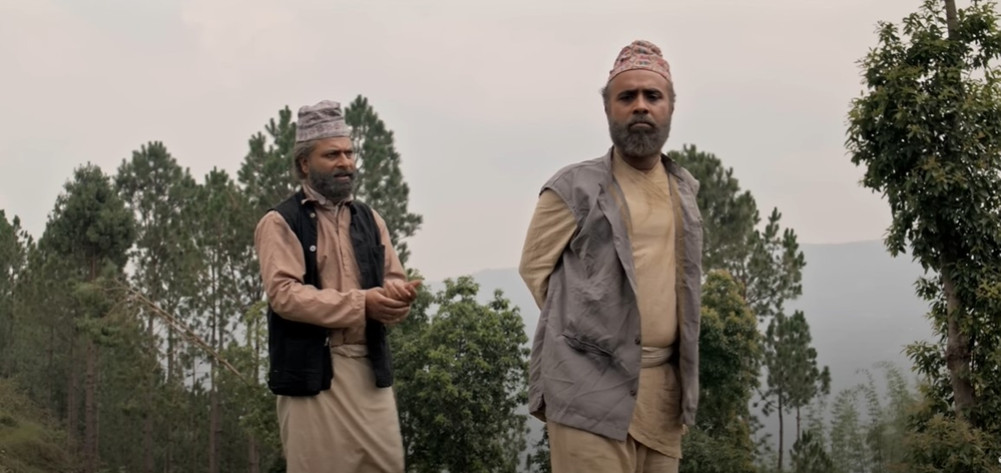
The story of the film is not entirely new, it is the woe of our village, a representative tune of neglected marginalized stories.
We use Google Cloud Translation Services. Google requires we provide the following disclaimer relating to use of this service:
This service may contain translations powered by Google. Google disclaims all warranties related to the translations, expressed or implied, including any warranties of accuracy, reliability, and any implied warranties of merchantability, fitness for a particular purpose, and noninfringement.
Today, it would be too hasty to explain the appreciation and money market science of 'Poorna Bahadur Ko Sarangi' among the crowd of tearful viewers in cinemas.
However, the past of masledar films doing business is still with us. In the background of that past, the common psychology of Nepali society and cinema 'literacy' are definitely there. However, the main reason for this historical turning point in which the viewer's immense attraction towards Nepali cinema is due to 'Poorna Bahadur's sarangi'.
'Poorna Bahadur's sarangi' means the story and saga of our society! It is known that although the story is strong, the visual language must be strong for an important part of cinema, for which the collective passion and combination must be agile from the theoretical and experimental aspects. The strength of 'Poorna Bahadur's Sarangi' is to be able to get off fast.
Even today, some intellectuals refuse to put cinema in the category of art and say - 'Film cannot be art. Because, it only reproduces the real facts in a mechanical manner.' This kind of ideology of analyzing cinema by analogy with painting has passed, we can find the highest examples of artistry even in Nepali cinema tradition. The continuous participation of Nepali cinemas in international film festivals has also opened the door for optimism. With the recent exception, the Nepali audience continues to ignore the trend of making formulaic movies by counting the number of songs and 'fights' in the name of entertainment. The positive reviews of the recent movies like 'Sambala', 'Gaon Indi Bato', 'Gharzwain', 'Jari', 'The Red Suitcase', 'Halkara' show that the audience is looking for a new taste. The question arises, what is that new flavor? The possible answer is simple – Raithane's story, new visual language and its own sweetness in style. In a multicultural society like ours, there are no stories of sadness, instead there are endless stories of sadness. A strong example of this is 'Poorna Bahadur's sarangi'.
The story of this movie is not completely new, it is the pain of our village. The tune is representative of neglected marginalized stories. The structure of the plot is also woven in the traditional style of beginning, middle and end. However, Purna Bahadur has a dream of a different taste than the thunderous ideals of 'heroism' that will be set up in masledar cinemas and the roar of taking 'contracts' for social change. His dream may be higher than social 'character', but not extreme. What is the dream come true for children in a poor Dalit's house? Let's move on to the song from the movie without any relevant explanation - 'Eastkot is a bad son, born in a poor house is a wrong deed/The desire to become a big man by reading and writing, spent his life in the village, let his son reach the city/Since the time of my grandfather, this life has been going on with the fiddle, I don't know anything else. So, the son asked me not to walk anymore/ I took him to the ground, you take him I carry it as long as I can on the axis/arm, put it on my shoulder.'
This movie was born from the struggle saga created by Purna Bahadur's life-like sarangi while running after this dream. According to a data published two decades ago, there were only 6 dozen Gandharvas who passed SLC. Therefore, even though the writer and screenwriter have recreated some tunes of poetic imagination and creative music, the main story has remained in reality. Since the story of this movie is still adapted from the environment of the Panchayat period, it is clear that the visuals of the village houses of that time have been taken seriously. Some of the scenes seem to have been scratched from the point of view of historical juxtaposition. However, the flow of the entire cinema is bound by the rhythmic string of music. And, because of the struggle songs of the Gandharva community, it was imperative that the music aspect be strong.
The Gandharvas are not only proficient in playing sarangi but also in making sarangi. However, our society has never given the status of knowledge to the skill required to make sarangi strings. The whole society has suffered because the living tradition of knowledge in the Raithane Sanskar-culture of that community has been disrespected. Its sign is symbolically spoken from Purna Bahadur's strangulation to the scene where he has to sell the sarangi. Overall, this movie can be considered Gandharva-Blues.
It would be an exaggeration to say that 'Poorna Bahadur Ko Sarangi' is excellent in terms of cinematography compared to other movies. However, this cinema once again jolts us all for a sociological scandal over the question of where the Gandharva community falls in the stratification of our society. And, especially, this film is a window to help the new generation to understand the history of the Gandharva community. The 'Sarangi of Purna Bahadur' is a partial manifestation of the pain caused by the caste system that is deeply rooted in Nepali society, while the tears shed by the audience are sympathy for that pain. However, sympathy alone does not make sense to move society forward. The Gandharva community, which is one of the living cultural heritage of Nepal, has been neglected by the state, and today the knowledge of that community is on the verge of extinction. The Garndhavs, who are considered to be the living carriers of music culture, are still victims of contempt and exclusion due to the caste system adopted by the state since history. Due to the art and talent of the Gandharva community, today Nepal should have been able to stand on the stage of world music with a proud identity.
In particular, states and rulers selfishly exploited and used the Gandharvas from time to time. And, after the work was done, the concerned community was relegated to the state of anonymity, due to which even today they are innocent looking 'stubborn'. The state's attitude of despising labor and knowledge has left the Gandharvas in the caste system and made them 'untouchable'.
According to the mythological references, the Gandharvas were the children of Gandharva sage Sozha but were made 'untouchable' by the conspiracy of the Chambu sages. After the erstwhile state power deprived the Dalits of their property rights, the Gandharvas were branded as 'Gayne' and made 'Magante'. It is an ironic scenario to see even the power that controls the economy through grants in the form of 'Dan-Dakshina' and 'magante' its own people. The contribution of the Gandharva community in Nepali society is not outstanding. In particular, they are masters of musicology, i.e., 'musicians of tears' in a way. Not only do they sing twelve months, but they can instantly sing about unexpected events with new and interesting rhythms. Born singers, Gandharvas used to play the role of newsmen yesterday when technology and mass media were not available. They were helpful in reviving oral history while going from village to village singing Karkha and Gatha, they also motivated the common people to fight for the country in the state-to-state war since yesterday's state expansion. In the words of Sardar Bhim Bahadur Pande about the Gandharva community, which is low in terms of demographics, if there is a special credit for not letting the lamp of Nepali nationality go out in the village at that time, then it is the poor squatter Chytikora Gyane. He used to sing in the guise of a Maganta and sang the Karkha sung by the ancestors of Nepali in village, house and haat bazaar. Ruvin Gandharvas, who helped in the expansion of Prithvi Narayan Shah's kingdom by singing Maniram songs in the republican movement, covered the period from the then state to the revolutionary movement according to their style. It is well known how much the psychological effect of cultural workers and music is on movements and battles.
From telling village stories to Lahure who returned from the war, the Gandharvas telling the stories of the battles fought by Lahure from the sarangi in the village, although our folk music has been revived with pride, but it has been 'failed' in history by grinding the community. The state still has a chance to correct yesterday's missteps. However, the rulers are on the journey of 'Kholo Taryo, Lauro Birsyo' without conscience and policy. As a result of the ruler's hardness of heart, today the people are wetting their handkerchiefs with tears after watching the 'Sarangi of Purna Bahadur'. Again the truth – tears are not the solution, sympathy is.
In this movie, most of the actors have tried their best to improve their qualifications and actors like Maotse Gurung, Bhola Sapkota, Buddhi Tamang, Bhatsak Khanal, who have been swimming in acting for a long time, have done justice. Equally important are the performances by Mukun Bhusal, Anjana Barailly, Prakash Saput, Swayam KC, Sarita Sah. Purna Bahadur and Veere's eligibility easily conveys the conflicting sense of intimacy and jealousy between the lower class characters standing on the same ground. The master who represents educated hypocrites who wear the guise of a 'revolutionary' on the inside and fill them with 'people' of the oppressive caste-system has removed a layer of our society.
Deciding that actor Vijay Baral can do justice to the central character of this movie, Khubi and Baral in the lead roles for the first time confirms the prowess of Saroj Paudel's directorial skills. The effort Baral has put into the character is admirable. However, Vijay Baral is not a new face for Nepali drama and cinema. He has been working in drama for 17 years and is one of the pillars of Mandala Theatre. And, although he has been working continuously in cinema for 12 years, he was limited to a supporting role, although his performance in the group of director Rambabu Gurung, Upendra Subba and actor Dayahang Rai was memorable. He made full use of the first opportunity to prove himself as an accomplished actor on the screen among the audience who had not seen the play and was successful to a large extent. And also got the name of the artist who makes the audience cry the most in the market. It was a challenge for Vijay, who has acted well in
dramas and movies, to qualify as Poorna Bahadur. The reason - on the one hand, he was brought up in a Brahmin family in the Terai, so there was difficulty in the western language, on the other hand, playing the role of a Gandharva was not just about holding the sarangi. Moreover, playing the three-dimensional role of the same character from adult, middle-aged and elderly was not possible with great effort. According to Baral, to understand this character, he not only studied Gandharva culture, but also went to Thamel and learned to play sarangi with members of the Gandharva community. Perhaps he tried to understand the collective psychology of the Gandharva community along with playing the sarangi. As people with different cultural histories differ from their way of thinking to their behavior, such Utbus may have functioned as a 'small Gurukul'. Even though there is an expectation of excellence, Vijay has done his utmost justice to the ups and downs of body language, psychology and speech along with the age difference of the same character. It seems that for Vijay Baral, Purna Bahadur's eligibility will be a meaningful tour of his acting journey. After more than a decade and a half of acting, Vijay made the main role strong, and the commentary on the ancient definition of 'hero', which is collapsing, has received another big blow. Vijay Baral has raised another level of architecture with the character of Poorna Bahadur in a new environment where heroism is not based on a person's skin, color, height, voice, dance etc. For this, he deserves congratulations.
The example of 'Poorna Bahadur Ko Sarangi' has further confirmed that literature and cinema can do politics even without dividing 'Zindavad and Murdavad'. This movie indirectly says that the class structure of Nepali society is based on the caste system, the hierarchical system of the caste system is wrong and by destroying such a system, we should be able to preserve the knowledge tradition in our original art and culture. For that, there is a need for leadership with the idea to change the sympathy expressed in 'Poorna Bahadur's Sarangi' into public opinion to end the caste system.