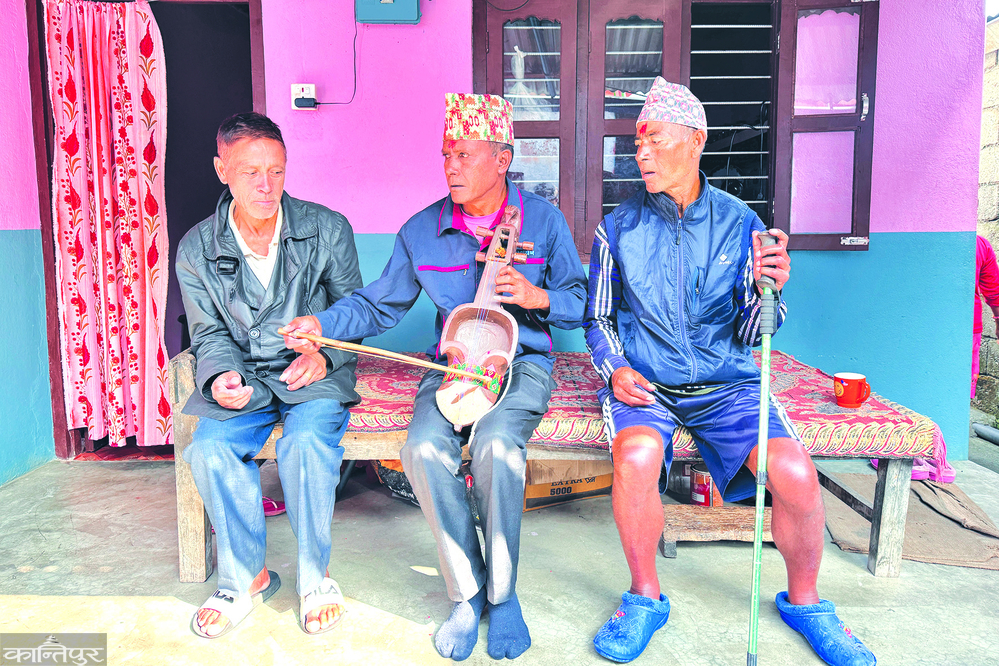
After the poet Keshari Dharmaraj Thapasag reached China, Khim Bahadur Gandharva played sarangi tunes to Mao Zedong.
We use Google Cloud Translation Services. Google requires we provide the following disclaimer relating to use of this service:
This service may contain translations powered by Google. Google disclaims all warranties related to the translations, expressed or implied, including any warranties of accuracy, reliability, and any implied warranties of merchantability, fitness for a particular purpose, and noninfringement.
As soon as you enter through the main door of the office, you meet Hark Bahadur Gaik (Gandharva) in the sanitation branch of Pokhara Metropolitan Municipality. Having lived a working life for thirty years, he did not learn sarangi. After becoming a branch officer, he who is 55 years old now feels, "I made a mistake by not learning sarangi."
Pokhara is the city of Jhalakman Gandharva. Pokhara is the city of Sarangi. 'Poorna Bahadur Sarangi' is going on in the city. So far this film has broken the 'records' of the books. Films make you cry, laugh, connect with life. Brings closer to reality. You find yourself in the characters inside the screen. The religion of the film is completed by 'Poorna Bahadur's sarangi'. How close is the film to the reality of the Gandharva community? Is this the story of Gandharva-Father's struggle or of a father? If Durga Bahadur had Damaha, Birkh Bahadur's flute or Surya Bahadur's conch, would it have made any difference in the business of the film?
Jhalakman's birth place is in Batulechaur of Pokhara - a settlement of the Gandharva community. Hark Bahadur of Batulechaur gathered his relatives and went to the hall to watch 'Poorna Bahadur's sarangi'. I didn't understand after watching it once, I watched it a second time with my wife. While watching the film, Hark Bahadur was shocked many times as he remembered the suffering of his own father. "I have seen the pain of my parents when I was in school. I have also suffered. I went to school after eating rice and flour brought by my father from house to house while playing the sarangi,' he said, 'Unable to pay the tuition fees, my father has kept the plate of hashish he used to eat rice hostage.'
Father Dan Bahadur played the sarangi and mother Krishnamaya taught him by fishing. Hark Bahadur saw the face of his own father in Poorna Bahadur remembering the old days. He cried saying 'to cry'. I am wearing the same clothes that my father brought me. The school uniform was a blue shirt and black pants. Father used to buy it on Dasain. The new dress for Dasain was the same, the school dress was also the same,' he sounded emotional.
Plow revolution activist Pandit Muktiram Timilsina belongs to Batulechaur. He B.S. In 2001, he broke the tradition of 'Brahmins should not plow' by ploughing, who was also an activist of educational and social awakening. His work 'Ko Achut?' written against untouchability was banned at that time. Under his leadership, V. No. Vindhyavasini Mavi opened in Batulechaur in 2004. Timilsina reached the Gandharva settlement and told everyone to 'read'.
Hark Bahadur's father passed matriculation from the same school. He also studied there. He used to say that you should study. Even the Gurus never said not to read. Didn't care about reading. We studied with some scholarships," he said. "My father also thought that he would educate all his children." At that time, only three of his brothers passed SLC. Milo brother Man Bahadur is now abroad after passing JTA, younger brother Bhim is an accountant in Vindhyavasini.
In his father's generation, there was no other option but to go from village to village to fetch grain, sell grain and make a living. There was not enough land for farming. Considering his art and voice as Saraswati's skills, he could not even embrace other professions. The Gandharvas used to narrate the epics from the time of Prithvi Narayan Shah in 'Karkha'. He used to sing songs related to various crimes in 'Ghadana', who were the bearers of information.
In his time, a Dalit had to wash the glass himself while drinking tea in a shop. He would not drink tea because he had to wash the glass. There was a tea shop downstairs from the school. Once when he went to drink tea with a friend, the shopkeeper kept his glass separately. He called his mother and asked her to brush him. From that day he stopped drinking tea in the tea shop.
He did not pick up the sarangi, but instead learned the flute after seeing the helahoncho associated with caste. Played the flute at Hotel Crystal, Hotel Dragon in Damside of Pokhara. Damside at the end of Pokhara and Batulechaur at the top, he used to walk. Studied Law at Prithvi Narayan Campus after passing SLC. "At that time, it was a custom to touch the Gandharva and look at it from the point of view," he said.
When it came to this generation, Gandharva of Batulechaur became more attracted to jobs than sarangi. In the then Pokhara Municipality, many people got jobs from cleaning to administration. Manipal Hospital opened in Pokhara. When other teaching hospitals also started opening, Gandharva started getting a job in the sanitation department of those hospitals. At the same time, Hark Bahadur joined the municipality. He no longer had to play the sarangi to teach his children, to bring them up. It was not difficult for my children to study. They didn't see that I had to walk away. Because I went to work,'' he says, 'how much I have suffered, my heart will know. They got emotional watching the film, but they couldn't feel the same way I did.''His son Vivek joined the band while continuing his studies as a singer. The aim of the band 'Lakshya', which is run only by the youth of the Gandharva community, is sarangi preservation.
Those who have said 'cry' after watching the film with Hark Bahadur, he said that he remembers the struggle of his father while reading. He said that it matches his own life. He commented that the Gandharva's lifestyle, language, customs and culture were not shown in the film which is the story of the Gandharva community. "If we had been consulted before making the film, there would have been room for improvement," he said, "more reality would have come." The struggle of the Gandharva community was visible.'
The film, which gives the message that education should be embraced, has also raised another question mark - can Dalits who are unqualified or uneducated be discriminated against? Aren't eligible Dalits really discriminated against? Hark Bahadur's experience says, "There is no direct discrimination, but it still exists indirectly." He has felt that even if his clients or accompanying employees say ``Hark Sir'', he has experienced discrimination in a roundabout way. They say, 'somewhere, non-Dalits should not be called during pujas, weddings, fasts etc.' Sarangi has become mandatory in double evenings, ghazal restaurants, fairs, recording studios, etc. A generation is ready to travel abroad playing sarangi. There is no need to go from house to house like before. There are examples of non-Dalits also making sarangi playing their profession. Gandharva now sees identity in Sarangi, not inferiority complex.
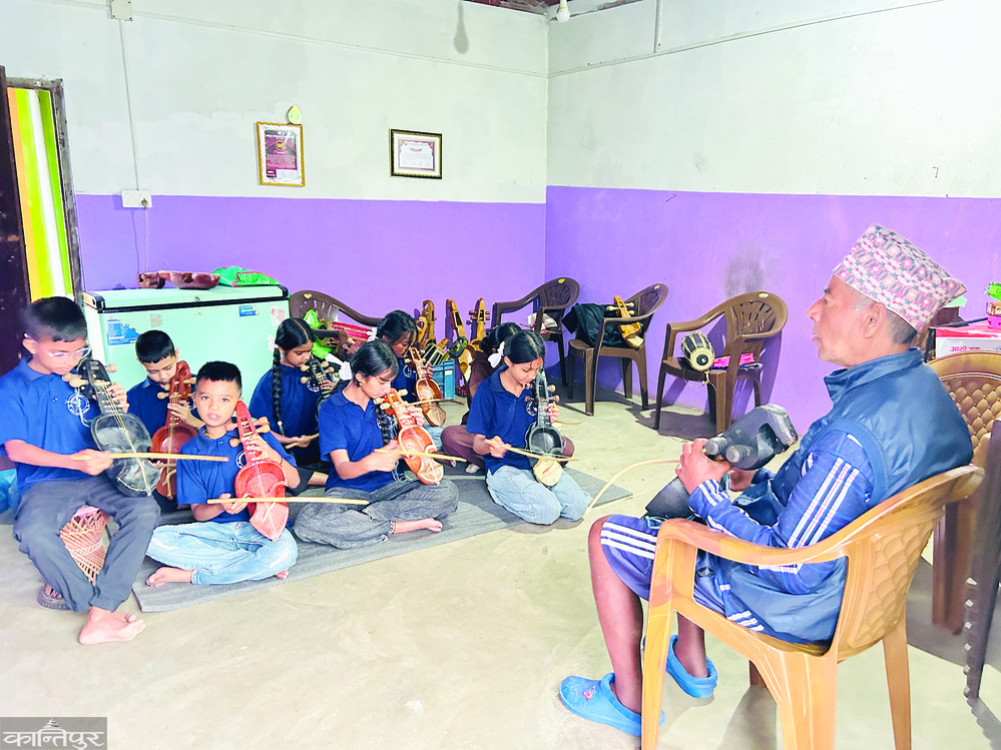
Jhalakman Gandharva of Batulechaur is a source of inspiration. Although he is gone, his son Khim Bahadur Gandharva is still alive. He V. No. In 2013, Keshari Dharmaraj Thapa, a folk poet of Batulechaur, reached China and recited sarangi tunes to Mao Zedong. Dhan Bahadur singer, who was worried about the new generation moving away from the sarangi, opened the 'Jhalkaman Gandharva Rashtriya Lok Baja Sarangi Sankaran Pathshala' in Batulechaur 16 years ago. He started teaching Sarangi in his home to children above 11 years of age from the Gandharva community. Earlier it was said that women should not play sarangi, now girls are learning sarangi. The aim of the
foundation is to ensure that the sarangi does not die. After his death, his son Dilip has taken up this work. Dileep learned sarangi from his father from the age of 10. While learning, he became proficient in playing sarangi and madal, singing and dancing. He was able to study up to class 10 on scholarship because of music. While studying on the campus in 2057, he started working with his father in Solti Dohori Sanjh at Amarsingh Chowk. Now the situation has changed. You don't have to go from house to house to save the sarangi. Sarangi is used in folk, modern and fusion songs. The school also teaches students the sarangi along with other musical instruments. "My children didn't learn it, now I am teaching it to their children," he said. The new generation sarangi players in Pokhara are produced by most of the establishments.
Hark Bahadur, who is also an advisor of Nepal Gandharva Community Development Center, says that he feels proud to present Sarangi as an identity of Gandharva. It is not necessary to make sarangi the main profession. Our children should also become doctors and engineers. They are also going abroad," he says, "but if the sarangi is forgotten, we will also be lost."
There are Gandharva settlements in Hemja, Badhare, Gagangonda, Rithepani along with Batulechaur in Pokhara. Gandharvas prefer to live in groups rather than alone. There are Gandharvas living in 69 districts across the country. After Kaski, there are many Gandharvas in Chitwan, Tanahun, Gorkha, Bhojpur, Surkhet, Dang and other districts. According to the 2078 census, the population of this community is 6,971, which is 0.02 percent of the total population. There are 618 people in Pokhara alone.
62-year-old Lal Bahadur Gaik and 58-year-old Govind Gaik from Hemja went to the theater to watch the film this time after two decades. The story of 'Poorna Bahadur's Sarangi' was similar to Govinda. His mother died in 2035 when he was 8 years old. A single father raised three sons and a daughter. He was also enrolled in school, but due to the financial condition of the family, he could only study up to 3rd standard. "At that time, there was no one who told me not to study, I could not study because of my own family problems," he said.
He used to walk with his father since he was 7-8 years old. After watching the film, he also remembered his father. When the mother tried to enter the city with her son, her eyes were filled with tears when the son left the mother and rushed to the father. However, he was not satisfied in one or two places. "We used to play the sarangi and give them door-to-door and enjoy listening to songs," he said. Some people who did not understand said that they could have eaten with their hands.'' He complains that Gandharva's music is not used in the film. He thought that the film would have been closer to the Gandharva community if it had shown a couple of scenes, incidents or Krishnachari, and had used the language spoken by the Gandharvas.
Lal Bahadur also had to leave school while studying in 7th standard. The then Pradhan Panch Gunj Bahadur Sapkota told him not to stop studying at home. However, it was not possible to go to school in the morning and evening. He started playing sarangi from the age of 13-14. At that time, one had to make a living by playing sarangi. "Early on, when you go to ask for a girl for marriage, you won't get a girl who doesn't know how to play the sarangi," he said. It is the reality shown in the film.
He experienced caste violence. Even though the non-Dalit sprinkled gold water on the teapot and the place where she was sitting, she was not mistreated for not playing the sarangi or singing. He fell ill 4 years ago and passed away. Until then, every Dasain he used to go to Guptkalika Temple in Kaskikot Palace to play Mangal Dhun. Govind taught his son Sunil Gaik till graduation. He now teaches music in various schools. "Now the situation has changed. Non-Dalits are also playing sarangi," he says, "now there is no need to go door to door. What is the shame of carrying a sarangi? Gandharva sarangi school is also operating in Hemja. 13-year-old Nikesh Gaik, 9-year-old Asim Gaik, 14-year-old Ashika Sunar, 15-year-old Aruna Gaik and others are learning sarangi. Playing sarangi is more respect than insult and improving the financial situation.
After watching the film 'Poorna Bahadur's Sarangi', the audience was moved by the father's struggle to educate his son, but they could not get deeply into the discrimination faced by the Dalit community.