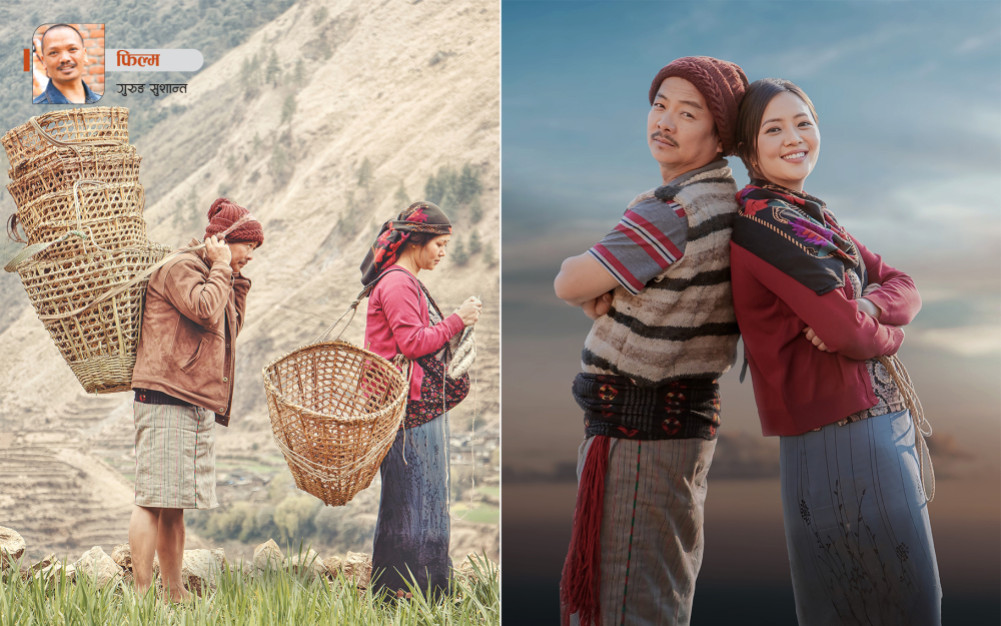
The Magar community, which wants to live a natural life in the rhythm of music, dance, alcohol, madal and their own belief system, has recently been overwhelmed by encroachments such as political alliances, foreign cultures, and Lahure influence. 'Gharzwain' tells the story of this Dosand, with historical and cultural beauty.
We use Google Cloud Translation Services. Google requires we provide the following disclaimer relating to use of this service:
This service may contain translations powered by Google. Google disclaims all warranties related to the translations, expressed or implied, including any warranties of accuracy, reliability, and any implied warranties of merchantability, fitness for a particular purpose, and noninfringement.
Lately, it seems that the general audience is slowly welcoming the beautiful development of making stories about tribal culture as the center in Nepali cinema. It would be appropriate to consider this as the beauty of cultural renaissance. The active presence of the audience in the recent cinébahas shows that the responsibility of imparting cinema-literacy to the aesthetic sense in the general public also belongs to the cultural workers who work as cinematographers.
It should not be delayed to accept that the beautiful wave of multiculturalism slowly advancing from the marginal to the mainstream is the special face of our society. On the one hand, the subtle portrayal of culture is protecting the cinema from becoming an entertainment ephemera, on the other hand, it has created a strong foundation for full optimism about our Raithane story and the future of Nepali cinema. Now, 'Gharzwaiin' stands as a bold and strong example that 'a good film is made in our story'. The first feature film directed by director Anil Budha Magar, who has won the hearts of the audience and awards at various film festivals with the short film Lomba and the documentary Agre, has presented the culture of the Magar community very sweetly.
To explain that communities have their own different and specific identities, the main character of 'Gharzwai' says in Soro class - 'We Magar community are living by the strength of collectivity. For example: When people die, when they get married, when they plant crops, when they bring in, when they build a house, they help each other and advise each other. Soro is worried that the local culture is dying after the Magar youth generation of Rukum, who are making a living by profession and skills, are going abroad with the intensity of the 'Jan Yuddh'. However, even though he is worried about belonging, he is not used to rural knowledge skills because he has fallen into a monotony after studying in the city. The Magar community, which wants to live a natural life in the rhythm of music, dance, alcohol, madal and their own belief system, has recently been affected by encroachments such as political alliances, foreign cultures, Lahure influence and Hinduization. However, this problem is not only of the Magar community, the entire tribal society is today entangled in the cultural dilemma of 'continuity and change'. 'Gharzwain' tells the story of this Dosand, with historical and cultural beauty. We have already seen
- a movie does not become strong just because the story is original, for that, the 'cinematography' that conveys it in visual language must be excellent. From this point of view, 'Gharzwai' comes out fast and true, it means that there is a dose available for cinematographers and viewers who are looking for a new language in cinema. Most of the scenes in 'Gharzwain' seem to be using tribal aesthetic cameras. Apart from the Hindu influence, the aboriginal tribal society may be holding on to the core that is basically away from the top of the 'hierarchy'. The story of a community that carries the vision of collectivity must be told, the camera's attention is more focused on the society and the environment than on a single character.
Some scenes are such that the whole society is immersed in entitlement. And, the whole society is rhythmic in Raithane culture, viewers who understand the geographical culture of West Nepal can find this movie slowly flowing in the rhythm of 'Yanimaya'. Another strong aspect of the cinema is the color of Taksera, which he played on his canvas. Cinema must have found its color from the tripartite combination of smoke, fog and raadipakhi. Any particular cinema takes on a particular color to express its language, philosophy and worldview. It seems that this color played by the cinema is the most appropriate to show the high settlements, sheep farming, agriculture and alcohol culture. Some of the views of Taksera, Lugum and Bachigaon, famous for tourism, are almost rare. The combination of sound, light, technology and music seems to be very carefully crafted. Some of the scenes are symbolic and metaphorical, so they sound specific and poetic on a semantic level. However, the focus of the camera is on portraying the characters in a smoky environment rather than showing the attractive scenes of the slums, which reveal the mood and current state of Magar culture. And, from the story of Soro-Binjuri, the aspects of love, sacrifice and rituals should be explored. From the relationship between Dan Bahadur and Binjuri, the love and traditions of father and daughter can be born. May one's love and customary psychology be drawn from the merits of memory and memory. From the qualification of Chaite-Soro, the difference and importance of becoming a Lahure and becoming a teacher within the tribal community can be shown.
directorial policy, the rhythm of the story, the beauty of the community and the angle of the camera, because of the hard work of the actors in acting, 'Gharzwaiin' has become a good movie. The ups and downs experienced by Soro's character have been very easily portrayed by artist Dayahang Rai. He has to protect his love on the one hand, family prestige, male ego, social ego of being educated and cultural ego on the other. Dayahang, who portrayed the work done by a person who has moved away from agriculture by living in the city, has given excellent performance in this film. Especially in the rural Gurung-Magar community, it is difficult to get a culturally confirmed son-in-law status, just as it is difficult to be a daughter-in-law elsewhere. In 'Gharzwain', Soro has realistically represented the sons-in-law who work for the mother-in-law. Well, not all mamas are as rough as Dan Bahadur. As Dayahang has been judging his eligibility in the cinema made on tribal culture, this is not an aspect that only certain communities appreciate and avoid. This is something that the entire Nepalese society should be proud of, so that the multicultural country can understand each other's culture and also reflect the identity of Nepaliness in the international world through cinema. Actor Miruna Magar has worked so sweetly even in Lovez to get the opportunity to act in the story of her own community that she likes to wear a garland of appreciation. The audience will remember Binjuri, a villager who is trapped in the triangle of Akolo Ba, Premi Soro, Lahure Vena Chaite. The stubborn character of Dan Bahadur is well played by Shishir Bangdel. She can be served with a walnut lovingly cosellied towards Taksera, always hard on the outside but soft inside. Raj Thapa, Buddhi Tamang, Pushkar Gurung, Kavita Ale, Sunil Magar, Khabpu, Sonam Lama and Bholaraj Sapkota have given excellent performances, while Anu Thapa, who appeared in the role of Yaman in this film, is admirable. The environment, influence and psychology of the period of 'Jan Yuddh' as presented in an artistic style by 'Gharzwai', it seems that this is the right way for cultural cinema to walk. The small aspects of the culture are shown in a subtle manner which makes the scenes of this movie more real.
Seto Tika, Titepati, Guranse Mala, method of spinning sheep's wool, songs sung while sitting and playing Madal, Dhangro used in Bonpo culture, Bhume Puja, death ritual scenes and materials have set the cinema as a cultural paradigm. This movie, under the guise of a love story, has raised topics that can be discussed such as individual and family, family and family, family and society, family and culture, culture and politics, tradition and modernity.
Love and marriage have been discussed from the perspective of community aesthetics by 'Gharzwaiin'. In the Magar community, there is a tradition of patting a handkerchief at a young age, as Mamacheli-Phupuchela marriages take place. However, questions can be raised from the perspective of human rights and violence about marriage without family consent, while sociological discussion can be done on the positive and negative aspects in many dimensions. Things to be understood - In terms of getting rights, the community usually takes care of the girl's consent, except when 'pulling', the girl herself lovingly gives signs of consent.
When the family situation is unfavorable, 'pulling' rather than running away can be considered a psychological way to win female ego. However, the community should not shy away from accepting that unprejudiced Tani marriage is a cultural injustice. Another thing - due to the lack of understanding of the cultural aspects of some tribal marriages, there are instances where the Mamacheli-Phupuchela relationship is accused of 'brother-sister' marriage. Such cultural cinema should also be made to prevent such accidents from looking at the culture of others with the glasses of one's own tradition. Some people look down on being a 'housewife'. Whereas, being a daughter-in-law and going to other people's houses is very easily practiced. The main question is - where do we stand and watch? We cannot forget the economic and political reality where the tribal women are socially a little ahead and the custom of husband-in-law is still there. The question of animal rights may arise due to the fact that wildlife hunting is shown very vividly in
'Gharzwai'. However, 'Gharzwai' gives an illustration that gives more strength to the conclusion that the tribal philosophy of water, land and forest is connected with the tribal knowledge that preserves the nature and wildlife. Dan Bahadur's ancestral gun, known as a famous hunter, did not even kill two dozen boars. Since the indigenous people have a nature-friendly knowledge of what, how much and how to use the local resources, the state should also respect the community's opinion on the legislation to be controlled by the park.
In one scene of 'Gharzwaiin', although there is some effort, it seems insignificant from the angle of thought and art. For example, during the funeral ceremony, there is a custom of not touching the dead body that is placed vertically in the pit. Even though the local folk belief that Jhankri's head remains upright even after death due to the mantra is shown, it is difficult for the audience to understand it. It may seem that it is not enough to intensify the naturalness and intimacy between the characters. However, the scenes like wood-grass, farming, mining, rakhid, mela-madal and women's volleyball, immerse the viewers from the rural background in the passion of the past. With the release of the
trailer, 'Gharzwain' was tried to be dragged into the controversy by accusing him of openly using 'obscene' words. The insistence of expressing only the positive aspects of the society makes cinema and literature one-sided and hypocritical. If we believe that the influence of cinema's visuals and language on society is correct, scenes of rape and violence may never be shown on the screen. It is regrettable that without considering the purpose of cinema, from the supposedly moral society to the censor board, it has become the embodiment of 'word-police'. It is known that Sanskrit, Hindi and English words which are considered 'obscene' are easily used in Nepali. By the way, the meaning of one word in Khas Nepali is "loose" in some tribal communities. Although some Marxists see language as separate from ideology, language becomes a tool of ideological domination in some contexts. It is said that 'obscenity is in a sense a means of maintaining male supremacy. The search for a definition of obscenity is done by the patriarchal society's own needs. Why is a word that is used carelessly in a group of men censored as soon as a woman enters? The answer is simple – our masculine social psychology wants to see women as Sati Savitri through mind, word and deed. That is, some words are forbidden as 'obscene' because the character of women is viewed as a test of sexual purity. Male-constructed paradigms and dignity take away from women's free expression and concern for appearance. It is this double standard between men and women that creates such terrible taboos on words in society. Similarly, arrows of taboos are pointed towards tribal cinema-literature like 'Gharzwai'. There is a question wrapped around the same arrow - 'Are such words easily spoken in tribal society?'
Compared to the Brahmin community, women are ahead in terms of activism, decision-making authority and family roles in tribal communities.
In tribal liberal society, the difference between men and women's character standards is reduced, so words that are considered 'obscene' in Brahmin society only mean powerful meaningful sounds that express tension and anger. Such words that women speak easily in public are called 'obscenities'.
is considered to be the normal way to destroy war without looking at it, the tribal community. To label a simple psychological style of suppression as 'obscenity' is an attack on cultural diversity. In the midst of such challenges, the courage of 'Gharzwai' should be considered a positive step, while the unnecessary scissors of the Censorboard on the film should be considered reprehensible. Director Anil Budha Magar has presented a strong example that instead of making the
culture a subject of jokes, the roots of the related culture should be assimilated to understand the community. Anil has definitely taken inspiration and influence from veteran directors and previous movies. However, simultaneously digesting those influences and keeping them within himself, he has created his own 'signature' as an attempt to break new ground in art.
- Anil himself now has to study and work hard to surpass the prowess of his son-in-law.