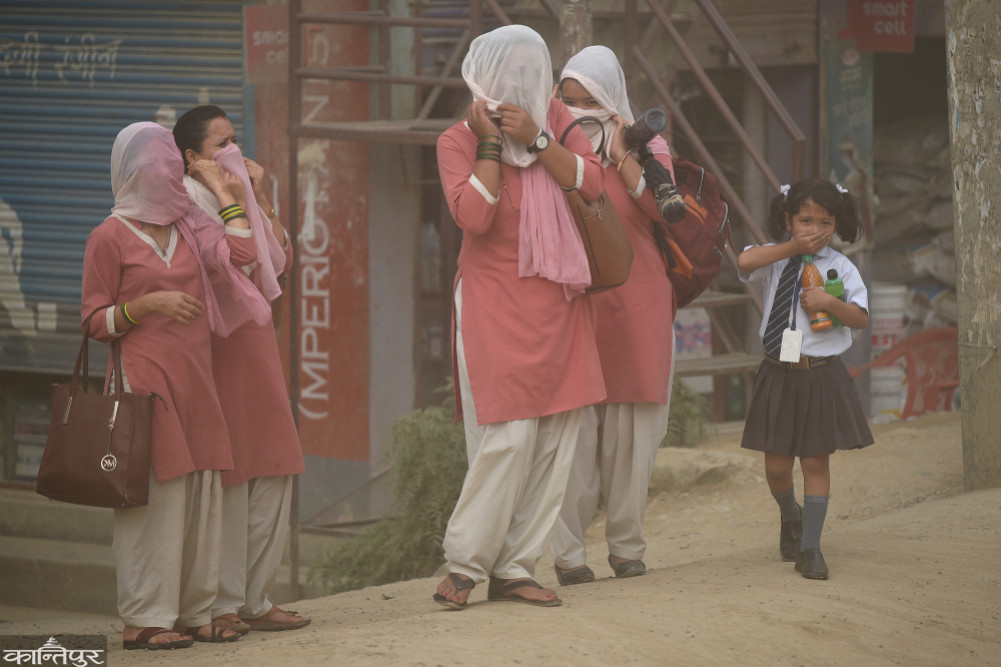
According to the 'Air Quality Life Index-2024' published last month, Nepal is the third most polluted country in the world. According to the report, 37 million Nepalis are breathing polluted air. According to the World Health Organization, air pollution is the second leading cause of human death.
We use Google Cloud Translation Services. Google requires we provide the following disclaimer relating to use of this service:
This service may contain translations powered by Google. Google disclaims all warranties related to the translations, expressed or implied, including any warranties of accuracy, reliability, and any implied warranties of merchantability, fitness for a particular purpose, and noninfringement.
The Ministry of Health at Ramshahpath, Ministry of Health, placed an artificial lung on Chait 24, 2079. In that way, the main purpose of placing artificial lungs in public places was to measure the air pollution rate, alert the regulatory bodies of the state and make the general public aware.
When it was planned to keep it for a month for testing, it turned out to be muddier than expected and its shape was unrecognizable, so the ministry removed the lung, which was kept visible to anyone walking through Ramshahpath, within 15 days.
The same artificial lung revealed the extent to which the polluted air of Kathmandu valley is affecting human lungs. Which also indicated the health problems caused by polluted air. But the regulatory bodies are still not sensitive towards that disaster. Although artificial lungs indicate a possible disaster, the state has not yet started any concrete initiative to control pollution.
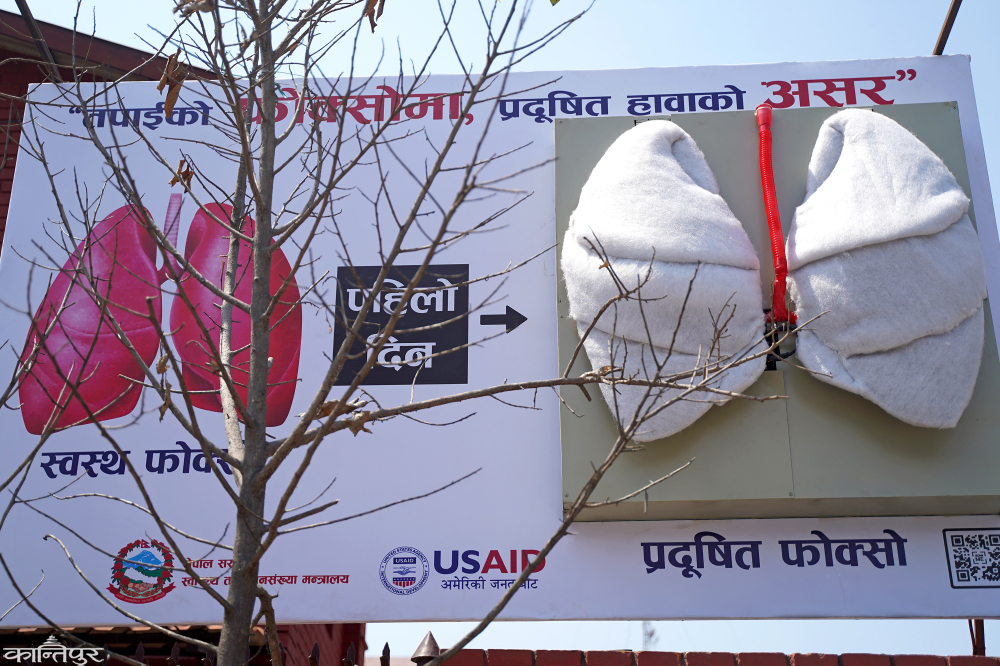
Co-spokesperson of the Ministry of Health Dr. Sameer Kumar Adhikari says, 'That artificial lung brought the dangerous situation of air pollution in the valley to everyone. That lung was placed there so that everyone could easily know the state of air pollution. But the Ministry of Health is not the only agency working for air pollution control. We have shown the condition of the same lung in the video and are still harassing all the state agencies.' He says that those who saw the infection in the artificial lung at that time could experience how terrible the effect of pollution is on human health.
That lung for awareness has been removed from there, but the government and policy makers have not learned the lesson from it, nor has the risk of pollution decreased so far. According to the 'Air Quality Life Index-2024' released last month, Nepal is the third most polluted country in the world. According to the report, 37 million Nepalis are breathing polluted air. According to the World Health Organization (WHO), air pollution is the second leading cause of human death. 99 percent of people in the world live in places with polluted air, and 8.1 million people die every year due to air pollution. 90 percent of them are from low- and middle-income countries.
Even in Nepal, about 50,000 people are dying every year due to air pollution. State of Global Air states that 19% of all deaths in Nepal are caused by air pollution. According to the Ministry of Health, 66 percent of deaths from chronic lung disease are caused by air pollution. Similarly, 34 percent of deaths from heart disease, 37 percent of deaths from stroke, and 22 percent of deaths from respiratory infections are caused by air pollution.
Right now, from the general public to the policy makers, Dr. Officials say. He says, "At present, air pollution is taken for granted by the general public to the policy makers. But actually it is very dangerous. Even if we look at the human damage caused by this, it is no less than an epidemic or a major disaster.' According to the WHO, the amount of dust particles with a diameter smaller than 2.5 micrometers per cubic meter of air should not exceed 25 per day and 10 micrograms per year. In Nepal, the air quality standard, 069, considers such dust particles to be up to 40 micrograms per day as a normal condition.
But Nepal's sky has gone far beyond this standard of pollution. Not daily, but even at the annual average rate, Nepal has come out many times ahead compared to WHO's standards. In 2023, the annual average index of Nepal reached 118 micrograms. That is why experts say that every time you breathe, you should think about air pollution control.
We may not eat for two days. Can't even drink water. But we cannot live even for a moment without breathing," said Dr. The official says, "Therefore, it is necessary for everyone to be aware of the crisis caused by air pollution and start reducing it." According to him, polluted air is twice as dangerous as smoking. Air pollution is more dangerous than smoking. It is affecting human health twice as much as smoking," he said. Heavy smokers lose 1.9 years of their life. But the polluted air is reducing the average life expectancy of Nepalese by 3.4 years.
Environmentalist Bhushan Tuladhar says that air pollution is now seen as the biggest human problem in the world. Air pollution is affecting human health as a slow poison. Now we are floundering but our situation is one of great crisis. Not only in Nepal, air pollution has been seen as the biggest human problem in the world,' he says, 'It is even considered as a new cancer.' The constitution and laws have tried to control and minimize it. Article 30 of the Constitution provides that every citizen has the right to live in a clean and hygienic environment. In the Environment Protection Act, 2076, there is a provision that no one can act against the standards.
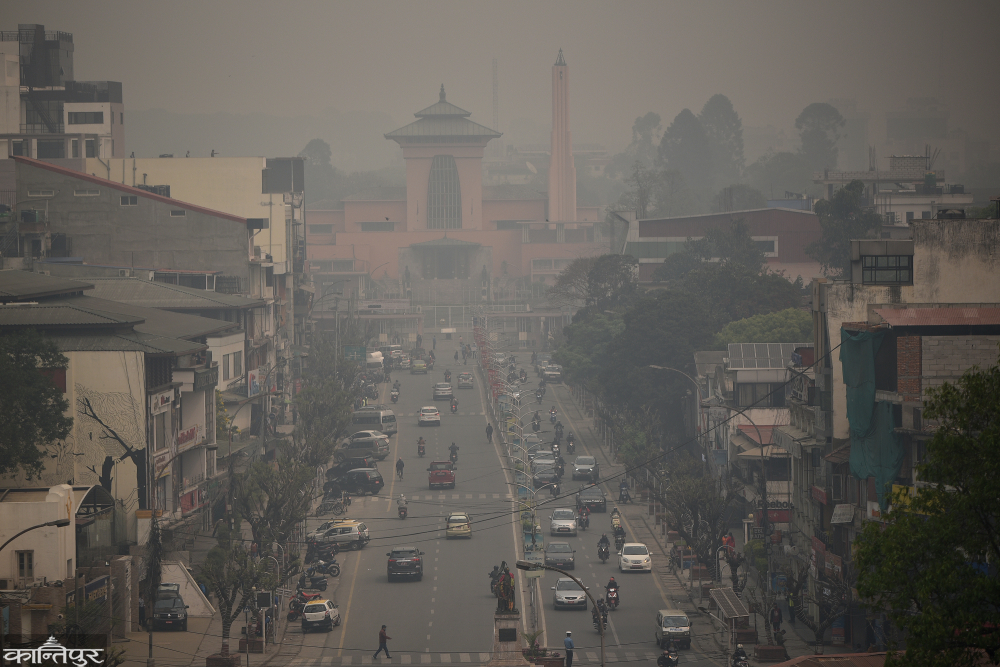
Similarly, various plans for pollution control have been put forward in the Strategic Action Plan for Environmental Sector Improvement, 2078 and the Kathmandu Valley Air Quality Management Action Plan, 2076. But the government seems to be indifferent to the effective implementation and monitoring of those legal arrangements. The mechanism for regular monitoring and action is not effective from the industries that emit polluted air to the vehicles that are operating against the standards on the road.
The Environment Department, which is directly carrying out various activities for pollution control, has been measuring air quality, spreading awareness, and monitoring whether or not the standards have been implemented. According to the department, 77 percent of the vehicles plying in Kathmandu valley emit more than standard smoke. But the government has not taken any initiative to ban those vehicles.
We measure air quality from 30 stations across the country. We regularly monitor and prepare a report and give it to the government. Deepak Gyawali, the spokesperson of the Environment Department, says that we do regular awareness activities. We reserve the right to monitor compliance with that standard. But there is no right to take action if someone does not follow the norms. We will only give suggestions after monitoring. We have been doing that on a regular basis.'' Many petitions have been filed in the Supreme Court saying that the government's initiative to control the increasing air pollution is weak. The court has been directing to take concrete initiatives for pollution control and to implement legal provisions.
The Supreme Court had ordered to create a separate mechanism for work such as regular inspection of vehicles and action against those who do not keep the city clean in order to reduce pollution. The then joint bench of Justices Deepakraj Joshi and Cholendrashamsher Jabra had ordered the government to implement the National Air Quality Standard, 069 and Nepal Vehicle Pollution Standard, 069 to prevent dust from flying on the roads.
Similarly, the court also ordered the removal of 20-year-old vehicles. But the government has not taken any effective steps as ordered by the court. However, government officials do not hesitate to make commitments. Forest and Environment Minister Ain Bahadur Shahi says that the government will prioritize necessary policy and legal efforts to improve pollution control and environmental health. Air pollution is a very sensitive issue. It is better not to treat people after they get sick,' he said, 'I am committed to take the necessary policy initiatives for that.' Dust, fumes from factories and fires are major causes of air pollution. But in Nepal, indoor smoke is still a challenge. Although the government has launched a campaign to remove smoke from the house, it has not been able to eliminate the use of firewood from the kitchens of citizens.
According to the 078 census, there are 6666 thousand 937 households in Nepal. Out of that, 51 percent of the houses are still burning firewood and 3 percent of the houses are burning wood. More than 60 percent of premature deaths worldwide in 2012 were women and children. Since then, WHO has considered indoor air pollution as a gender problem.
Indoor smoke is still the main cause of air pollution. But its effect is less than before," Dr. The official said, "Smoke inside the house is also the cause of air pollution outside." Indoor smoke is more dangerous than outdoor smoke. It goes straight to the lungs. The immediate impact is also greater.
In Nepal, air pollution is also high from diesel/petrol vehicles, brick kilns and fires. "In Nepal, the pollution from kitchens, roads and garbage continues for twelve months," says environmentalist Tuladhar, "When the fire season comes, air pollution will break records." Air pollution can be controlled if we apply control measures from the kitchen to the road.'
He says that even though they have repeatedly brought the attention of the government and stakeholders to the issue of micro-epidemic of air pollution, they have not been heard. Air pollution is difficult to control completely. But it is possible if you try to reduce it, for that it is possible if you make the kitchen smoke free. There should be a policy of the state to reduce the expansion of petrol and diesel vehicles from the road,'' he says.
He suggests that pollution can also be reduced by increasing the use of bicycles. But now the number of people using bicycles in the country is very low. "Only 3 percent of Nepalese own a four-wheeled vehicle, while 27 percent own a two-wheeled vehicle, the number of private vehicles is greater than public vehicles," says environmentalist Tuladhar, "35 percent own bicycles, but it cannot be guaranteed whether they travel by bicycle or not."
In Kathmandu Valley, 10 percent own a four-wheeler, 49 percent own a two-wheeler, and only 13 percent own a bicycle. He said that the use of bicycles and electric vehicles should be increased in the valley. "Transportation system should be changed to reduce air pollution. The government should promote walking, using bicycles, riding public transport and driving electric vehicles as a policy,' he said Children and women are most at risk from air pollution. Whether indoors or outdoors, air pollution is affecting children and women the most. Children tend to breathe faster and take in more air than their body weight. Lungs are not fully developed. The immunity of the body is also reduced. Dr. "Whether indoors or outdoors, women and children are most vulnerable to air pollution," says the official.
According to a recent survey conducted by Save the Children in Kathmandu and Saptari, 35 percent of children have experienced immediate skin problems due to air pollution, while 32 percent have experienced respiratory problems. According to the study, more than 75 percent of children do not even have basic information about how to avoid air pollution.