We use Google Cloud Translation Services. Google requires we provide the following disclaimer relating to use of this service:
This service may contain translations powered by Google. Google disclaims all warranties related to the translations, expressed or implied, including any warranties of accuracy, reliability, and any implied warranties of merchantability, fitness for a particular purpose, and noninfringement.
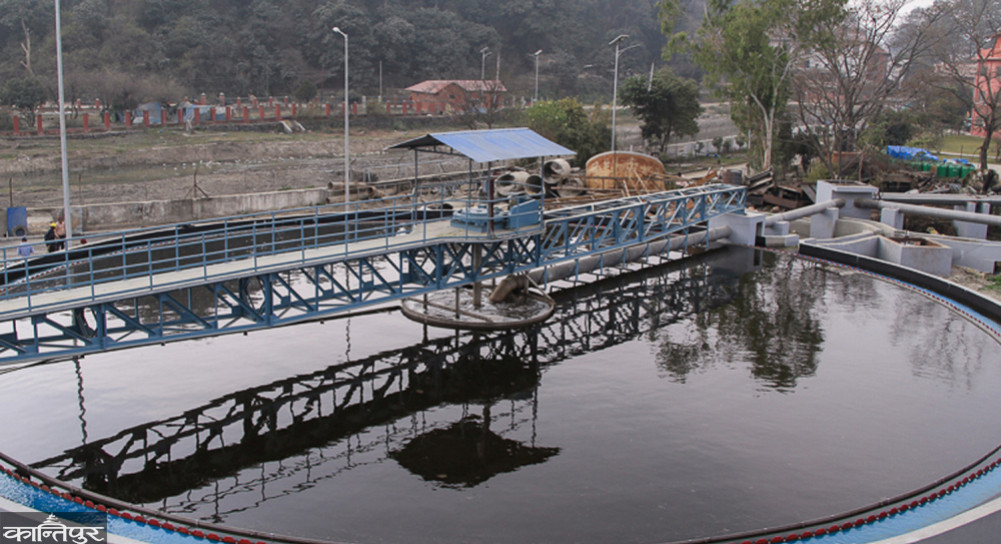
In 2017, the government started construction of waste water treatment center (treatment pond) to treat and send the clean water to the river instead of sending it directly to the river. Even after 7 years since the construction of the processing center started with the financial support of the Government of Nepal, Asian Development Bank (ADB) and OPEC Fund, only one of the proposed 6 has been put into operation.
Guhyeshwari treatment plant has been put into operation, while Dhobighat (second) wastewater treatment plant is in the testing phase, according to the Directorate of Project Implementation under Kathmandu Valley Water Supply Limited. Chandrakumar Pa Shrestha, information officer of the directorate, said that Sallaghari, Kodku and Dhobighat (first), Hanumanghat and Gokarna waste water treatment centers are under construction.
'Guhyeshwari waste water treatment plant with a capacity of 30 million liters per day has been put into operation 4 years ago,' Shrestha said, 'Dhobighat (second) treatment plant with a capacity of 37 million liters per day is in the testing stage.' Shrestha said that although 30.24 million liters of waste water is treated per day, only 20 million liters are being treated now.
He says that the waste water emitted by about 2 lakh people in Buddh and Jorpati area is being treated and sent to Wagmati. It is estimated that 80 percent of what a person consumes through various means is excreted as waste water. Shrestha said that even though the waste water treatment center is operating with a limited capacity, due to the lack of sewage system in all places, some sewage from Buddh and Jorpati areas is still flowing directly into the river. "The water of Guhyeshwari should not be clean, the water flowing from all the tributaries should be clean," Shrestha said. At the Guhyeshwari Centre, waste water brought through pipes from Gothatar, Jorpati and Buddh areas on the upper banks of the Wagmati River is transferred to the center and treated.
Considering the historical, religious and cultural importance of Guhyeshwari and Pashupati areas, the directorate said that despite trying to keep the quality of treated water high, the delay in construction of other treatment centers was not effective. The directorate informed that only after maintaining the prescribed quality by measuring the indicators of the quality of the water discharged from the treatment center, the treated water will be mixed with the Wagmati River.
It was expected that the flow of treated water to Bagmati would improve the riverine environment of the lower coastal area, but it has not been effective. An odor abatement unit attached to the treatment plant destroys odors generated during wastewater treatment. "Plastic and solid objects are still being dumped in Mars, streams, and rivers," Shrestha said, "There should be a change in human behavior, it is necessary to increase the level of awareness. We build a house, connect the sewage to the river. That is wrong. He said that the solid waste coming to the Guhyeshwari processing center also includes dead dogs, cats and helmets.
Kathmandu Valley Wastewater Management Project was started in 2013 with the mobilization of financial resources from Nepal Government, Asian Development Bank and OPEC Fund. 4 years after the start of the project, the construction work is equally slow as the contract for the construction of the processing plant has been awarded. Although 27 percent of the processing plants at Sallaghari, Kodku and Dhobighat (1st) have been completed, the directorate has terminated the contract and awarded it to VITech Wabag (India). Information Officer Shrestha said that the company that got the contract for the construction of Sallaghari, Kodku and Dhobighat (first) processing center costing about 6 billion rupees is currently reviewing the design.
Before the Indian company got the contract, an agreement was made with the Chinese company 'Safbone Water Service' at a cost of about 4 billion rupees to start work from 074 Baisakh. Although the contract with the Chinese company entrusted with the construction of three processing centers was concluded in October 2016, the construction was not completed. Meanwhile, Shrestha says that the company has not been able to work due to the Covid epidemic.
The directorate said that the contractor company that returned to Nepal after the end of the corona epidemic broke the contract with the Chinese company in 080 Baisakh after it could not work according to the plan. The directorate called for contracts again in June 2008, and an agreement has been signed with India's Vietek Wabag Company in June 2024 for the construction of three processing plants. The directorate said that 27 percent of the physical progress has already been made, including the review of the design of the three processing centers.
"The old Chinese company did work worth 88 million rupees, of which 341,000 dollars have yet to be paid," Shrestha said, "We have suffered a loss in the said contract." Therefore, the PID is ready to claim 19.5 million dollars. According to the
directorate, waste water treatment plants with a capacity of 1 million liters per day in Hanumanghat and 3 million liters in Gokarna are under construction. About 72 crores in the partnership of the Chinese construction company called "TIMS" and the Nepali company BCPL.
Hanumanghat and Gokarna waste water treatment plant is being constructed at a cost of Rs. The directorate said that the design work of these two waste water treatment centers is in the final stage. In the campaign to make the rivers flowing through the valley sewer-free, a treatment center for waste water or contaminated water is going to be constructed.
After these centers are built, Shrestha says that the sewage will not be mixed directly into the river or the river, but only after processing, clean water will be mixed into the river.
is working on laying sewage pipes for sewage collection on both sides of the river and the river for the processing plant itself. The Directorate is constructing Interceptor Sewerage System on Hanumante and Manohara River banks. The directorate also informed that the construction of interceptor sewerage system of 10 km in Hunmante and 3 km in Manohara has been stopped due to internal disputes of the municipalities. The government plans to connect the waste water to the integrated sewerage system to reach the treatment plant. The sewage will be transported to the treatment plant and treated in various stages. In that process, bio gas will also be produced. There is a plan to generate electricity using the said gas. 300 kilowatts of electricity is consumed in Guhyeshwari waste water treatment plant.
Shrestha says that the pending treatment plant is not enough to clean the river flowing through the valley. In addition to the under construction, the directorate is preparing to build additional waste water treatment plants with a capacity of 17 million liters in Guhyeshwari, 17 million liters in Kodku and 203 million liters in Dhobighat. According to the directorate, it will cost 11 billion rupees for the construction of processing centers with a total capacity of 140 million liters including 17 million liters in Guhyeshwari, 175 million liters in Kodku and 203 million liters in Dhobighat.
According to directorate's information officer and project deputy director Shrestha, the goal is to build a processing center with a capacity of 500 million liters by 2050. He argues that 60 decentralized waste water treatment centers should be built in Tukucha, Mahadev Khola, Bishnumati and other small rivers of the valley that flow into Wagmati to make the valley clean and pollution-free.