We use Google Cloud Translation Services. Google requires we provide the following disclaimer relating to use of this service:
This service may contain translations powered by Google. Google disclaims all warranties related to the translations, expressed or implied, including any warranties of accuracy, reliability, and any implied warranties of merchantability, fitness for a particular purpose, and noninfringement.
In the Himalayan districts of the east, until a decade ago, the Yak and Chaunri families were considered to be the home. Cattle breeders tried their best to create a fence. Across the border, breeders from China's Tibet and India's Sikkim also used to keep an eye on Nepalese cattle for breed improvement. The price of chaunri in Nepal used to increase every year. That price was raised not by the Nepali sellers but by the cattle breeders of the neighboring countries who bought it and took away their livelihood.
Times have changed in such a way that now most of the yaks and chaunripalaks of Taplejung are worried about selling the chaunri and yak to make a small herd. Farmers are forced to feed salt and chaff to the cattle full of khark.
Tiptala Bhanjyang of Taplejung, which was closed due to corona infection, Kimathanka Naka of Sankhuwasabha was opened from 11th May 2081 . However, since the four-wheeled transport has not been opened through the border, the yaks and chaunripalaks have been hit the hardest.
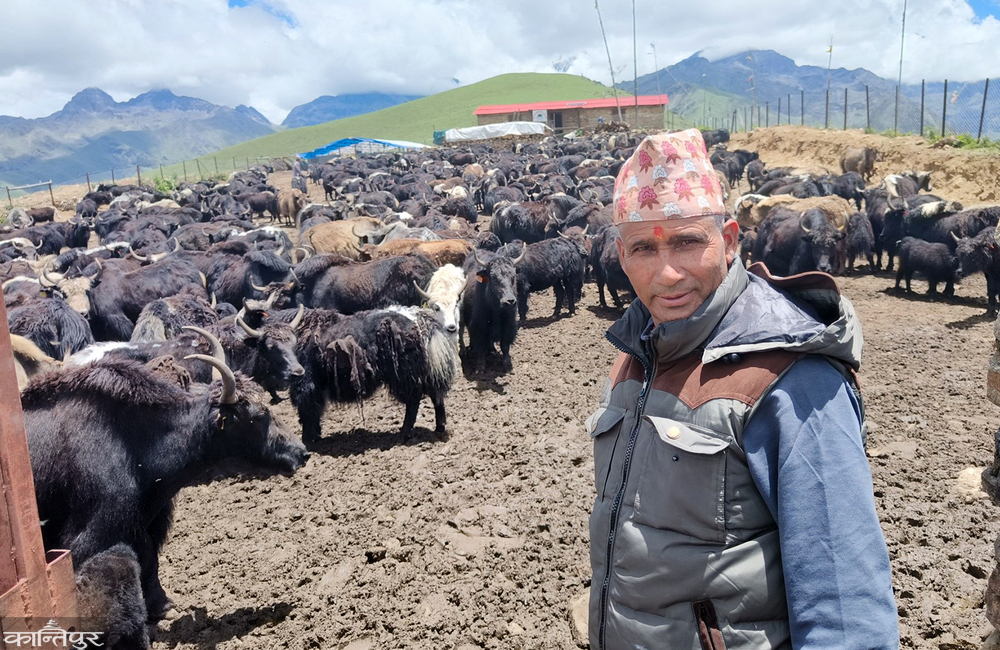
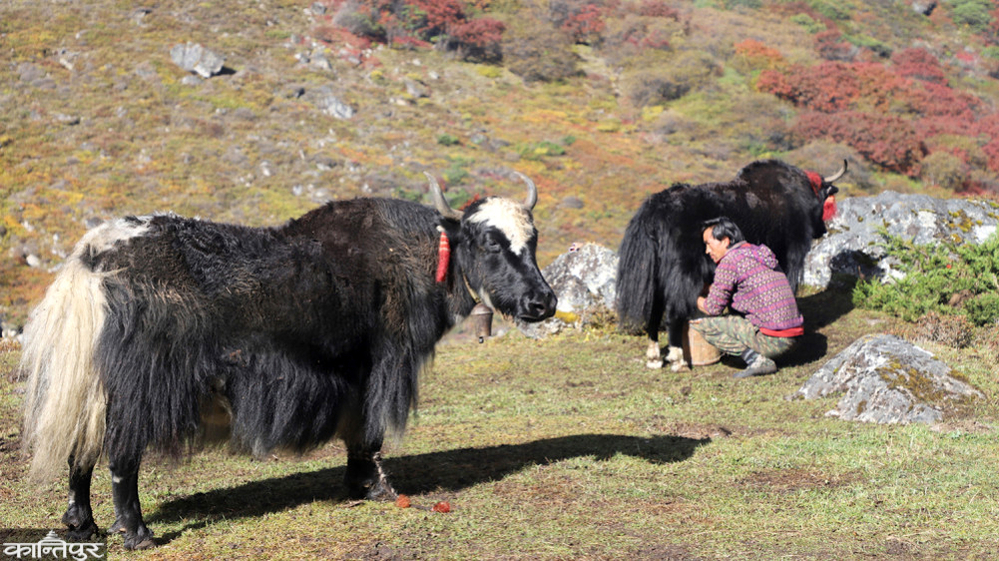
The longest impact of corona infection in China has been on chaunri and yak business farmers raised in the Himalayas. Nupu Sherpa, President of Chaunri, Yak Farmers' Federation, Taplejung, says that the impact was unimaginable. Now there are 95 quadrupeds in Nupu's cage, which can raise a maximum of 60 in terms of its own cage and maintenance. He has reared 80 yaks and 15 chaunri .
Chounri are bred for carrying heavy loads. The objective is to grow yaks and sell them. But now the use of both is less . With the expansion of transportation, even long-distance heavy goods are not found. The Chinese market for sales is at a standstill .
Nupu, who continued the business done by Babubaje, has not been able to exchange Su's money for four years. 25 to 30 cubs are added every year . 15 to 20 die a year. "Some die from the attack of wild animals, some die of old age or some disease," said Nupu, "I don't know what the future will be from animal husbandry." But they have not been able to act accordingly.
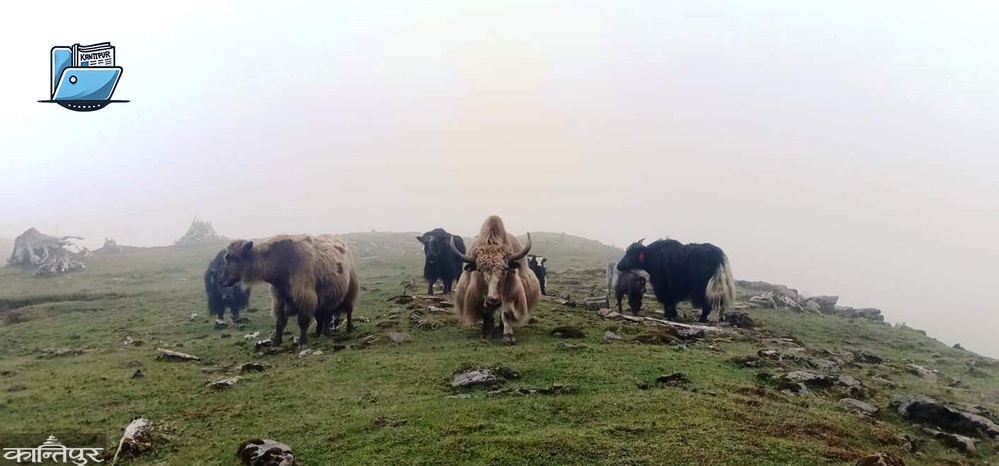
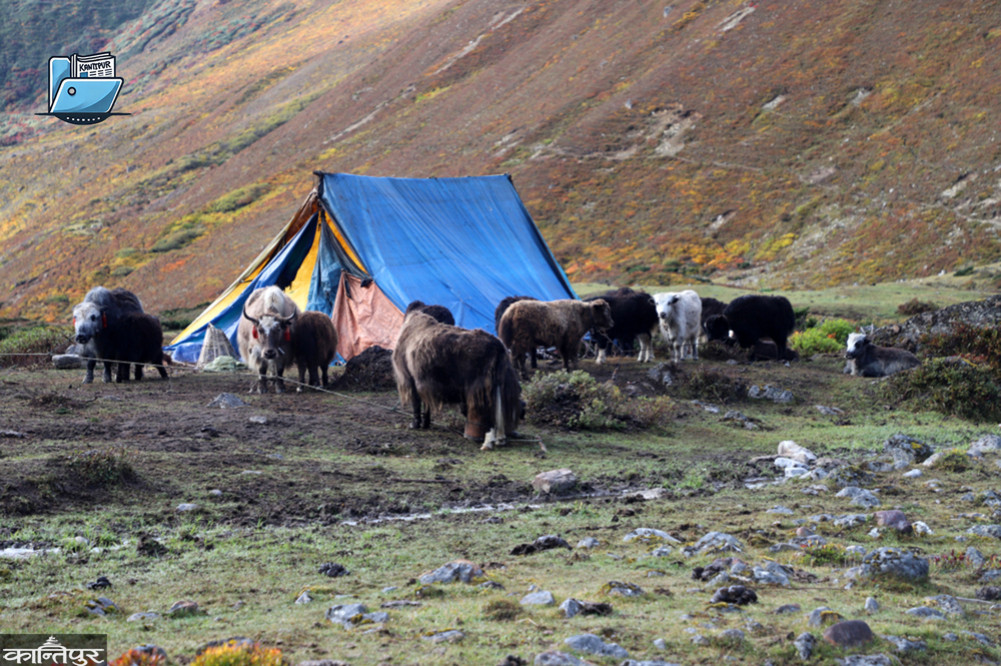
The Chinese border crossing which was closed due to the corona infection has been opened, but the ban on the sale of four-legged animals has not been lifted. The Nepali farmers who plow towards Aul in November/Pus during the snowy season and reach the border with China from Tiptala Bhanjang, Mouwatar from March/May to August/August say that they have to keep moving around on these crops . Farmers who carry snow, rain, and landslides to one hill after another have to pay 25 to 60 thousand annually to buy a loan. Nike Chungdak Sherpa of Mikwakhola-5 Papung complains that he is not able to sell even though he has 250 four feet. Last year, he lost 67 yaks, chaunri and calves to Lumpy Skin infection . Now the problem of disease is not seen but the problem of sales is the same .
Such a problem is not only in Taplejung, but the farmers in the northern Taplejung, Panchthar, Sankhuwasabha, Solukhumbu, Tehrithum. Taplejung, the confluence of Tehrithum and Sankhuwasabha at Guphapokhari, Tamm Chaunri, farmers who collect yaks are facing the problem of Harpal market . Nupu said, "Everyone is waiting for when the Chinese market will open". Since it is not sold, it is less possible to feed the cattle.' The cattle reared in the Himalayan and hilly districts such as Taplejung, Panchthar, Ilam, Tehrithum, Sankhuwasabha, Solukhumbu and others were bought and sold in Tibet and Sikkim in India. The import and export of chaunri and yak, which are raised in Tibet, Nepal, and Sikkim in India, used to be double. As the money of that country is big and the population is large, Nepali farmers used to earn good cash by breeding and selling in neighboring countries.
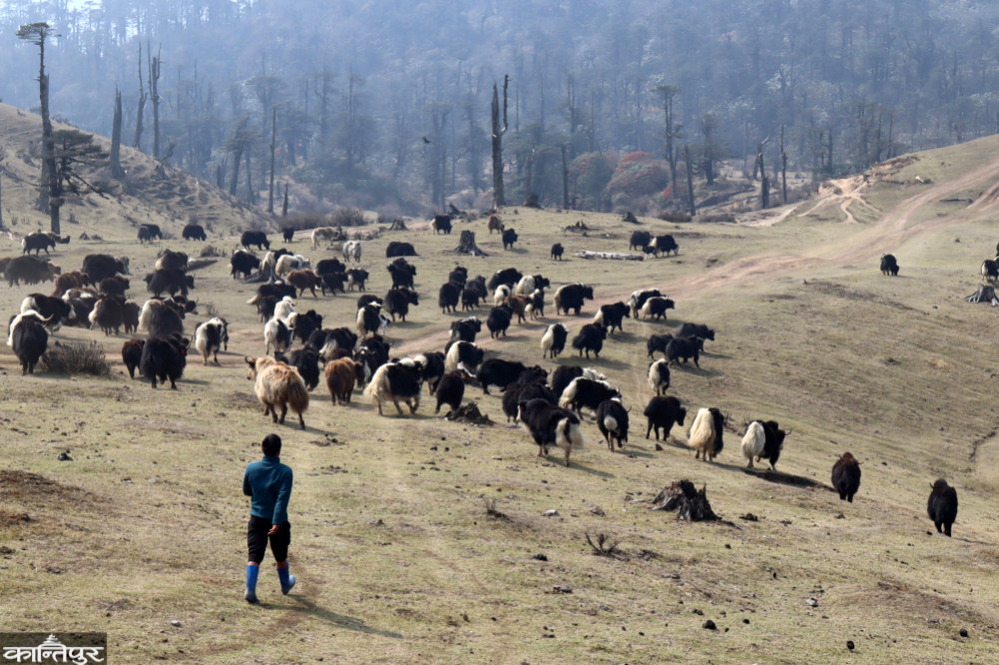
According to the data of Taplejung Animal Services Office, there are more than 8000 salable chaunri, yak in the district. Most of them are reared in the barns of Mikwakhola rural municipality-5 Papung and Ward-4 Sanwa. There is a figure of 3500 in this municipality. After that, more than 2500 have been reared in Paktanglung Rural Municipality. In Meringden, Maiwakhola, Sidingwa and Sirijanga Rural Municipality, farmers are also moving the cowshed. There are also two barns in Fungling Municipality. Nupu says that China's market is open and 5,000 square meters are ready to be sold immediately. China has been buying the yak and chawri breed for milk and meat. According to Yak, Chaunri Farmers' Federation, 180 farming families in the district are fully engaged in this profession. The number of families raising four/five to eight/ten children is more than three hundred . The obstacle in exporting to China is now the common problem of all farmers.
Cheten Sherpa Lama, the ward president of Paktanglung-7 Olangchungola, which is connected to the border with China, says that it was found that China had thought of taking them only by placing them under quarantine. "When we ask about Dingje county, they say it is the direction of the center," said the ward president Chheten, "No cattle has left even at any border with Nepal, the federal government should adopt it and initiate it." "I raised it as an agenda subject under agricultural produce, the Chinese replied that they would take it there because the Chinese had blocked all the crossings." Chheten says that there will be a lack of feed when the cattle grows and the farmers who run it will have no money. "We people's representatives are also under pressure, but what can we do?," said Sherpa.
 Based on the market value of China and the current number of yaks, yaks in Taplejung's expenses of one billion more than the data of the yaks, Chaunri Farmers' Federation has shown . Animal Services Office is of the opinion that if 60 percent of sales are made for the time being, the enthusiasm of the farmers will increase and further promotion can be done by raising baby chicks.
Chotragaon, who is rearing attractive cows in Jumla
Jumla Guthichour rural municipality-1 Sangbu Gurung of Chotra village is a shepherd of 90 cows. He sells 30 to 35 chaunris every three years. He has also made ghee and Churpi and sold it from Chaunri's milk. "There is no other source of income for us," he said, "We have not abandoned the farming that our ancestors have been doing." According to him, traders from Manang and China come to the village to buy yaks. He said that yaks are bought and sold up to 50 thousand rupees and chaunri up to 65 thousand rupees. Buying and selling is also done in Chaunri village. There are 115 chaunris in the barn of Tondul Gurung of Chotra. When he takes it from the house to graze, the attractive shape of the chaunri is visible. Tondul said, "Our livelihood is also chounri". The cost of children's education, medicine treatment and going on pilgrimage is being done from chaunri.' They have taken Chaunri to the base camp of Ghat, Akashetal, Indkhola, Chindab, Agulte, Vyaulipatan, Bharbarre, Patarasi Himal for grazing. Khursa Dala in Barkha, Nigali Jhar to Buki Patan in winter is considered a suitable place for chaunri to graze. Now efforts are being made to develop Chotra village as a chaunri pocket area . Just a week ago, Animal Hospital and Animal Services Office Jumla has distributed 40 boxes to the local farmers . Gyanendrasingh Budthapa, head of Animal Hospital and Animal Services Office Jumla, informed that the animals were given animals because of the farmers' attraction towards animal husbandry. 37 chaunris and 3 yaks have been given. He said that by purchasing yaks at the rate of 70,000 rupees and 85,000 rupees for chaunri, a total investment of 30 lakh rupees was made to the farmers. Chotra village is very attractive. Farmers have awareness. The future of the village is also bright with commercial chaunri rearing,' Chief Budthapa said, 'We have been providing chaunri to the farmers for two years to increase the courage of the farmers.' 15 lakh rupees are invested by animal services office and 15 lakh rupees by farmers' groups. Last year also 20 chaunris were given in this village . Farmers are excited after the addition of chaunri every year . Ward president Arjun Kumar Mahtara said that efforts are being made to develop Chaunri as a resource center. He said, "The farmers of this village are dependent on chaunri farming". With the hard work of the farmers, desirable chauri breeding is being done. According to the ward president Mahatara, more than 1,600 chauri have been reared in Chotra village. District Coordinating Committee Chief Gaurinanda Acharya said that efforts will be made to promote Chotra as a resource center as farmers' livelihood is being improved by increasing chaunri farming. She Phoksundo of Dolpa, Tripura Sundari, the center of attraction of every tourist who comes to Jumla is being guarded.