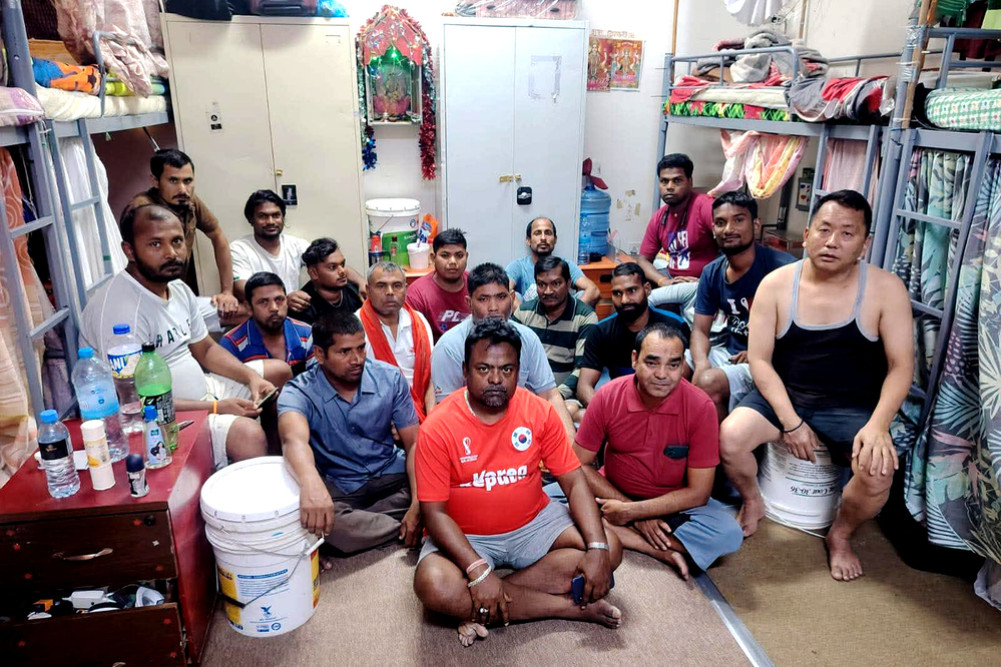
85 foreign workers, including 36 Nepalis, have not gone to work demanding their salaries. The affected workers say, 'We don't have money to eat. We are eating by borrowing from friends.'
We use Google Cloud Translation Services. Google requires we provide the following disclaimer relating to use of this service:
This service may contain translations powered by Google. Google disclaims all warranties related to the translations, expressed or implied, including any warranties of accuracy, reliability, and any implied warranties of merchantability, fitness for a particular purpose, and noninfringement.
36 Nepali workers in Qatar have not received at least 25 million rupees in salary for 8 months. They are going from the Nepali embassy to the local labor office for their salary.
They have said that the sole-owned Qatari company Intertektra Qatar WLL has not paid them salaries, allowances, overtime, gratuities and food for 8 months. 85 foreign workers, including 36 Nepalis working in that company, have not gone to work demanding their salaries.
Ramdayal Ray of Siraha, who has been working in Intertektra for 7 years, said that he has requested the Nepali Embassy and the Ministry of Youth, Labor and Employment to take the initiative for his salary. 'Our company is owed 15,000 to 40,000 riyals in salary and service benefits. 8 months of salary is due. "We have not been paid 10 months of food money and overtime pay for two years," he said. "We have filed a complaint with the labor office after calculating everything. The final hearing has not been held."
According to him, the local authorities have not ensured that all workers receive their salaries on time. "Initially, the amount we will receive is 540,000 riyals. It could be more than this," he said.
Another worker working with him, Mr. Khatwe, said that the company had not paid regular salaries at intervals of two to three months for eight months. "Even when the company did not pay regular salaries, work never stopped. It was always going on. After paying one month's salary, the company started making us wait for another two months." They started avoiding it by saying that the rest of the salary would come from the site,' he said, 'and in the same way, after paying for food once, they started not paying .'
The sites they work on are very prestigious projects in Qatar . 'We have worked on government projects in Lusail, Raslafan and Doha . Even when we worked on government projects, we did not get paid,' he said .
The Nepali Embassy in Doha had called the company officials for a discussion . The company officials had informed that they would be able to pay the salary after working for two months . The workers had asked for a written commitment as the company had been lying . The company did not give a written commitment .
'We had approached the police for the first time after not receiving our salary . The company had asked the police for two months . We had continued to work after the police asked us to work for two months . Even after two months and five days, the salary was not received from the company,' said Shyam Teli, 'Then we went to the police. The police told us to go home if we did not get the salary. Then we went to the embassy.'
They have now reached the labor office in Sanaiya, Qatar. If the Sanaiya labor office fails to resolve the issue, preparations are being made to go to the high court. 'We do not have money to eat here. We are eating by borrowing money from friends. Now the NRNA is providing food,' said Rai, 'There is no question of leaving the salary alone. For so many months, the family in Nepal has been living on debt. As soon as we go home, the moneylender comes to the courtyard. How can they return the money? In this heat, it is not right to leave the money of hard work just like that.’
The embassy has suggested that they go home with a power of attorney to fight the case. ‘They are saying to give them a power of attorney if they want to fight the case. There is an option to change to another company,’ he said, ‘We are thinking about it.’
Qatar had implemented the Wage Protection System (WPS) a decade ago, requiring employers to make mandatory payments to workers through banks. However, international human rights organizations are regularly raising questions about its ineffectiveness.
Migrant workers are not being protected when government agencies themselves do not pay contract amounts on time: Human Rights Watch According to a recent report by Human Rights Watch, migrant workers are not receiving their salaries when Qatari government-related agencies and other large businesses do not pay project contractors on time. “Clients at the top of Qatar’s contract supply chain, including government agencies, often enjoy impunity, with the burden borne by subcontractors who employ migrant workers,” said Michael Page, deputy director of the watch, in a public press release last December. “Qatari authorities have failed to protect migrant workers on two fronts. First, by failing to pay them on time as clients themselves, and second, by failing to act as effective regulators.” According to
Page, much-publicized wage protection systems and systems such as wage support and insurance funds have not been effective in preventing and resolving wage arrears.
Watch has previously documented that “pay-as-you-go” contracts contribute to wage theft. The organization says Qatar should extend its wage obligations beyond direct employers in the labor supply chain.
Qatari authorities should hold large companies accountable for labor abuses committed by subcontractors and labor supply companies, Human Rights Watch said. “All businesses must ensure worker protections throughout their operations and supply chains,” Page said.