The promoter says, ”By the time a project reaches from survey license and study to PPA, an average of 5 to 6 million per megawatt has already been spent, so let's not put investors in uncertainty.”
We use Google Cloud Translation Services. Google requires we provide the following disclaimer relating to use of this service:
This service may contain translations powered by Google. Google disclaims all warranties related to the translations, expressed or implied, including any warranties of accuracy, reliability, and any implied warranties of merchantability, fitness for a particular purpose, and noninfringement.
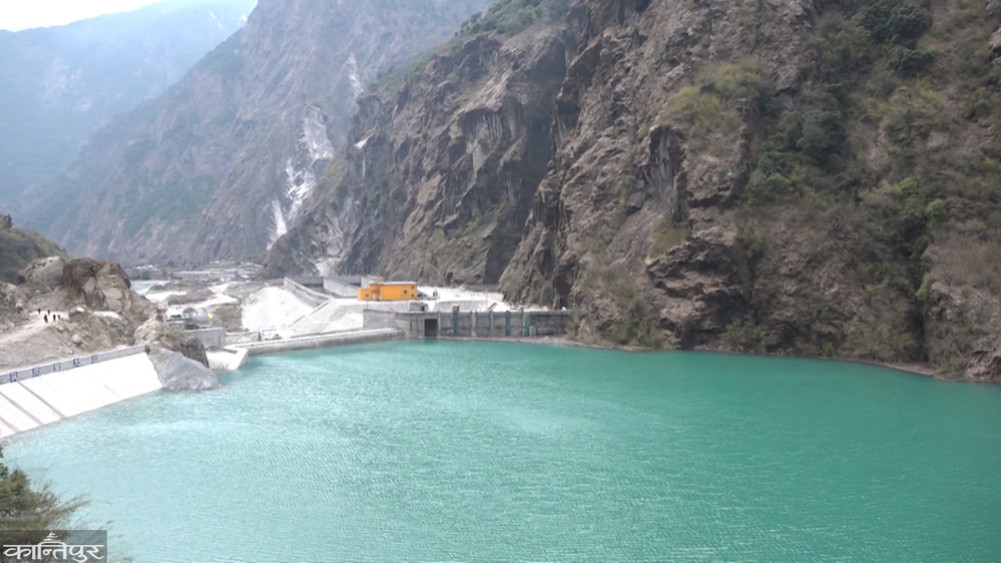
Approximately 16,500 megawatts of capacity from 281 hydropower projects are awaiting Power Purchase Agreements (PPA) with the Nepal Electricity Authority. Energy promoters claim that by the time a project reaches the PPA stage, after obtaining survey permits and conducting studies, an investment of 5 to 6 million rupees per megawatt has already been made. Therefore, they argue, investors should not be left in uncertainty in this way.
Even after a PPA is signed, it takes a minimum of five years to build a hydropower project. Stakeholders warn that if PPAs continue to be stalled, it could lead to a long-term energy crisis.
According to the Authority, as of mid-Asar last year, among those awaiting PPA after completing grid connection agreements, there are 102 run-of-river projects with a combined capacity of 2,556.30 megawatts, 31 semi-reservoir projects with 5,276.30 megawatts, and two reservoir projects with a total capacity of 1,491 megawatts. Among those who have applied for PPA, there are 122 run-of-river projects with a combined capacity of 1,874.88 megawatts, and 19 semi-reservoir projects with a capacity of 1,548.29 megawatts. Similarly, there are five reservoir projects with a total capacity of 3,679 megawatts. In total, projects with a combined capacity of 16,425.77 megawatts are waiting for PPA.
Citing low electricity consumption, lack of transmission infrastructure, and absence of markets for sales, the government has been delaying PPAs since 2079, even though promoters have applied. While PPAs for projects up to 10 megawatts used to be done automatically, this has not happened since the last fiscal year.
After the last fiscal year’s budget introduced the ‘take and pay’ concept for run-of-river (ROR) projects, PPAs for such projects were halted. This fiscal year’s budget announced that PPAs for projects under 10 megawatts would be done immediately, but this has not yet been implemented.
According to a study by the Independent Power Producers’ Association of Nepal (IPPAN), 1.31 trillion rupees have already been invested in 923 hydropower projects at various stages, from those in operation to those with survey and construction permits. Therefore, outgoing IPPAN president Ganesh Karki says the government should ensure the security of private sector investment and open up electricity trade to the private sector.
“Last year’s budget closed PPAs for projects under 10 megawatts. This year’s budget opened it, but it has not been implemented yet,” Karki said. Acting Managing Director of the Authority, Dirghayu Kumar Shrestha, stated that a study committee has already been formed by the board of directors to open PPAs for projects under 10 megawatts, and a decision will be made based on its report.
When Rajendra Lingden was Energy Minister, the Cabinet meeting of 24 Asar 2079 reviewed the share of ROR hydropower projects, increasing it from 30–35 percent to 40–45 percent. At that time, the Authority’s board decided to do PPAs for up to 1,500 megawatts of ROR projects based on the order of grid connection agreements. Subsequently, on 24 Magh 2080, during the tenure of then Energy Minister Shakti Bahadur Basnet, it was decided to do PPAs for any capacity of ROR and semi-reservoir projects up to 10 megawatts at any time. However, PPAs have not been done yet.
The Authority has a monopoly on electricity purchase and sale. It is the only entity conducting PPAs. The Authority is currently doing PPAs at the rate of 8 rupees 40 paisa per unit for the dry season (16 Mangsir to 15 Jestha) and 4 rupees 80 paisa per unit for the wet season (16 Jestha to 15 Mangsir). PPAs are done to ensure the purchase of produced electricity, provide financial security to investors, facilitate obtaining loans from banks, and ensure long-term electricity supply in the country. After this, banks and financial institutions invest in hydropower projects.
Before signing a PPA, the Authority evaluates whether the national electricity system needs more power, whether there are sufficient transmission lines and substations to connect the project to the national grid, the prospects for domestic consumption or export of the electricity produced in the future, and how much long-term financial liability the new PPA will add to the institution. The Authority has already signed PPAs for 404 run-of-river projects with a total capacity of 6,713.44 megawatts, 51 semi-reservoir projects with 4,186.81 megawatts, and one reservoir project with 140 megawatts.
In the country, electricity production is higher during the wet season and lower during the dry season. If there is no assured market for wet season electricity, the Authority faces significant financial risk. Since PPAs are done on a take-or-pay basis, once electricity production starts, the Authority must pay the promoter whether or not it purchases the electricity.
On one hand, the government needs to increase the proportion of the generation mix to do PPAs. Stakeholders say the Authority must also be capable of building transmission infrastructure at project sites and bearing the investment and financial risks. Balancing increasing electricity production, expanding domestic consumption, and the potential for export, the issue of new PPAs is seen as a major policy decision in the energy sector.
In the Kantipur Fireside program broadcast last Asar, Energy Minister Biraj Bhakta Shrestha had already said that PPAs would be opened soon. He has also formed a committee to study project permits and PPAs. Although the committee has submitted its report, no further decision has been made.
Since Baisakh, Minister Shrestha has instructed the Department of Electricity Development not to issue survey licenses for hydropower, solar, and other projects. Since then, no new survey licenses have been issued, but the department continues to accept applications. According to the department, 257 projects with a combined capacity of 12,330.68 megawatts have applied for survey licenses, and 46 projects with 8,731 megawatts have applied for generation permits. The department’s website states that 257 projects with a total capacity of 12,321 megawatts have already obtained survey licenses. Additionally, 360 projects with a combined capacity of 7,336.69 megawatts have already obtained generation permits.
On one hand, due to lack of trade according to production during the wet season and insufficient consumption, electricity is wasted every year. Even after 4,300 megawatts are connected to the national grid, promoters say that over 900 megawatts of electricity is wasted during the wet season. However, the Authority does not like to acknowledge this. The capacity of electricity connected to the national transmission line is also increasing every year. Although export permits have been obtained for 1,200 megawatts from 37 projects to India and Bangladesh, the Authority says that on average, only 1,000 megawatts are being exported.
According to the Authority, in fiscal year 2082/83 alone, 560.99 megawatts (about 561 megawatts) of electricity from 25 hydropower and solar projects were added to the national system. In fiscal year 2081/82, 434 megawatts were added. Most of the electricity added to the national system last fiscal year came from run-of-river projects.
The government had set a target of connecting 942 megawatts to the national system last year, but due to transmission line problems and delays in project construction, the projects could not be brought into operation on time, according to the Authority. Last year, 102 megawatts from the Middle Bhotekoshi Hydropower Project, promoted by the Authority’s subsidiary company, were connected to the national transmission line.
The project began electricity production nearly 14 years after construction started. The budget states that 1,040 megawatts will be added to the system in the current fiscal year. Since most projects connected to the national system are run-of-river, electricity production is high during the wet season, and there is a need to import in the dry season. However, imports are decreasing compared to exports. Last fiscal year, electricity worth 29.32 billion rupees was exported, while only 10.22 billion rupees worth was imported.
Although not as expected, there was a 10.74 percent increase in 2081/82. Stakeholders say that produced electricity should be consumed domestically as much as possible before exporting. Industrialists have also complained about not receiving quality electricity. Birendra Raj Pandey, president of the Confederation of Nepalese Industries, told Kantipur that Nepal should consume electricity domestically and export the surplus.
“Electricity is a raw material. If Nepal can consume electricity, it can add value, reduce imports, and there are many benefits,” he said. Pandey noted that due to transmission and distribution infrastructure, there are quality issues such as frequent tripping in industrial corridors. “Fifty to sixty percent of industries still have to use generators,” he said. “The government should invest in infrastructure and, as much as possible, electricity should be consumed domestically rather than selling it as a raw material.”
The industrial sector is not receiving quality electricity. The Authority has not opened PPAs either. In this situation, energy entrepreneurs claim that it is essential to allow the private sector to trade electricity. Since investments have already been made at various stages from survey licenses to studies, IPPAN Senior Vice President Uttam Bhlon Lama emphasizes that if the Authority does not do PPAs, the private sector should be allowed to trade electricity. “The Authority cannot refuse both to do PPAs and to allow trade,” Lama said. “The private sector must be allowed to trade.”
Only then, Lama says, will the burden of PPAs shift from the Authority to the private sector. He said the government should open the market to increase consumption and focus on transmission and distribution infrastructure. Currently, 1,000 megawatts are being imported and exported through the 400 kV Dhalkebar–Muzaffarpur line and other 132 kV transmission lines.
Nepal and India have agreed to increase import capacity to 1,400 megawatts and export capacity to 1,650 megawatts through the Dhalkebar–Muzaffarpur and under-construction Dhalkebar–Sitamarhi 400 kV transmission lines. An agreement has also been reached to import up to 130 megawatts and export up to 200 megawatts in the initial phase through the under-construction New Butwal–Gorakhpur cross-border transmission line. The construction process for the Inaruwa–New Purnia and Dododhara (New Lamki)–Bareilly 400 kV cross-border transmission lines is said to be accelerating.
While cross-border transmission line construction is being expedited, the Authority must also focus on building internal transmission lines. In 2012, construction began on the 288-kilometer transmission line from the Thanabaryang substation in Hetauda to the Inaruwa substation, divided into two sections.
Of the Hetauda–Dhalkebar (134 km) and Dhalkebar–Inaruwa (154 km) sections, the Dhalkebar–Inaruwa section has been completed and is now charged. However, the Hetauda–Dhalkebar section has not been completed on time due to various obstacles. Once the Hetauda–Dhalkebar section is built, it is expected to further strengthen the country’s internal electricity supply, increase reliability, and make a significant contribution to expanding trade with neighboring countries.
According to an IPPAN study, 1.243 trillion rupees have been invested in 347 projects with a combined capacity of 7,251 megawatts that are either operational or under construction. Similarly, 66.62 billion rupees have already been invested in 576 projects with a combined capacity of 27,535 megawatts that are in the development phase, including those applying for survey, study, design, and construction permits.