Buddha Air claims to be a game changer for Pokhara flights.
We use Google Cloud Translation Services. Google requires we provide the following disclaimer relating to use of this service:
This service may contain translations powered by Google. Google disclaims all warranties related to the translations, expressed or implied, including any warranties of accuracy, reliability, and any implied warranties of merchantability, fitness for a particular purpose, and noninfringement.
Based on accessibility to domestic flights and the number of daily flights, Buddha Air, the country’s leading airline, has added a new-generation, state-of-the-art ATR 72-600 series aircraft to its fleet, marking the beginning of a new technological chapter in Nepal’s aviation sector.
The aircraft, bearing the call sign ‘9N-AOS’, took off from Toulouse, France on Thursday and landed at Tribhuvan International Airport in Kathmandu on Saturday morning, via Cairo, Egypt and Muscat, Oman.
After completing the necessary administrative and technical procedures, the aircraft, which was ferried by Captain Olivier Monthuel and Captain Samit Lachkar, will soon be brought into commercial operation.
With the addition of this aircraft, purchased from a private Brazilian airline at a cost of nearly 1.5 billion rupees, Buddha Air’s total fleet has reached 17, which will further strengthen and make more reliable the company’s daily schedule of over 140 flights and maintenance operations.
This 600 series aircraft, introduced to Nepal’s aviation sector, is considered far more advanced in terms of technology and safety compared to the previous 42 and 72-500 series. Equipped with a fully digital ‘glass cockpit’ manufactured by Thales, the aircraft features five multifunctional LCD screens, a digital flight management system, and automated safety systems.
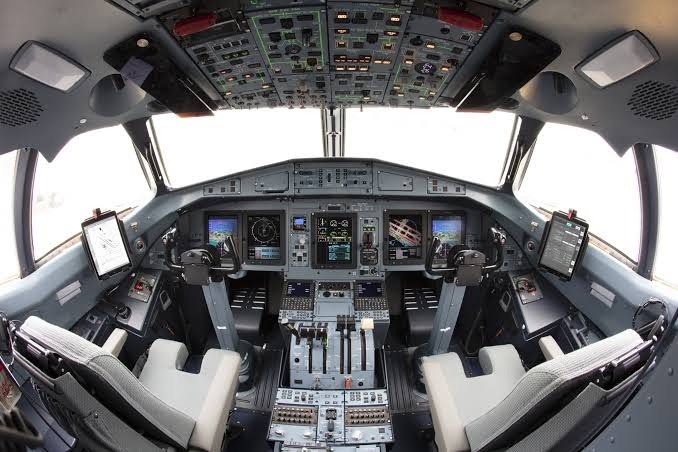
Due to its features of lower fuel consumption and reduced noise pollution, this aircraft is considered environmentally friendly. Its greatest technical strength, however, is its high-level RNP-AR navigation capability based on satellite technology.
According to Buddha Air, thanks to this advanced system, the aircraft can safely land by following a digital route even in low visibility conditions at airports with challenging terrain and poor weather, such as Kathmandu, Bhairahawa, and especially Pokhara.
The most important and far-reaching aspect associated with the arrival of this aircraft is the improvement in flight convenience and operations at Pokhara International Airport. Currently, under the conventional Instrument Landing System (ILS) used in Pokhara, a minimum visibility of 3,100 meters is required for takeoff and landing. As a result, especially during winter fog and the rainy season, a large number of flights are delayed, diverted, or canceled.
However, with the full implementation of the RNP-AR technology in the new aircraft, in cooperation with the Civil Aviation Authority of Nepal, it is said that safe takeoff and landing will be possible even when visibility drops to 2,000 meters or even as low as 1,700 meters in Pokhara.
It is estimated that this will reduce the flight cancellation rate due to bad weather to below 3 percent, making air travel to Pokhara extremely reliable and dependable.
Buddha Air has formulated a strategic plan to open the door not only for domestic but also for international flights through the successful installation of this satellite-based technology in Pokhara. In the context of international airlines hesitating to come to Pokhara due to adverse weather and low visibility, this technology will prove to be a ‘game changer’, according to Buddha Air’s Executive Chairman Birendra Bahadur Basnet.
According to him, after the RNP-AR system is established, Buddha Air’s long-term goal in the second phase is to operate direct international ‘point-to-point’ flights from Pokhara using jet aircraft such as the Airbus (A319). By combining the Airbus’s rapid climb capability and the technical analysis of the European navigation system ‘NAVBLUE’, Pokhara can be directly connected to the international air network.
The company plans to further expand its services by adding two more ATR 600 series aircraft within the next few months.
Currently, Buddha Air operates international flights from Kathmandu to Varanasi and Kolkata in India, and its main priority is to make domestic and regional flights more reliable through the use of new technology.