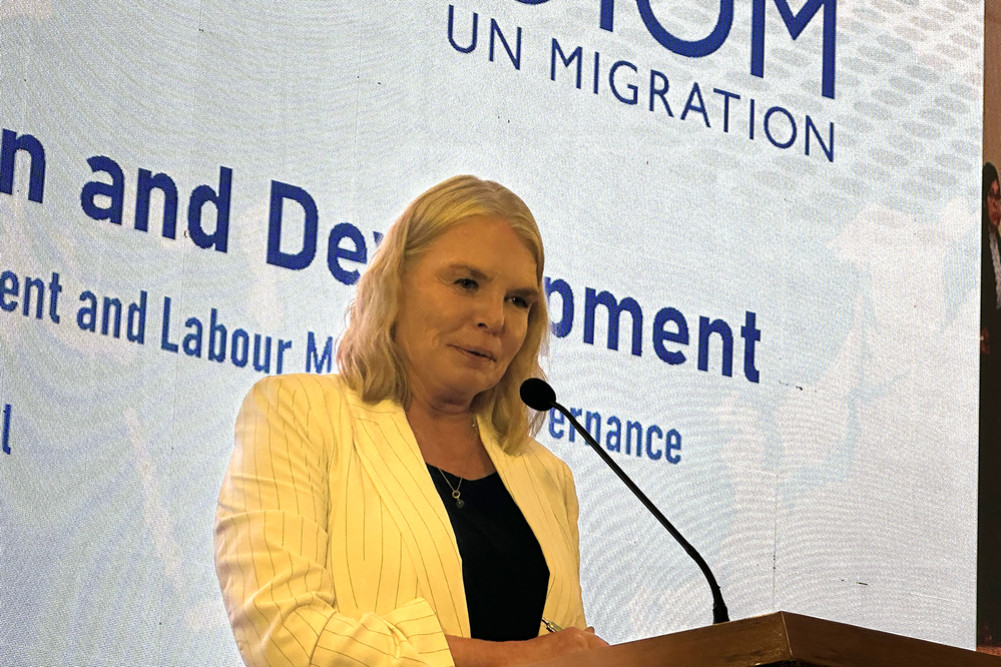
Helen Foyth, Nepal Chief of IOM, pointed out the need for Nepal to advance its labor migration policy in a new way in the changing global labor market.
We use Google Cloud Translation Services. Google requires we provide the following disclaimer relating to use of this service:
This service may contain translations powered by Google. Google disclaims all warranties related to the translations, expressed or implied, including any warranties of accuracy, reliability, and any implied warranties of merchantability, fitness for a particular purpose, and noninfringement.
Helen Forth, the head of the International Organization for Migration (IOM) in Nepal, has stated that the success of labor migration should not be measured solely by remittance inflows and the number of workers going abroad for foreign employment.
Addressing the Nepal Forum on Migration and Development (NFMD) program jointly organized by the Ministry of Youth, Labor and Employment and IOM in Kathmandu on Friday, she pointed out that Nepal needs to advance its labor migration policy in a new way due to the changing global labor market.
“Nepal should not be limited to just how many people went for foreign employment or how much remittance came in,” she said. “Our success should also be evaluated based on how workers are prepared for foreign employment, how their rights and security are ensured, and how sustainable reintegration is carried out after their return.”
Forth noted that labor migration in Nepal has improved the living standards of millions of citizens and made a significant contribution to the country’s economy. Citing the latest data from Nepal Rastra Bank, she mentioned that more than 14 billion US dollars in remittance was received in the last fiscal year, calling it an important achievement, but she also expressed the view that the future priority should be to improve the quality of the labor migration system.
She said that as the security situation, migration policies, and labor market demands in major destination countries are rapidly changing, Nepal needs to develop an ethical recruitment system in line with international standards. According to her, employers are competing for skilled manpower, governments are seeking reliable labor partnerships, and there is increasing pressure on the private sector to adopt responsible recruitment systems that respect human rights.
Forth stated that Nepal, as a champion country of the Global Compact for Safe, Orderly and Regular Migration (GCM), has been active in translating international commitments into national policy. She said that the Labor Migration Policy–2025, the National GCM Implementation Strategy, and the Sixteenth Plan have laid an important foundation for strengthening labor migration governance.
She noted that Nepal has taken reformative steps in the past, such as setting limits on recruitment fees, implementing the free visa–free ticket policy, and strengthening regulations, but acknowledged that there are still challenges in implementation. She said that there is still a need for greater transparency in recruitment costs, effective enforcement of laws, and clear delineation of responsibilities among the government, employers, and manpower companies.
She explained that although the international concept of the “employer pays principle”—that employers should bear recruitment-related costs—has provided clear direction, not all destination countries and employers have fully implemented it, so practical and partnership-based solutions are necessary.