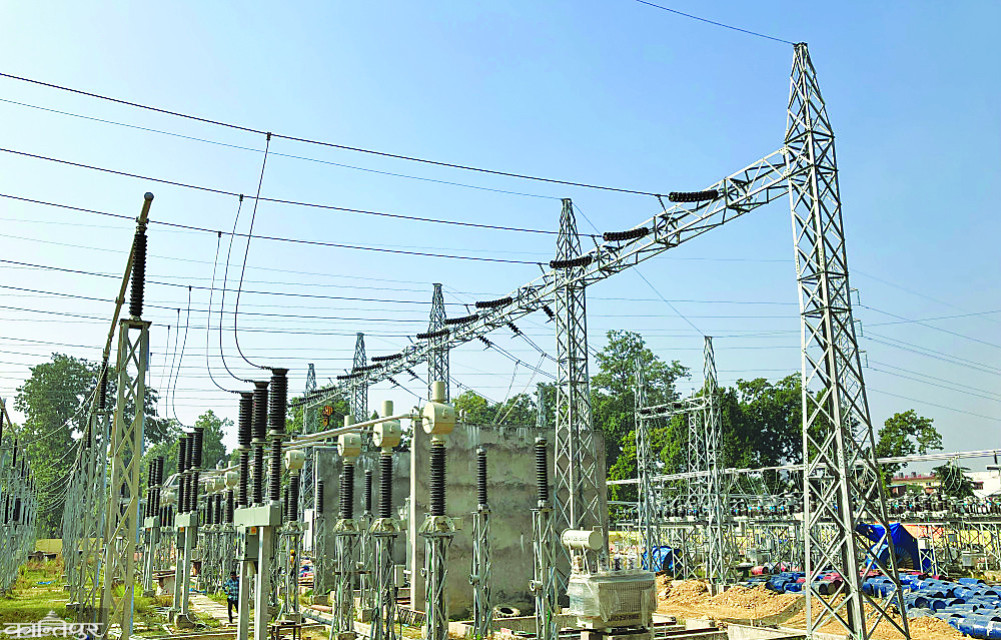
During the monsoon season, Nepal has been exporting surplus electricity, after meeting domestic consumption, to India and Bangladesh. Currently, Nepal and India have achieved an inter-country transmission line capacity of 1,530 megawatts for electricity import and 1,850 megawatts for export.
We use Google Cloud Translation Services. Google requires we provide the following disclaimer relating to use of this service:
This service may contain translations powered by Google. Google disclaims all warranties related to the translations, expressed or implied, including any warranties of accuracy, reliability, and any implied warranties of merchantability, fitness for a particular purpose, and noninfringement.
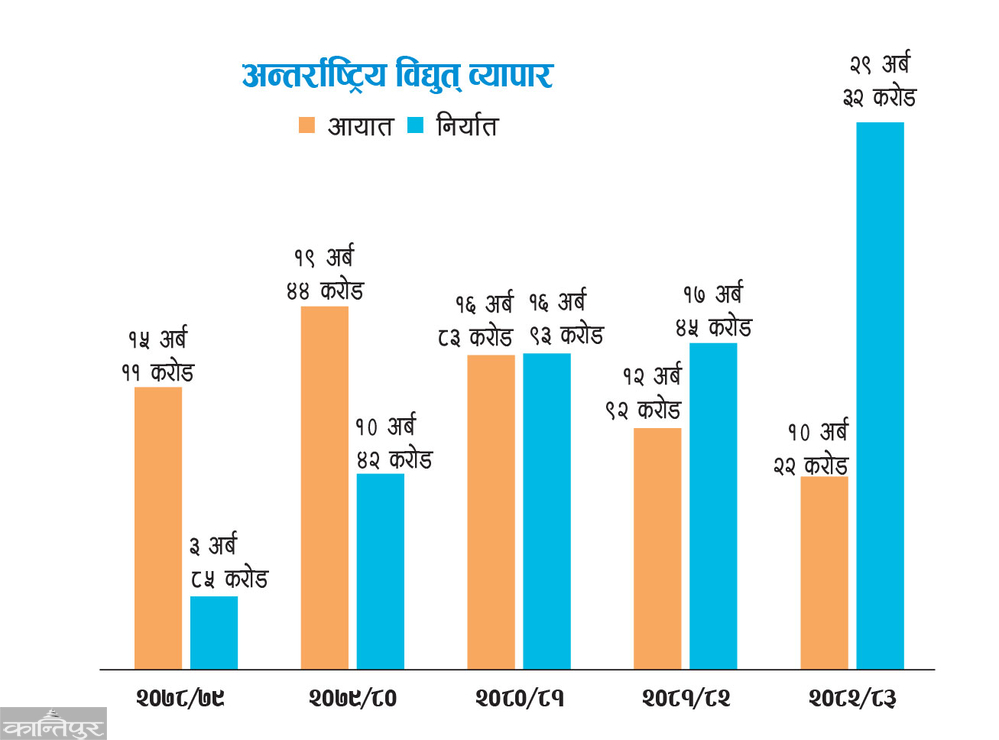
Nepal, which began exporting electricity in 2021, has started earning good revenue. In previous years, Nepal had only been importing, but now it is increasing its profits in electricity trade. In fiscal year 2025/26, Nepal exported electricity worth a total of Rs 29.32 billion to India and Bangladesh, while it imported electricity worth Rs 10.22 billion from India during the dry season. In a single year, the profit from electricity trade amounted to Rs 19.09 billion.
Since fiscal year 2023/24, Nepal has been exporting more electricity than it imports. Acting Executive Director of the Authority, Dirghayu Kumar Shrestha, said that exports have been increasing annually compared to imports. “We have become a net exporter from being an importer,” he said. “Currently, we are exporting an average of 1,000 megawatts.”
During the monsoon, Nepal exports surplus electricity, after domestic consumption, to India and Bangladesh. At present, Nepal and India have achieved an inter-country transmission line import capacity of 1,530 megawatts and an export capacity of 1,850 megawatts.
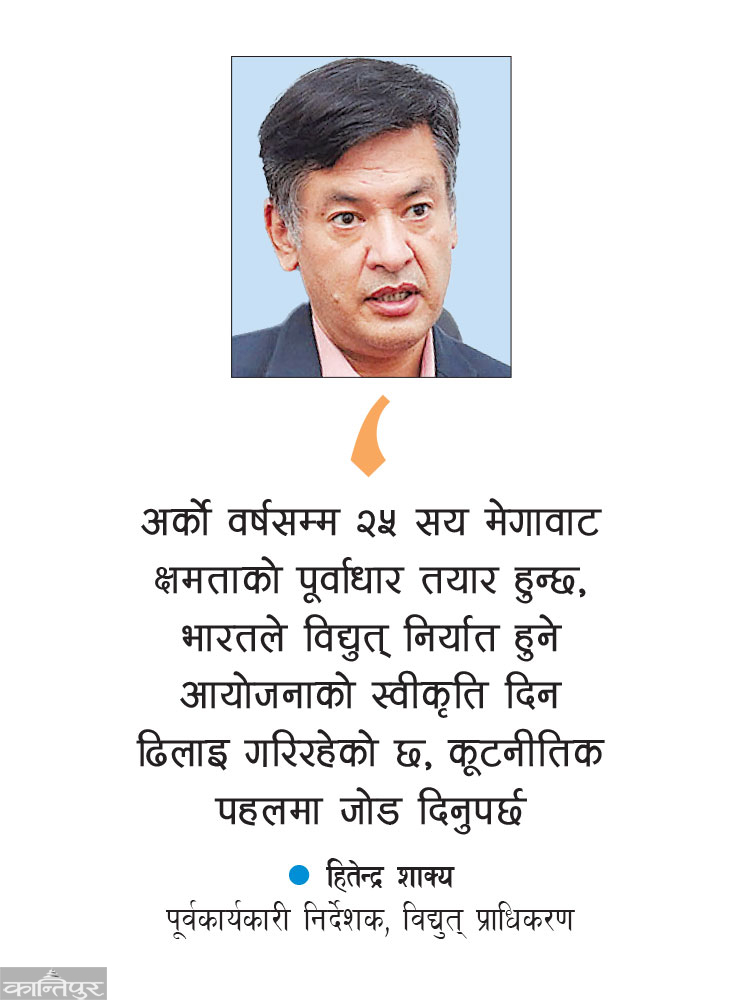
 Similarly, electricity import and export between Nepal and India is also taking place through various 132 kV transmission lines. Former Executive Director of the Authority, Hitendra Shakya, says that since inter-country transmission lines are under construction between Nepal and India, approval should be prioritized to increase electricity exports to India. “Transmission capacity and domestic production are sufficient for electricity trade; we have a surplus in production,” Shakya said. “Now, India grants permission for electricity sales according to the project. Therefore, emphasis should be placed on that.”
He said that if approval is obtained from India to export 1,000 megawatts of electricity before the next monsoon, electricity will not go to waste. “From the 400 kV Dhalkebar–Muzaffarpur and the under-construction Dhalkebar–Sitamarhi lines, 1,650 megawatts, and from the new Butwal–Gorakhpur line, 200 megawatts for now but 500 megawatts after completion, and 350 megawatts from 132 kV transmission lines can be exported. By next year, infrastructure with a capacity of 2,500 megawatts will be ready,” he said. “India is delaying approval for projects from which electricity will be exported. Therefore, diplomatic efforts should be emphasized.” Currently, India has agreed to import 1,200 megawatts of electricity from 37 hydropower projects. The Authority has stated that Nepal has not received approval for some projects after requests were made.
Likewise, electricity import and export is also taking place through the 400 kV Dhalkebar–Muzaffarpur line for 1,000 megawatts and other 132 kV transmission lines. Nepal and India have also agreed to increase the import capacity to 1,400 megawatts and export capacity to 1,650 megawatts through the Dhalkebar–Muzaffarpur and under-construction Dhalkebar–Sitamarhi 400 kV transmission lines.
Similarly, it has been agreed that in the initial phase, up to 130 megawatts of electricity can be imported and up to 200 megawatts exported through the under-construction new Butwal–Gorakhpur inter-country transmission line. The transmission line on the Nepal side is expected to be completed by August, and the substation by December 2027. It has been decided that by then, work will proceed to allow import of up to 130 megawatts and export of up to 200 megawatts of electricity through that line.
Although Nepal has become a net exporter, domestic industrialists have been complaining that they are not receiving quality electricity as per demand. President of the Confederation of Nepalese Industries, Birendra Raj Pandey, says that more electricity should be consumed domestically rather than exported. “Electricity is a raw material; if we can consume it in Nepal, it can add value and reduce imports, which has many benefits,” he said.
Pandey indicated that due to transmission and distribution infrastructure, there are problems with electricity quality, including frequent tripping in industrial corridors. “Fifty to sixty percent of industries still have to use generators,” he said. “The government should invest in infrastructure, and as much as possible, electricity should be consumed domestically rather than sold as a raw material.”
The Authority has been exporting surplus electricity, after domestic consumption during the monsoon, to India and Bangladesh. Electricity is being sold at competitive rates on the Indian Energy Exchange (IEX) in the ‘Day Ahead’ and ‘Real Time Market’. The Authority also sells electricity to the Indian company NTPC Vidyut Vyapar Nigam (NVVN) under a medium-term power agreement. The electricity purchased from here is being sent by NVVN to the state of Haryana.
 Electricity trade with India is conducted in Indian rupees. However, electricity is being exported to Bangladesh in dollars. As water flow in rivers and streams increases, production rises, so the Authority exports electricity during the monsoon. When the winter begins and water flow in rivers and streams decreases, hydropower production drops. At such times, to meet domestic demand, Nepal imports electricity from India for a few months in winter. On 24 September 2024, a tripartite agreement was signed between Nepal Electricity Authority, Bangladesh Power Development Board (BPDB), and India’s NVVN. According to that agreement, 40 megawatts of electricity are being exported every year from 15 June to 15 November.
Nepal exported electricity to Bangladesh for the first time for 12 hours on 16 November 2024. From that, it earned Rs 265.5 million. According to Authority data, in fiscal year 2025/26, it sold electricity worth Rs 1.06 billion.
Nepal has been selling electricity to Bangladesh at a rate of 6.40 US cents per unit. Although Nepal and Bangladesh have agreed to sell an additional 20 megawatts at the same rate, India has not granted approval, citing lack of transmission line capacity. The Government of India granted permission for the first time in October 2021 to import 39 megawatts of electricity from Nepal. So far, approval has been received to export a total of 1,200 megawatts of electricity to India and Bangladesh.