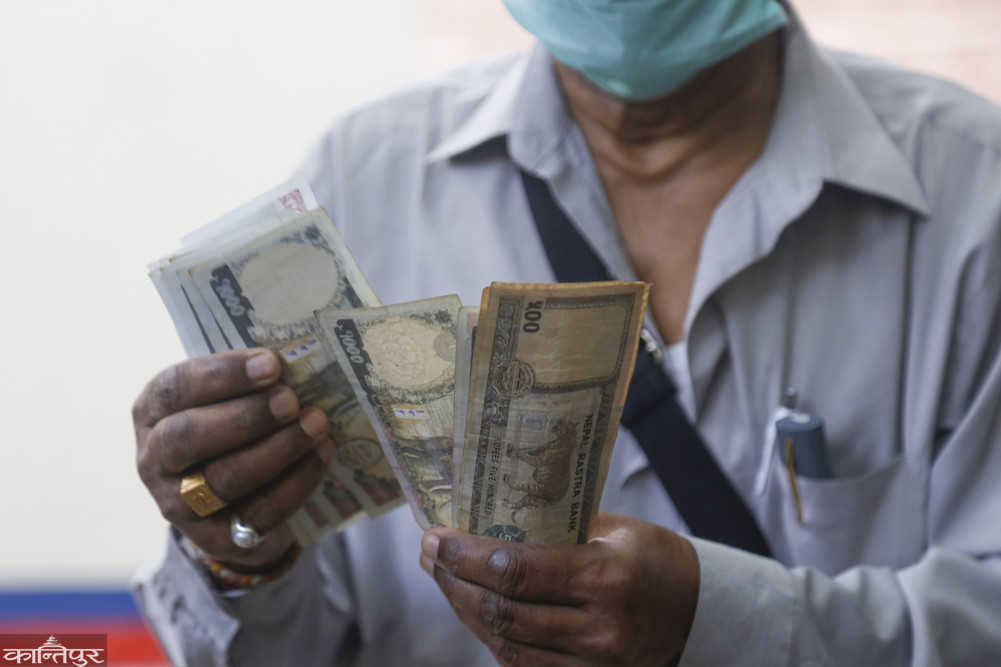
Due to the increase in the value of foreign currency, the government faces an additional burden of about NPR 167 billion on the outstanding public debt.
We use Google Cloud Translation Services. Google requires we provide the following disclaimer relating to use of this service:
This service may contain translations powered by Google. Google disclaims all warranties related to the translations, expressed or implied, including any warranties of accuracy, reliability, and any implied warranties of merchantability, fitness for a particular purpose, and noninfringement.
In the past year, the government’s outstanding public debt has increased by about NPR 300 billion. With this, the total public debt has reached NPR 2.974 trillion. In Ashad 2082, the total debt was NPR 2.674 trillion. Compared to a year ago, public debt increased by NPR 38.5 billion by the end of last Ashad, according to data from the Public Debt Management Office.
As of Ashad, the debt amounts to 45.07 percent of Nepal’s total Gross Domestic Product (GDP). The government has set a target to keep the ratio of outstanding public debt to GDP at 43 percent by the end of the current fiscal year.
However, not all of the increased amount is due to new government borrowing. The rise in the value of foreign currencies, including the US dollar, during this period has added extra burden to Nepal’s outstanding public debt. Of the outstanding debt, the share of external debt is 53.77 percent and domestic debt is 46.23 percent.
Despite limited resources, the government has faced pressure to bring a large-sized budget, resulting in a budget of NPR 2.124 trillion this year as well. This raises the risk that public debt will increase even further in the coming fiscal year. With limited revenue collection, the inability to cut mandatory obligations such as social security, and shrinking foreign aid and grants, the government was under pressure to bring a large budget to accommodate new plans.
Since revenue cannot even cover current expenditures, additional borrowing is required to pay salaries, allowances for employees, and debt principal and interest, which means public debt is expected to increase further this year, according to officials.
In recent years, there has been a slowdown in revenue mobilization. In the five fiscal years before the year most affected by COVID (FY 2076/77), the average annual growth rate of revenue was 14.9 percent, but in the five fiscal years since, this growth rate has dropped to 8.7 percent.
In FY 2077/78, the ratio of federal revenue collection to total GDP was 21.5 percent, but in FY 2081/82, it is 19.3 percent. There has been little improvement in this ratio in the past fiscal year as well. According to international standards, this level of public debt is still within a manageable range, but experts say that if it is not used to increase the productivity of the economy, debt management will become difficult.
Due to the increase in the value of foreign currencies last fiscal year, an additional burden of about NPR 167 billion was added to the government’s outstanding public debt, according to Public Debt Management Office chief Gopi Krishna Koirala. “The value of foreign currencies, including the US dollar, is rising. The Nepali currency is continuously weakening. This has directly increased the government’s outstanding debt obligations,” he said. “Apart from the losses caused by fluctuations in foreign exchange, Nepal’s public debt situation is satisfactory.”
Regardless of the exchange rate at the time of borrowing, repayments must be made at the prevailing rate at the time of payment. In recent months, the exchange rate of foreign currencies, including the US dollar, has been continuously rising. For this reason, an additional burden is being added to Nepal’s outstanding public debt every month. Nepal must repay its debt in foreign currencies (mainly US dollars).
“We calculate all foreign currencies by converting them into US dollars. When the exchange rate of foreign currencies other than the dollar rises, we have to pay more accordingly,” Koirala said.
Nepal benefits when the dollar’s exchange rate falls, but loses when it rises. Due to exchange rate fluctuations, there have been losses in four out of the last seven fiscal years, while the remaining years were profitable. The office’s data shows that Nepal has faced losses in most months this year as well.
Compared to Ashad 2082, the Nepali rupee depreciated by 9.8 percent against the US dollar by the end of last Jestha. In the same period last year, the Nepali rupee had depreciated by 3 percent. By the end of Jestha 2083, the buying exchange rate for one US dollar had reached NPR 151.88. At the end of Ashad 2082, the exchange rate was NPR 137.
The National Statistics Office projects that GDP will reach NPR 6.6 trillion in the current fiscal year. Compared to GDP, domestic debt is 20.84 percent, or NPR 1.375 trillion, and external debt is 24.23 percent, or NPR 1.599 trillion. Economists argue that the continuously rising public debt poses risks.
In FY 2080/81 and 2081/82, allocations under the financial management heading exceeded the size of capital expenditure. However, in the past and current fiscal years, allocations for financial management and capital expenditure have been roughly equal. Experts say this situation has arisen due to the continuous increase in both domestic and external debt.
Economist Dilliraj Khanal stated that as debt principal and interest payments have increased sharply, capital expenditure has been decreasing, and the gap between the budget for financial management and capital expenditure is widening. He commented that this is gradually shrinking the government’s capacity to invest. “About 33 percent of last year’s total revenue had to be allocated for debt principal and interest payments,” he said.
Khanal argues that the continuous rise in the value of the US dollar in recent months, the increase in interest rates on concessional loans taken from donor agencies such as the World Bank and ADB, and the shortening of grace periods for such loans have gradually increased Nepal’s risk of debt distress.
He said that since revenue collection is not meeting targets, debt has become the main source of funding, adding to the pressure. “To solve this problem, the government should cut current expenditures, restructure capital expenditure, reduce spending in unproductive sectors, and increase investment in productive sectors and projects that can be completed quickly and at low cost,” Khanal said. “The government should also prioritize immediate, medium-term, and long-term plans in capital expenditure allocation, so that necessary projects do not face budget shortages and less important projects do not receive excessive funding.”
Last year, the government raised NPR 447.18 billion in public debt. This is 75.07 percent of the annual target. Of this, the share of domestic and external debt receipts was 99.08 percent and 37.88 percent, respectively. Last year, the government had set a target to mobilize NPR 595.66 billion in public debt.
Last year, the government spent NPR 386.22 billion on debt principal and interest payments. This is 93.97 percent of the annual target. Based on total GDP, total debt service expenditure was 5.85 percent as of last Ashad. This year, the government has allocated NPR 411.01 billion for debt principal and interest payments. Of the total amount paid last year, NPR 312.40 billion was for principal and the remaining NPR 73.82 billion was for interest.
Of the total NPR 447.18 billion in debt raised last year, after deducting the NPR 312.40 billion spent on principal payments and adding NPR 167 billion, the Public Debt Management Office stated that a little over NPR 300 billion was added to public debt last year.