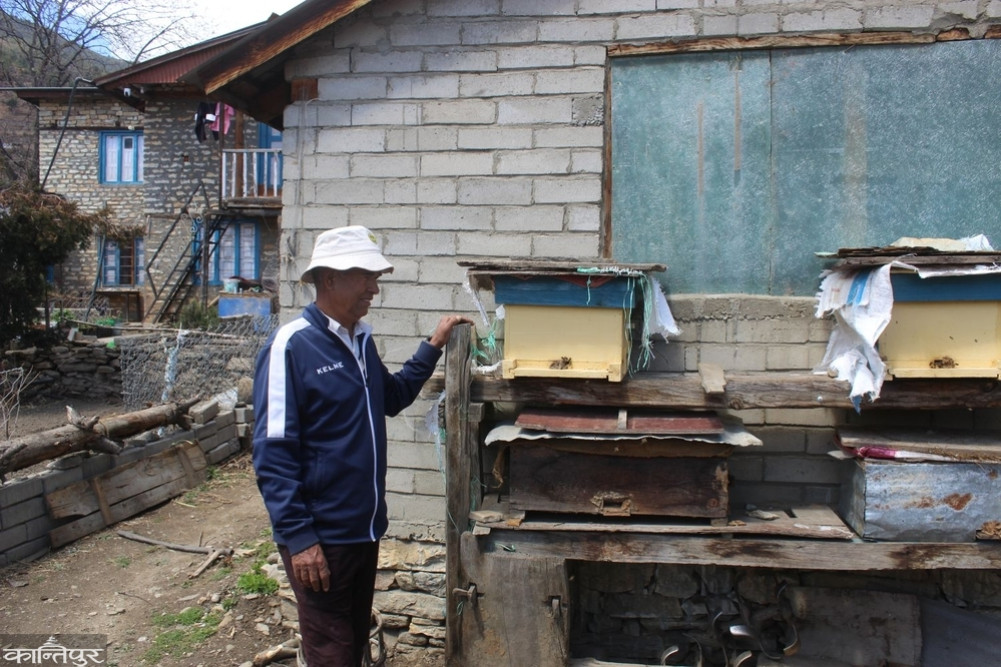
The meeting of the District Rate Determination Committee chaired by Chief District Officer Tej Prakash Prasai has increased the price of honey by 500 rupees this year.
We use Google Cloud Translation Services. Google requires we provide the following disclaimer relating to use of this service:
This service may contain translations powered by Google. Google disclaims all warranties related to the translations, expressed or implied, including any warranties of accuracy, reliability, and any implied warranties of merchantability, fitness for a particular purpose, and noninfringement.
The price of honey in Jumla has been set at 2,500 rupees per kilogram. The District Price Rate Determination Committee, chaired by Chief District Officer Tej Prakash Prasai, increased the price of honey by 500 rupees this year compared to the previous fiscal year. Last fiscal year, the price of honey was set at 2,000 rupees per kilogram.
According to the District Administration Office, the price of honey was set in accordance with Rule 148(a) of Chapter 15 of the Public Procurement Regulations 2064. Narayan Chaulagai, a beekeeper from Chandannath Municipality–4, said that farmers have become encouraged after the price of honey was set. “Previously, there was no uniformity in honey prices. Farmers were selling honey at their own rates,” Chaulagai said. “Since last year, after the District Price Rate Determination Committee started setting the price, the market has also improved.” He expressed happiness that the long-standing demand of beekeepers had been addressed.
The committee has set prices not only for honey but also for beehives. The price of a local hive with bees has been set at 10,000 rupees per hive. Last fiscal year, the price of a hive was set at 9,000 rupees. The price of a local hive without bees has decreased compared to last year. While last fiscal year it was set at 6,500 rupees, this year it has been set at only 6,000 rupees.
According to Dipendra Singh Dhami, Information Officer at the Jumla District Agriculture Development Office, the price of a Jumli Topbar hive with bees has been set at 13,000 rupees per hive, and a Jumli Topbar hive without bees at 8,000 rupees.
According to him, last year the prices of hives were 12,000 and 8,000 rupees respectively. The committee has set the price of an empty Jumli Newton beehive with at least 9 frames at 5,000 rupees per hive, an empty hive with a super at 7,000 rupees per hive, and 1,500 rupees per frame of bees, according to the District Agriculture Development Office.
Information Officer Dhami said that after the prices of honey and hives produced in the district were set, farmers have become enthusiastic about beekeeping. He said, “Recently, farmers have been very happy since the price of honey was set.”
The honey from here reaches cities such as Surkhet, Nepalgunj, Pokhara, and Kathmandu. Tourists visiting Jumla also take honey from here. Beekeeper Dhanjit Budha said that now it has become easier for consumers to buy honey at the government-set price. He said, “With the price of honey set, there is now a demand for beekeeping insurance facilities as well.” Previously, when trying to insure bees, insurance companies did not agree, saying a price rate was required, he said.
Beekeeping is practiced in all 60 wards of the eight local levels of Jumla. According to the Beekeeping Agricultural Cooperative Institution Jumla, there are statistics showing more than 8,000 beehives in the district. A minimum of 5 to 7 kilograms of honey is extracted from each hive. Honey is harvested here from the Apis cerana species of bees in the month of Kartik.