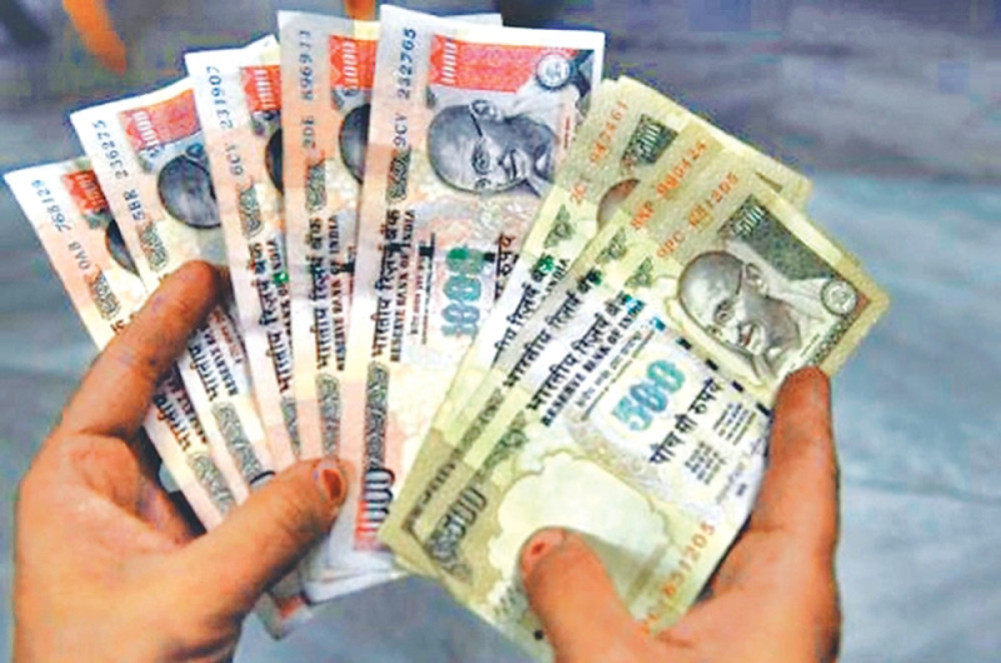
Now, banks, money changers, hotels, airlines, and other institutions authorized to exchange foreign currency will be able to exchange up to 25,000 Indian rupees per person without restriction. This is the only new provision made by Nepal Rastra Bank on Thursday.
We use Google Cloud Translation Services. Google requires we provide the following disclaimer relating to use of this service:
This service may contain translations powered by Google. Google disclaims all warranties related to the translations, expressed or implied, including any warranties of accuracy, reliability, and any implied warranties of merchantability, fitness for a particular purpose, and noninfringement.
Banks, money exchangers, hotels, airlines, and others authorized to exchange foreign currency will now be allowed to exchange up to INR 25,000 per person.
The Nepal Rastra Bank made this provision public through a notice on Thursday. On 28 Poush 2082, the central bank had already issued a directive allowing Nepali and Indian citizens to bring into or take out of Nepal up to INR 25,000 per person. That notice had permitted Nepali or Indian citizens to bring in or take out up to INR 25,000 in INR 200 and 500 denomination notes only. However, banks and money exchanger companies had not been authorized to exchange up to INR 25,000. This was because the Nepal Rastra Bank had not received assurance from the Reserve Bank of India that Indian currency received through banks and money exchangers would be exchanged.
Previously, after the Indian government banned INR 500 and 1,000 notes on 9 November 2016, about 50 million rupees of those denominations still remain at the Nepal Rastra Bank. Despite repeated requests, the Indian side has not exchanged that money. For this reason, the Nepal Rastra Bank had not exchanged INR 200 and 500 notes issued after 9 November 2016. Since the central bank did not exchange them, neither did banks and money exchangers. As a result, INR 200 and 500 notes had accumulated at various temples including Pashupatinath, as well as in hotels and dharmashalas.
To resolve this issue, the Nepal Rastra Bank had repeatedly requested the Reserve Bank of India. According to sources, about a month ago, Nepal’s Governor Maha Prasad Adhikari and Reserve Bank of India Governor Shaktikanta Das discussed the issue of unexchanged Indian rupees collected in Nepal. In that discussion, Governor Das assured that the problem would be resolved in writing. Accordingly, the Nepal Rastra Bank received a letter from the Reserve Bank of India on Thursday (7 Shrawan 2083). Based on that letter, the central bank issued a circular the same day.
With this directive, banks, money exchangers, hotels, airlines, and other entities authorized to exchange foreign currency can now freely exchange up to INR 25,000 per person. The new provision announced by the Nepal Rastra Bank on Thursday is limited to this.
Similarly, the central bank had already made provisions allowing Nepali or foreign citizens to bring into Nepal, without customs declaration, up to USD 5,000 in cash foreign currency (for Indian rupees, up to the equivalent of USD 5,000, and for other foreign currencies not published by the bank, also up to the equivalent of USD 5,000). For amounts exceeding this, customs declaration and certification are required.
“It is prohibited to transact in INR 500 and 1,000 denomination notes that were in circulation before 9 November 2016,” the central bank’s notice states. “Nepali or Indian citizens may, as per prevailing regulations, bring in, take out, or exchange up to INR 25,000 per person in INR 200 and 500 denomination notes issued and in circulation after 9 November 2016.”
Likewise, the Nepal Rastra Bank has clarified that Nepali citizens are not allowed to take Indian rupees to countries other than India, nor to bring Indian rupees into Nepal from countries other than India.