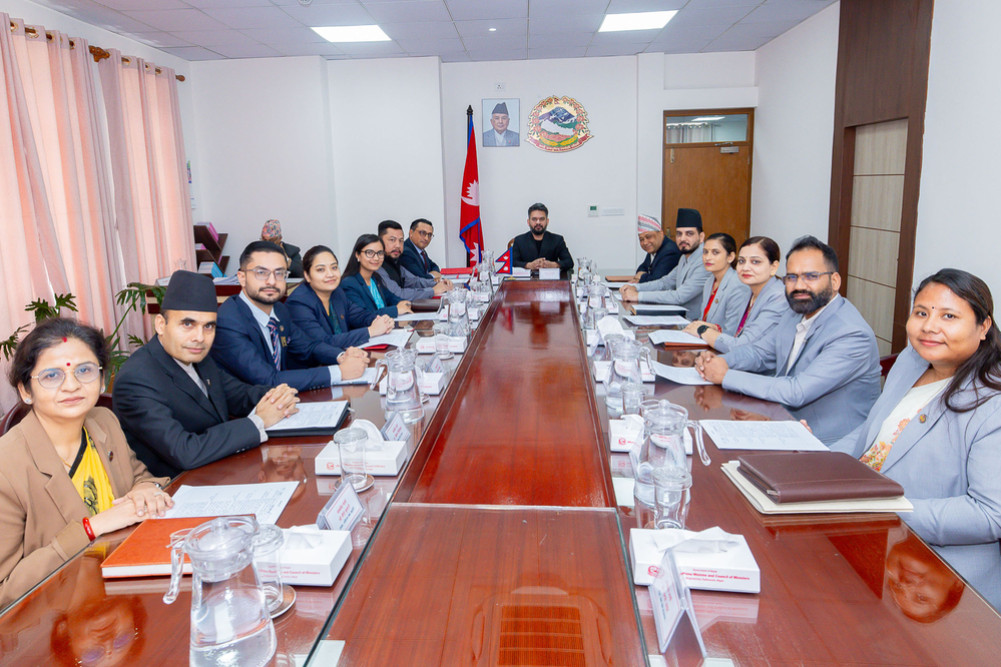
Although Prime Minister Shah has announced the withdrawal of the 3 percent equality tax, whether or not the tax paid by citizens will be refunded depends on the decision of the Council of Ministers.
We use Google Cloud Translation Services. Google requires we provide the following disclaimer relating to use of this service:
This service may contain translations powered by Google. Google disclaims all warranties related to the translations, expressed or implied, including any warranties of accuracy, reliability, and any implied warranties of merchantability, fitness for a particular purpose, and noninfringement.
After Prime Minister Balendra Shah announced the withdrawal of the Samata Tax imposed on education and health, questions have arisen about what will happen to the tax that citizens have already paid. On Tuesday, Prime Minister Shah announced via social media that the 3 percent Samata Tax imposed on education and health since 1 Shrawan 2083 has been withdrawn.
However, a tax that has been passed and implemented by Parliament cannot be withdrawn simply based on an announcement made by the Prime Minister on social media. Even when making decisions regarding tax withdrawal or exemption, the government must have the Ministry of Finance submit a proposal to the Cabinet, which then presents it to Parliament, and only after the decision is published in the Nepal Gazette does it gain legal recognition.
Finance Minister Swarnim Wagle has also stated that a proposal for the tax withdrawal has already been prepared. It is likely that the Cabinet meeting scheduled for 3 p.m. today will formally decide to withdraw the tax. Once the Cabinet’s decision is published in the Nepal Gazette, the tax will be legally withdrawn.
Looking at it this way, until today (until the Cabinet makes a decision), the 3 percent tax imposed by the government on education and health remains in effect by law. According to the procedure, after the government decides to withdraw the tax, what happens to the tax that has already been paid? Not only the general public but also officials at the Ministry of Finance and the Revenue Department are currently uncertain whether citizens will get a refund or if the money will remain in the government account.
“A proposal regarding the decision to withdraw the tax has already been prepared. Once the Cabinet makes a decision, it will be implemented,” a source at the Ministry of Finance said. “What happens to the tax already paid also depends on the Cabinet’s decision. If the decision is made to refund, citizens will get their money back. If not, they will not.” Thus, until the Cabinet makes a decision, officials say it cannot be said whether the tax already paid will be refunded or not.
The Internal Revenue Office also does not have an answer to the question of whether the tax paid by citizens from 1 Shrawan until now will be refunded. “Legally, the 3 percent Samata Tax on education and health is still in effect in the country,” the source said. “Because until now, there has been no withdrawal of the tax or any request or directive to stop collecting it from anywhere. As long as the tax provision remains in place, the question of refunding the tax paid by citizens does not arise.” The officials said they would only formally consider the tax withdrawn after the government decides to withdraw the tax on education and health and the decision is published in the Nepal Gazette. The answer to what happens to the tax already paid by citizens also depends on the government’s decision, according to those officials.
After widespread opposition, Prime Minister Shah announced on Monday the withdrawal of the 3 percent Samata Tax imposed on education and health. Prime Minister Shah stated that the tax was withdrawn after discussions with Finance Minister Swarnim Wagle. “If the 3 percent Samata Tax imposed on the private education and health sectors were implemented as stated, ordinary people would have to bear additional expenses and disappointment. Therefore, after consultation with Honorable Finance Minister Swarnim Wagle, it has been decided not to implement the Education Samata Fee and Health Samata Fee for now,” Prime Minister Shah wrote on Facebook.
Prime Minister Shah, describing the government as a people-oriented one formed from the trust and expectations of the people, said that their main objective is to ensure good governance and provide all citizens with a quality life. He also said that the purpose of introducing the 3 percent Samata Tax was to provide better education and health services to citizens in remote and disadvantaged areas. In addition, he stated that its aim was to support Dalit, marginalized, and underprivileged children, to expand health insurance, and to raise the necessary financial resources for that. He also said that the goal is to make the economy more organized by expanding the tax base.
“The public’s reaction to the Samata Tax has drawn the government’s serious attention. Our commitment to moving forward by listening to the people’s demands and building an equitable society is firm and clear,” Prime Minister Shah said. “All government decisions are made and will be made with the interests of citizens at the center. If citizens are dissatisfied with any decision, the government will always be ready to correct and amend it.”
Prime Minister Shah also stated that the government is committed to implementing a policy to transparently and fairly provide 10 percent of beds in private hospitals and 10 percent of seats in private campuses and universities so that poor and underprivileged citizens can access quality education and health services.
Finance Minister Wagle has also said that, based on discussions with the Prime Minister, the tax imposed on education and health has been suspended for now.