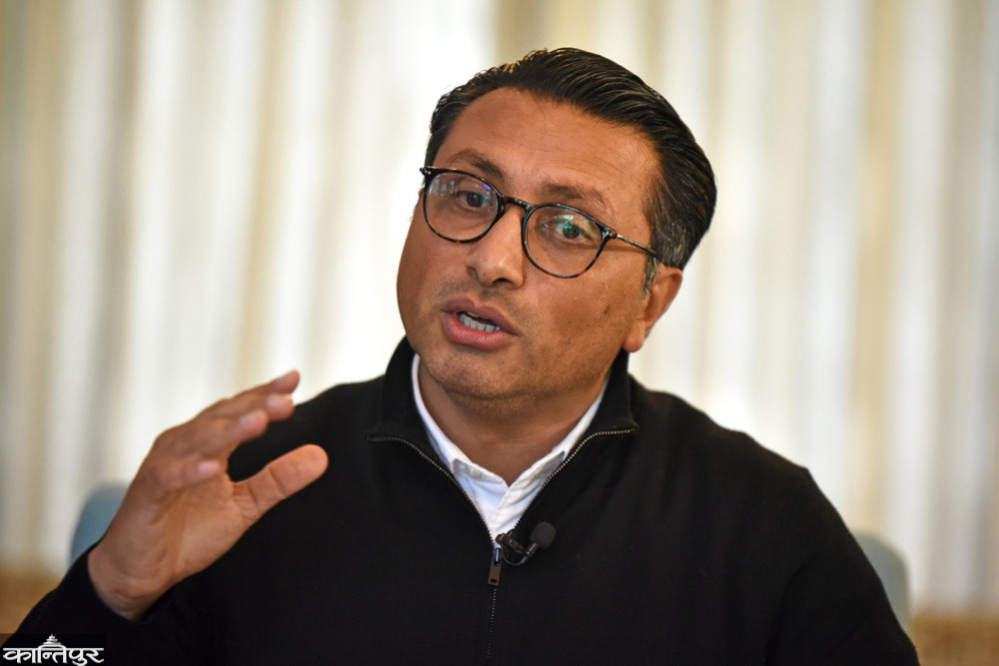
Even if the Prime Minister makes an announcement on social media, a specific process will have to be followed for its legal recognition.
We use Google Cloud Translation Services. Google requires we provide the following disclaimer relating to use of this service:
This service may contain translations powered by Google. Google disclaims all warranties related to the translations, expressed or implied, including any warranties of accuracy, reliability, and any implied warranties of merchantability, fitness for a particular purpose, and noninfringement.
After widespread protests, the government has announced the withdrawal of the 3 percent equity tax imposed on education and health. Prime Minister Balendra Shah announced the withdrawal of the tax on Tuesday through social media.
Even though the Prime Minister announced it on social media, a specific process will have to be adopted for its legal recognition. The government had decided to impose a 3/3 percent equity tax on education and health through the Economic Act.
Prime Minister Shah announced the withdrawal of the tax after discussions with Finance Minister Swarnim Wagle. ‘It was seen that the common man would have to face additional expenses and disappointment if the 3 percent equity tax imposed on private education and health sectors is implemented as it is now. Therefore, after consultation with Honorable Finance Minister Swarnim Wagle, it has been decided not to implement the education equity fee and health equity fee for the time being,’ Prime Minister Shah wrote on Facebook. Although the Prime Minister said that the decision has been made, he did not disclose whether the decision was made by the Prime Minister’s Office or the Council of Ministers. Because sources have said that no decision was taken on the matter in Monday’s Council of Ministers meeting.
Calling it a people-oriented government formed with the trust and expectations of the people, Prime Minister Shah has said that his main objective is to ensure good governance and provide quality life to all citizens. He also said that the purpose of introducing a three percent parity tax is to provide good education and health services to citizens in remote and backward areas. He also said that its purpose is to support Dalit, marginalized and underprivileged children, expand health insurance and raise the necessary financial resources for that. He also said that the goal is to make the economy more systematic by expanding the scope of taxes.
‘The response to the parity tax seen at the citizen level has drawn the serious attention of the government. Our commitment to move forward by listening to the demands of the citizens and building an equitable society is unwavering and clear,’ said Prime Minister Shah. ‘All decisions of the government have been and will be made keeping the interests of the citizens in mind. If citizens are dissatisfied with any decision, the government will always be ready to improve and revise it.' Prime Minister Shah has also said that the government is committed to implementing a policy of providing 10 percent of beds in private hospitals and 10 percent of seats in private campuses and universities in a transparent and fair manner so that the poor and needy citizens can get quality education and health services.
However, Finance Minister Wagle has stated that the tax has not been refunded but has been postponed for now. 'In the prime ministerial system, what the Prime Minister says is final. Even when introducing the tax, we brought it after consultation. The issue of postponing it now was also discussed,' Finance Minister Wagle said. When Kantipur inquired about the possibility of opposition from citizens, Finance Minister Wagle did not want to talk about it. Although it was said that the government had taken the decision to refund taxes related to education and health equity, when Kantipur inquired whether this decision was made by the Council of Ministers or through some other process, Finance Minister Wagle said, 'The proposal is ready in the cabinet. We have made this proposal based on Section 18 of the Finance Act. I had a discussion with the Prime Minister about this for 1 hour yesterday. Based on that, the decision was made today. Our advice was also given when imposing taxes. They will say to postpone it now.'
This has been done according to the idea of the Equity Fund. The aim of which is to establish a dedicated fund for the nutritious diet of Dalit and marginalized children, expansion of health insurance, and upgrading of public schools, Finance Minister Wagle said. 'We had imagined 4/5 sources of the fund so far. The aim was to create a significant fund of a few billion by collecting education equity fee, health equity fee, excise duty on alcohol, excise duty on tobacco products, and some fees related to foreign currency used by Nepalis when they go abroad,' Finance Minister Wagle added, 'It has been decided to postpone the implementation of health equity fee and education equity fee for now.'
Finance Minister Wagle said that even though education and health are postponed, legal procedures will be taken for the implementation of the Equity Fund. "A draft order for the formation of an equity fund like the reconstruction fund is being drafted. Fees for these two sectors will not be collected. We are discussing options that can be brought in from other sources," he said. Finance Minister Wagle said that a proposal has been prepared regarding the legal process for withdrawing taxes on education and health and the process will now be taken forward. The Finance Minister claims that a proposal was made in the Cabinet meeting on Monday regarding health and education taxes. Finance Minister Wagle said that the equity tax on education and health has been withdrawn based on Section 18 of the Finance Act. That section provides for the possibility of reducing, increasing or granting exemptions to tax rates. This provision is only for the period from 1st Shrawan to the next year's budget (15th Jestha). After the budget is implemented, the Finance Minister can revise tax rates only after completing the process based on necessity and justification.
However, only the Prime Minister or the Finance Minister can change tax rates. There is a provision that the matter must be passed by the Council of Ministers along with the decision of the Ministry of Finance to revise the rates for rate revision, and the amendment must also be passed by the Parliament and published in the Gazette. ‘The Ministry of Finance, Government of Nepal, shall submit to the Federal Parliament every year a statement of the reduction, increase or partial or complete exemption of any tax, fee, duty or tax,’ states in subsections 5 and 6 of Section 18 of the Act. ‘Notices of reduction, increase or exemption of tax in accordance with this section shall be published in the Gazette.’ After Prime Minister Shah announced the tax refund, many have taken it positively.