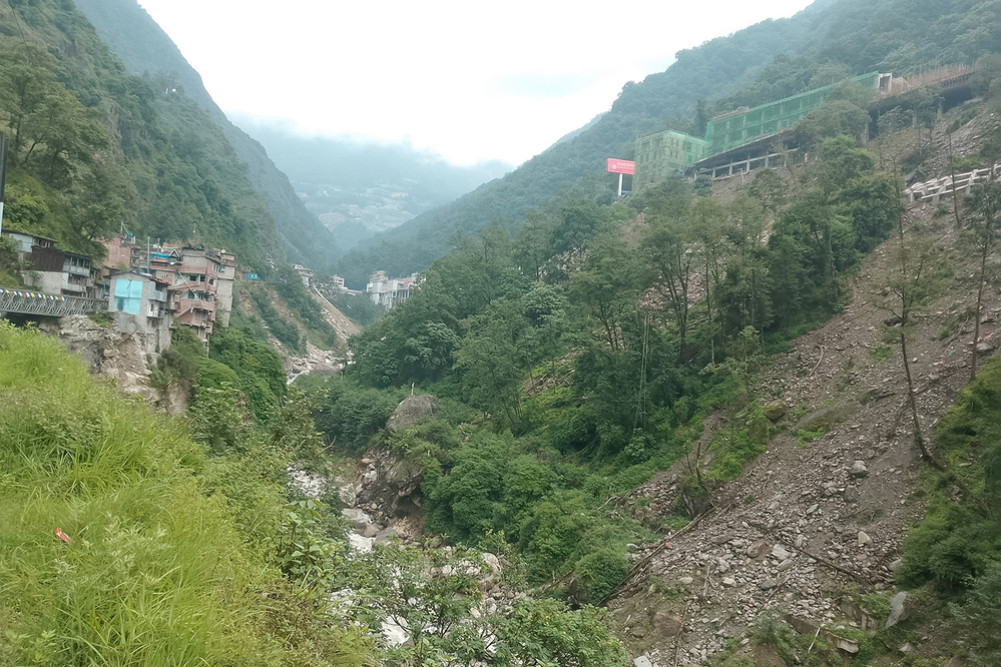
Around 150 containers carrying goods worth hundreds of millions of rupees bound for China halted due to road landslides and subsidence; dozens of containers stranded on the Nepal side as well
We use Google Cloud Translation Services. Google requires we provide the following disclaimer relating to use of this service:
This service may contain translations powered by Google. Google disclaims all warranties related to the translations, expressed or implied, including any warranties of accuracy, reliability, and any implied warranties of merchantability, fitness for a particular purpose, and noninfringement.
After continuous rainfall, the Tatopani checkpoint, the main entry point for Nepal–China trade, has been closed for seven days. Due to landslides and road subsidence, about 150 containers carrying goods worth hundreds of millions of rupees have been stranded on the Chinese side. Dozens of containers are also stranded on the Nepali side.
As this recurring problem has resurfaced in Tatopani Bazaar, which has not recovered since the earthquake, traders have complained to the government, saying, “The hero checkpoint has now become a zero checkpoint.”
The Tatopani checkpoint connecting the Nepal–China border has not been able to resume operations as of Tuesday. The Kodari road section, which has been blocked since last Monday due to landslides at Liping and road subsidence in the Eco and Daklang areas, has still not reopened.
Even if the roads in Liping and Daklang are cleared, daily subsidence in Eco has halted movement, according to Rajesh Bhandari, executive committee member of the Nepal Himalayan Cross-Border Commerce Association. As a result, about 150 containers carrying apples, oranges, ginger, readymade goods, equipment, and other items are stranded beyond the landslide. More than 50 containers loaded with goods worth hundreds of millions of rupees are also stranded in Nyalam and other areas of China. “When will the government see our problem?” he said.
As the monsoon started late, the Tatopani checkpoint, which had been operating regularly until Asar 27, has been closed for the first time this year due to rainfall. After two days of rain, a landslide occurred in the border area of Liping, and in the Eco area, where the problem recurs annually, the road has been washed away toward the Bhotekoshi River. The Daklang landslide, which had been under control for a long time, has also become active again.
Narayandatta Bhandari, chief of the Charikot Road Division Office, said that landslides in Liping are being cleared daily and the road in Daklang has also been brought into operation. However, he stated that continuous rainfall in the Eco area has made repairs difficult and efforts to reopen the road are ongoing.
After a landslide in Liping and road subsidence in Eco and Daklang last Monday, the blocked Kodari road section was repaired and partially reopened for one-way traffic from Thursday evening. With the road open, cross-border container movement had also resumed. However, after continuous rainfall throughout Thursday night, water from an overflowing stream in the Eco area washed away the road, causing the checkpoint to close again.
Kodari Highway still not completed after a decade
The 26-kilometer Bahrabise–Tatopani road section leading to the main Nepal–China trade entry point, Tatopani checkpoint, has not been fully upgraded since the 2015 earthquake. This strategically important road is blocked every year during the rainy season.
Even though the project was funded by Chinese grants and assigned to a Chinese construction company, the road’s condition has not changed, said Kumar Shrestha, Ward Chair of Bhotekoshi Rural Municipality–2. “Again, Chinese grant, Chinese company, and Chinese contractor, but the road’s condition is the same,” he said.
After the earthquake, the Chinese government announced significant financial assistance in various phases for the reconstruction of the Kodari Highway and landslide control. During then-President Ram Baran Yadav’s visit to China, on Chaitra 14, 2071, Chinese President Xi Jinping announced assistance worth 900 million Chinese yuan (about 16.2 billion rupees). Previously, China had also provided assistance worth about 484.9 million rupees.
Under this assistance, the responsibility for road repair and blacktopping was given to the Chinese company China Railway Fourth Construction Bureau Group Co. Ltd. (CRCC). However, even after nearly a decade, many sections of the Kodari–Tatopani road remain in a risky condition.
Last year as well, the Tatopani checkpoint was closed for about three months due to landslides. Afterward, under local pressure, a budget of 484.9 million rupees was allocated for landslide control.
According to Road Division Chief Bhandari, after a contract was signed with a Nepali company and about 15 percent of the work was completed, the contract was canceled based on a letter from the Ministry of Foreign Affairs. Although the ministry decided to have the construction done by a Chinese company in that area, the construction company has not yet arrived at the site.
Although two phases of agreements have been completed between Nepal and China, the implementation agreement is still pending. It is expected that the Chinese company will begin permanent landslide control work in the Eco area after the rainy season. Locals say that with about 175 households above the Eco landslide and the Bhotekoshi River continuously eroding below, finding a long-term solution remains challenging.
As the problem of road blockages recurs every year, many containers carrying apples have had to be diverted toward the Kerung checkpoint, said Sharad Prasad Parajuli, executive member of the Himalayan Cross-Border Commerce Association.
“The erosion by the Bhotekoshi River has put even the customs yard at risk. When landslides block the road and the concerned authorities cannot clear them in time, traders themselves have to raise funds to repair the road,” he said.