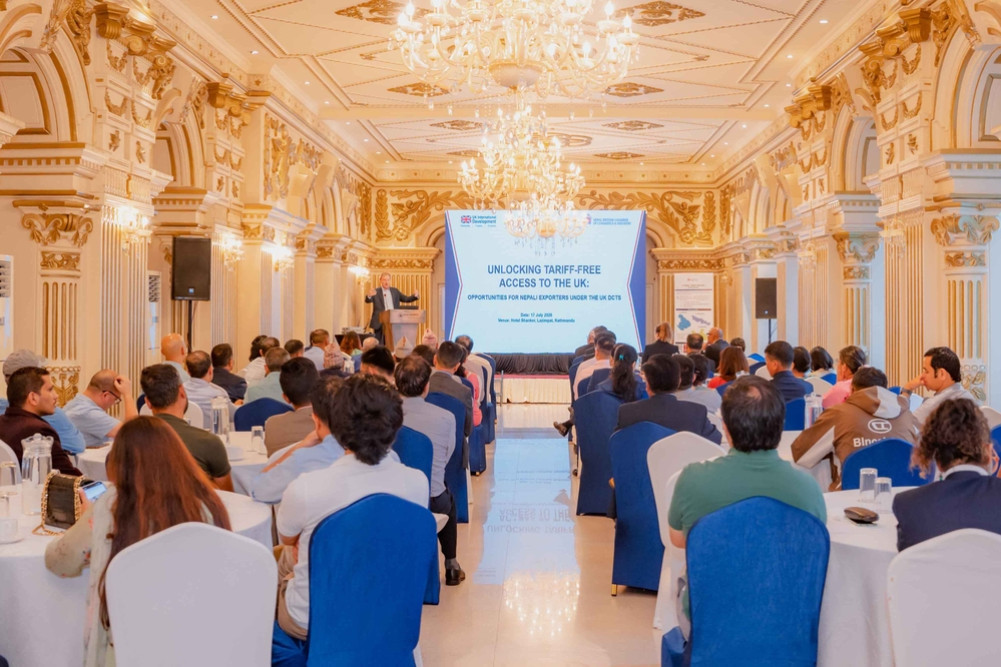
About 99 percent of eligible goods exported from Nepal to the United Kingdom are not subject to any customs duties. More importantly, the previously strict rules of origin for goods have been significantly relaxed.
We use Google Cloud Translation Services. Google requires we provide the following disclaimer relating to use of this service:
This service may contain translations powered by Google. Google disclaims all warranties related to the translations, expressed or implied, including any warranties of accuracy, reliability, and any implied warranties of merchantability, fitness for a particular purpose, and noninfringement.
The story of Nepali carpets, pashmina, or tea finding a market in the UK is not new. However, there is once again a debate about bringing Nepali products to that market at zero tariff rates. But a question arises: how prepared are exporters in Kathmandu, in terms of capacity and quality, to reach that market?
A recent high-level interactive program held at Hotel Shanker in Kathmandu has once again highlighted this crossroads of opportunity and challenge. The conference, titled ‘Opening the Door to Duty-Free Access in the UK’ and organized under the British government’s ‘Developing Countries Trading Scheme’ (DCTS), has given Nepali exporters renewed hope. However, it also sparked discussion about the structural weaknesses of domestic production.
The concessions granted by the UK to developing countries like Nepal under the DCTS scheme are significant. Nearly 99 percent of eligible goods exported from Nepal to the UK are exempt from any customs duties. Even more importantly, the previously strict rules of origin for goods have been greatly relaxed.
Nepali industrialists can now import raw materials from more than 95 countries, process them in Nepal, and export to the UK while still claiming duty-free benefits. For example, it is now legally and technically possible to import raw materials from India or Vietnam, process them in Nepal, and export them to the UK under the ‘Made in Nepal’ brand.
Emphasizing this technical flexibility at the program, Ellie Parker, Regional Trade Development Advisor at the British Embassy, said, “The 99 percent duty exemption and flexible facilities Nepal has received are rare opportunities in international trade. The responsibility now lies on the shoulders of Nepali exporters.”
Looking at the list of goods exported from Nepal to the UK, carpets, ready-made garments, pashmina, felt products, and handmade paper have dominated for years. However, according to experts participating in the conference, British consumer preferences and market demand have changed.
Currently, there is a rapidly growing demand in the UK market for Nepali organic tea, natural and herbal products, unique handicrafts, and home decor items. British Ambassador to Nepal Rob Fenn said, “The UK places high priority on its trade relationship with Nepal. If these facilities are maximally utilized, new jobs will be created in Nepal and the diplomatic and economic ties between the two countries will reach new heights.”
Buddha Bahadur Gurung, Joint Secretary at the Ministry of Industry, Commerce and Supplies, said, “We cannot be content with only traditional exports. Unless we meet the technical capacity, production volume, and international quality standards required for the UK market, legal exemptions alone will not increase trade.”
According to participants in the program, major problems facing Nepali domestic industries include the inability to produce goods in sufficient quantities on time, lack of laboratory testing, and shortcomings in packaging and labeling according to British standards.
At the program, Shiv Prakash Khemka, representative of the Nepal Britain Chamber of Commerce and Industry, pledged continuous technical and informational support to the private sector to overcome these obstacles.