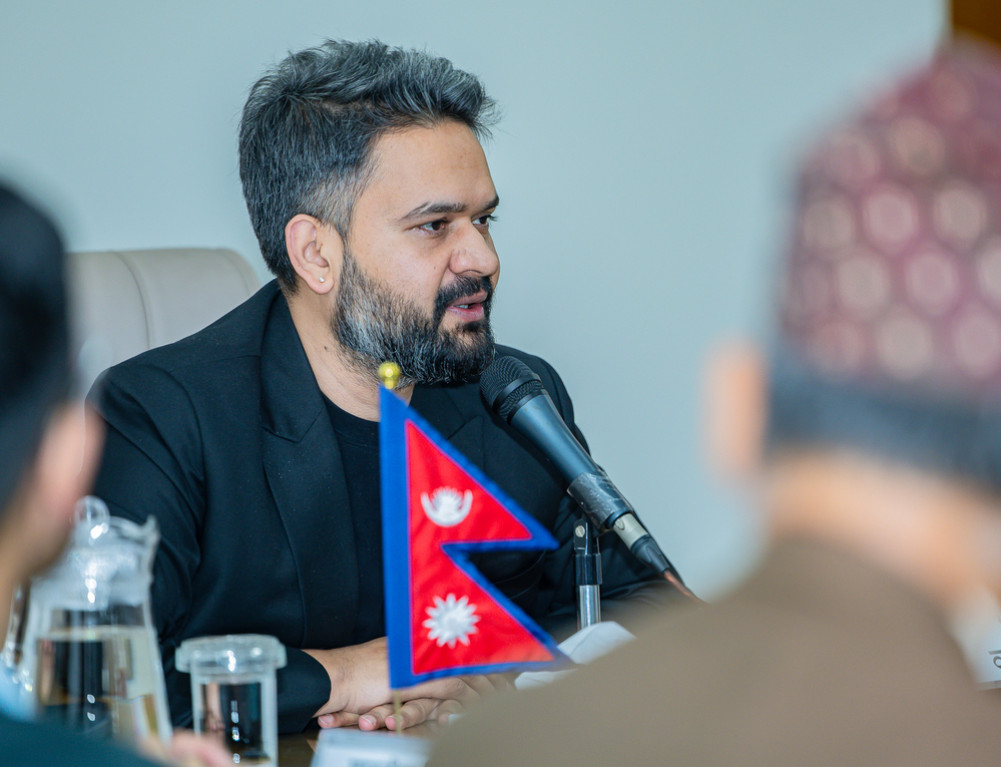
Officials of the Nepal Readymade Garment Industry Association emphasized the need to place the promotion of domestic production, import substitution, and export growth as national priorities.
We use Google Cloud Translation Services. Google requires we provide the following disclaimer relating to use of this service:
This service may contain translations powered by Google. Google disclaims all warranties related to the translations, expressed or implied, including any warranties of accuracy, reliability, and any implied warranties of merchantability, fitness for a particular purpose, and noninfringement.
Prime Minister Balendra Shah has directed to implement necessary policy and structural reforms to revive the ready-made garment industry, boost exports, and strengthen industrial competitiveness.
In a discussion with officials of the Nepal Readymade Garment Industry Association at the Prime Minister's Office on Tuesday, the Prime Minister said that the government is committed to providing necessary support in collaboration with the private sector to promote the industry's production and exports. He also expressed interest in the processing of raw materials in various regions of Nepal.
Nepal Readymade Garment Industry Association President Pashupati Dev Pandey, Vice President Basanta Raj Adhikari, General Secretary Bhim Kumar Giri, Chief Executive Officer Suyash Khanal and Technical Advisor Prakash Kumar Jha were present in the discussion.
The association informed that in the fiscal year 2001/02, Nepal's readymade garment industry had established itself as a major export-oriented industry by exporting readymade garments worth about US$ 400 million in a year, and after the 'Multi Fiber Agreement' ended in 2005, there was a significant decline in exports, many industries were closed, large investments were at risk and millions of workers lost their jobs. The association has stated that the annual export of ready-made garments is currently limited to around Rs 10 billion.
The Prime Minister has directed the Ministry of Industry, Commerce and Supplies to immediately proceed with the process of forming the ‘Textile and Clothing Development Council’ and re-operating the closed ready-made garment industry to solve the problems of the industry, said Bhim Kumar Giri, general secretary of the association. ‘The Prime Minister has instructed to proceed with the work that needs to be done immediately,’ he said. ‘We are confident that if necessary to promote the industry, even if it is by amending the law, it will facilitate the operation of the industry.’ He informed that the association has discussed with the Prime Minister how to proceed with it since it is included in the ‘Green Garment’ policy and program but not mentioned in the budget, and the Prime Minister has committed to removing the obstacles seen in the law and technology in the raw materials required for the industry.
According to point number 13 of the policy and program for the current fiscal year 2083/84, the association has demanded the establishment of a 'Green Garment Village' by identifying a suitable location to organize the ready-made garment industry scattered within the Kathmandu Valley. The association expects the formation of a National Export Council, a separate budget and policy continuity for export promotion, export credit insurance, the construction of an international-level exhibition and conference center, the establishment of an internationally recognized testing laboratory, the development of digital trade and 'cross-border e-commerce'. The association has emphasized the need to effectively implement the concept of 'My Nation, My Product and the World Market' and to keep the promotion of domestic production, import substitution and export growth as national priorities.
The association has proposed to connect the skilled young manpower being produced in the ready-made garment sector, including ‘fashion design’, with the industry and connect it to startups, innovation, entrepreneurship and job creation, and to develop an integrated value chain based on the concepts of ‘farm to fiber’, ‘fiber to fabric’, ‘fabric to fashion’ and ‘fashion to export’. The association believes that if policy stability, infrastructure development, trade facilitation and export-oriented programs are effectively implemented in the industry, the industry can once again be established as a major export-oriented industry in Nepal. The association expects that the industry will contribute to job creation, increase foreign exchange earnings and strengthen the overall national economy.