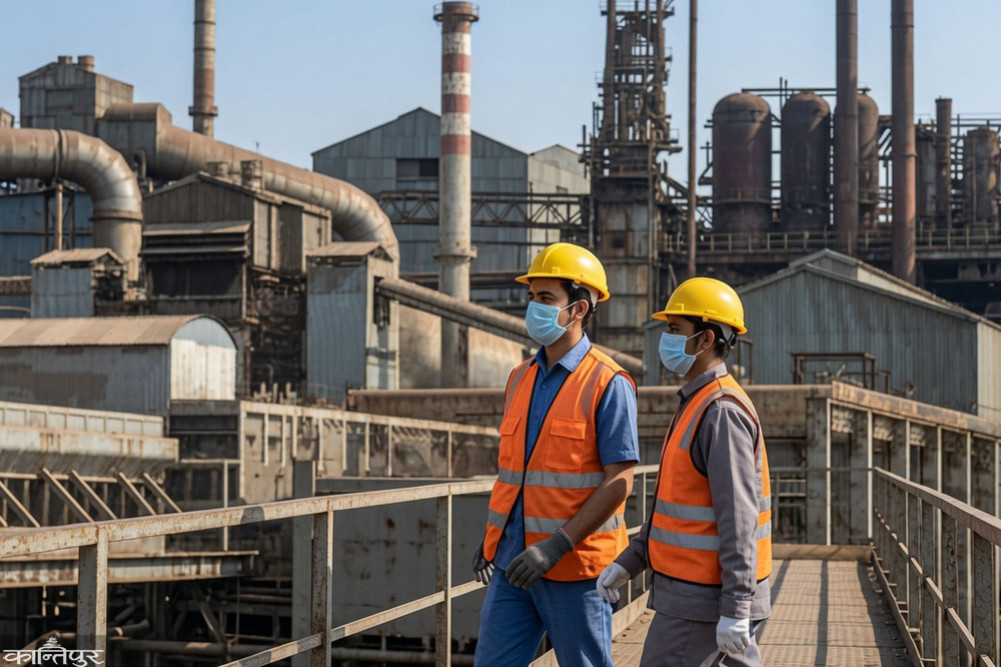
The Industrial Area Management Limited has disconnected both electricity and water lines for industries that have not paid their rent increases.
We use Google Cloud Translation Services. Google requires we provide the following disclaimer relating to use of this service:
This service may contain translations powered by Google. Google disclaims all warranties related to the translations, expressed or implied, including any warranties of accuracy, reliability, and any implied warranties of merchantability, fitness for a particular purpose, and noninfringement.
The Industrial Area Management Limited has cut off water and electricity lines to 20 industries operating in various industrial areas due to non-payment of dues for land, buildings, water, electricity and other expenses.
4 Asarayata Limited has cut off water and electricity lines to 167 industries operating in 10 industrial areas. Of these, the lines have been reconnected to the industries that have paid their dues, but the lines are still blocked in 20 industries.
The Limited had issued a notice on 25th Jestha asking the industries operating in the concerned industrial areas to pay their dues within seven days. The electricity lines are still cut off to 20 industries that have not paid their dues, said the General Manager of the Limited, Padam Wali. 'We have reconnected the lines to 5 industries after paying the dues on Monday. But the lines are still blocked for those who have not paid,' he said.
He also said that Rs 467.311 crore has been collected so far. In the case of industries that did not pay the rent increase dues, the electricity and water lines were disconnected.
The outstanding rent and service charges from industries operating within the industrial zone were more than Rs 890 million. There are 8 industries in Hetauda Industrial Zone, 2 in Balaju Industrial Zone, 2 in Dharan Industrial Zone, 3 in Pokhara Industrial Zone, 3 in Nepalgunj Industrial Zone, 1 in Patan Industrial Zone and 1 each in Gajendra Narayan Singh Industrial Zone.
The Industrial Zone Management Limited had increased the rent rates in various industrial zones in 2079 BS with effect from 2075 BS, in which the Balaju Industrial Zone was increased by up to 686 percent.
This was the dispute between the industrialists and the Limited. The High Court decision, which was certified on 24 Chaitra 2080, said that industrialists should pay the increased rent since 2075 BS. Against this, the industries in the industrial sector had approached the Supreme Court. In which, on 12 Chaitra 2081, the Supreme Court had reversed the High Court order to some extent and issued a mandate to implement the revised rent only from 22 Ashar 2079 BS, as it was not legal and fair to try to make correspondence effective from 2075 BS.
However, on 25 Deush 2082, the Limited decided to file a review petition against the Supreme Court's decision, which was somewhat reversed by the Supreme Court in Chaitra and issued a mandate, and since the decision required the return of land rent for 4 fiscal years to be adjusted, the Limited's annual income would be affected.
The Limited and the Federation of Nepal Industrial Sector Industries had also gone for a review of the Supreme Court's decision, saying that they were not satisfied with the decision of the Board of Directors of the Limited and the Limited. But the Supreme Court bench of Justices Binod Sharma, Sunil Kumar Pokharel and Nityanand Pandey did not grant permission for review.
From then on, the Supreme Court's decision will be implemented and the entrepreneurs will have to pay the revised rent from 2079 BS. General Manager of the Limited, Wali, said that they are requesting to collect the arrears of the rent increase since 2079 BS as per the Supreme Court's decision. 'We are collecting the arrears of the rent increase since 2079 BS as per the Supreme Court's decision. Some industries also have arrears older than the rent increase. We are collecting that too,' he said.
The Limited says that the non-collection of arrears has directly affected the construction of necessary infrastructure within the industrial area, maintenance and service facilities provided to the industry.