Real estate transactions increased in Asad last year after capital gains tax was increased by 2.5 percent from Shrawan and the deduction of shares was stopped, businessmen claim.
We use Google Cloud Translation Services. Google requires we provide the following disclaimer relating to use of this service:
This service may contain translations powered by Google. Google disclaims all warranties related to the translations, expressed or implied, including any warranties of accuracy, reliability, and any implied warranties of merchantability, fitness for a particular purpose, and noninfringement.
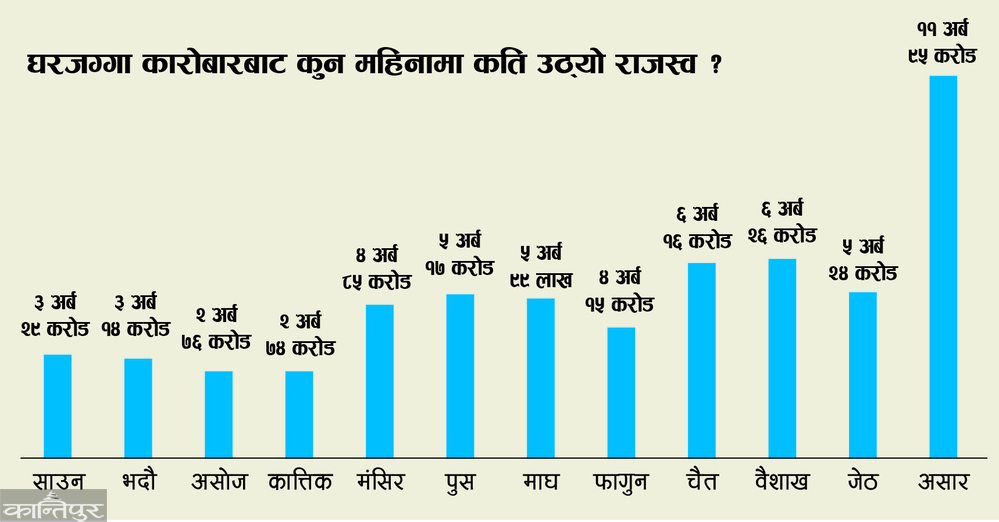
The government has collected Rs 60.73 billion 72 million in revenue from real estate transactions in the fiscal year 2082/83. This is the highest since the fiscal year 2079/80. According to the Land Management and Records Department, Rs 41.15 billion 76 million were collected in the fiscal year 2079/80. In the fiscal year 2080/81, Rs 42.42 billion 2 million were collected in the fiscal year 2080/81. In the fiscal year 2082/83, the highest amount of Rs 11.94 billion 89 million was collected in Ashar. According to the department, the lowest amount of Rs 2.74 billion 51 million was collected in Kartik.
In the last Shrawan, Rs 3.28 billion were collected, in Bhadra, Rs 3.10 billion were collected, in Asoj, Rs 2.75 billion were collected, and in Kartik, Rs 2.74 billion were collected. The department has stated that Rs 4.84 billion were collected in Mangsir. However, the revenue increased in Poush. While the revenue collected in Poush was Rs 5.17 billion, it was only Rs 5 billion in Magh and Rs 4.14 billion in Falgun.
The department says that the revenue collected was Rs 6.16 billion in Chaitra, Rs 6.26 billion in Baisakh, Rs 5.24 billion in Jestha and Rs 11.94 billion in Ashar.
The department has data showing that along with the revenue, real estate transactions also increased in Ashar. Overall, real estate transactions increased in Ashar compared to Jestha. The department stated that 70,480 new real estate transactions were made in Ashar alone. A total of 193,280 real estate transactions were made. The department stated that 58,886 new real estate transactions were made in Baisakh, 54,724 in Jestha and 70,480 in Ashar.
Businessmen say that real estate transactions increased in Ashar because the capital gains tax will increase by 2.5 percent from Shrawan and the installments will also be stopped. Through the budget for the current fiscal year, the government has made a provision to pay 7.5 percent capital gains tax on profits earned from the sale of real estate owned for five years or more. Earlier, it was five percent. Real estate transactions owned for less than five years have been increased to 10 percent. Earlier, it was 7.5 percent. This tax has been implemented since 1st Shrawan.
 The new rate of capital gains tax has been implemented since Shrawan, and the division of shares has also been stopped in municipalities that have not been classified. This also shows that real estate transactions have increased significantly in Ashar, said the outgoing president of the Nepal Real Estate Housing Development Federation, Bheshraj Lohani. “This situation has arisen even after the capital gains tax has increased and the division of shares has been stopped again,” he said. “Capital gains tax has increased by 2.5 percent. That is why it seems that there has been an increase in real estate purchases and sales.'
Out of 753 municipalities across the country, only 340 have classified land in 10 sectors including agriculture and industrial by the third week of Asad. The remaining 413 municipalities have not classified land. Land allotment has been stopped in these municipalities. Although the government has amended the Land Use Regulations 2079 for the third time and temporarily opened the way for land allotment in municipalities that have not classified land, land allotment has been stopped again since Shrawan in municipalities that have not completed the classification within the specified period.
There is a provision that land allotment can be done only after the municipality has classified the land. However, land allotment has been stopped several times when the municipality has not classified the land. In addition, the government has already amended the regulations three times to classify the municipalities. However, most municipalities have not classified it within that period.
Lohani estimates that some purchase and sale may have increased in Asad because land allotment will be stopped from Shrawan. 'Land allotment has been stopped again from Shrawan. In municipalities that are not classified, there was a rush to buy and sell,' he said. He said that the real estate market has seen a general improvement as people started investing in real estate due to low bank interest rates. 'Interest rates have come down. People started investing instead of keeping it in the bank,' he said, 'Now real estate transactions are decreasing. Shrawan and Bhadra are off-season.' Along with transactions, land acquisition has also increased. Compared to Jestha, transactions, land acquisition and revenue have also increased in Ashar.' The department's data shows that while there were 143,857 land acquisitions in Jestha, there were 212,779 land acquisitions in Ashar. New land acquisitions have also increased significantly. While there were 62,457 land acquisitions in Jestha, there were 93,906 land acquisitions in Ashar.
When the quota was stopped, it was 42,563 times in Shrawan and 212,779 times in Ashar. Meanwhile, the government has made it mandatory for real estate transactions with a turnover of more than Rs 30 million to be conducted only through licensed companies. The department issued a notice last Monday and has made it mandatory for transactions to be conducted only through companies within metropolitan and sub-metropolitan cities across the country.

