The policy and program for the current fiscal year has put forward initial preparations for the commercial production of green hydrogen in Nepal.
We use Google Cloud Translation Services. Google requires we provide the following disclaimer relating to use of this service:
This service may contain translations powered by Google. Google disclaims all warranties related to the translations, expressed or implied, including any warranties of accuracy, reliability, and any implied warranties of merchantability, fitness for a particular purpose, and noninfringement.
The government has adopted a policy of preliminary preparations for the commercial production of green hydrogen. In the policy and program of the current fiscal year, preliminary preparations for the commercial production of green hydrogen in Nepal have been put forward.
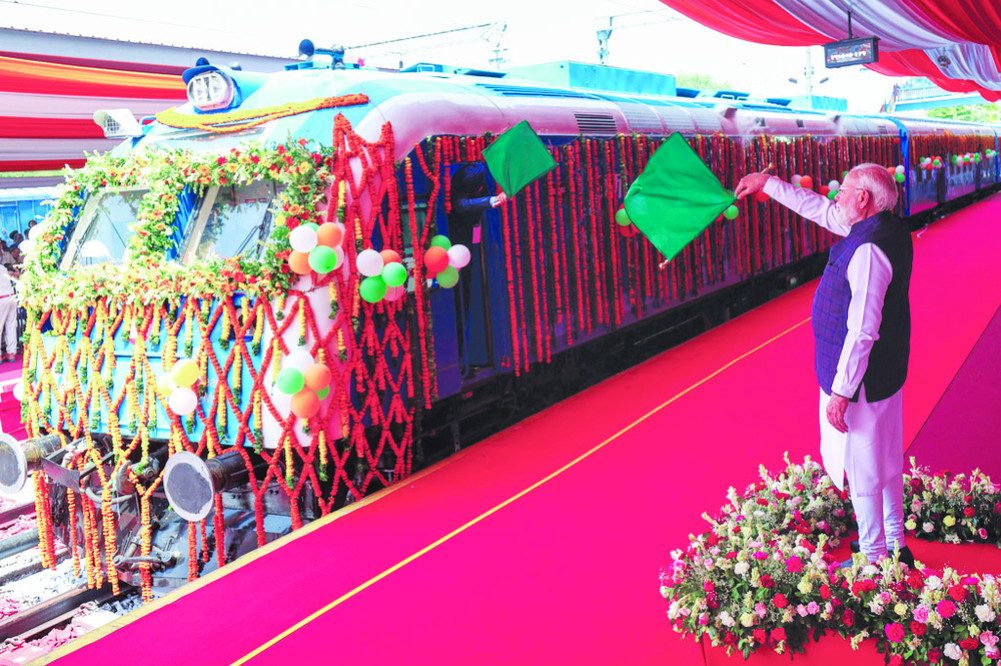
On the other hand, while the debate is ongoing about the policy, legal and technical basis for the safe, sustainable and effective development, operation and regulation of hydrogen-based vehicles, India has already brought the 'hydrogen train' into operation. Prime Minister Narendra Modi inaugurated the first 'hydrogen train' from Jind Railway Station on Friday. The train has been named 'Namo Green Train'.
The train will operate on the 89-kilometer 'Jind-Sonepat' railway line in Haryana. The minimum fare for this has been fixed at Rs 5 and the maximum at Rs 25. The train will serve various stations and halts including Jind, Gohana and Sonipat. The train is being described as India's historic achievement towards clean, sustainable and green rail transport. While most hydrogen trains in the world are limited to two to three coaches, India has brought a 10-coach train into operation.
Since the hydrogen train came into operation in India, the Ministry of Infrastructure Development in Nepal has also sought suggestions to prepare the necessary policy, legal and technical basis for the safe, sustainable and effective development, operation and regulation of hydrogen-based vehicles in the country. The train is said to have a capacity of carrying 2,600 passengers. The train does not require a power line to operate. According to a press release issued by the Indian Railways Ministry, electricity will be generated from the chemical reaction between hydrogen and oxygen from the atmosphere through a 'proton exchange membrane fuel cell' installed inside the train. The electricity operates the traction motor and turns the wheels of the train. Since this process produces only water vapor and heat, there will be no smoke or direct carbon emissions, the release said.
In the last 12 years, Indian Railways has rapidly electrified its railways. Currently, more than 99 percent of India's broad gauge railways have been electrified. Now, Indian Railways has taken another important step in clean rail operation through the use of hydrogen technology. This train has two ‘hydrogen driving power cars’ and eight trailer coaches.
Each power car is equipped with a ‘proton exchange membrane fuel cell’, lithium iron phosphate battery and hydrogen storage cylinder. Each power car will generate 1,200 kilowatts of electricity. The combined capacity of both the power cars will allow the train to operate at a maximum design speed of 110 km/h. The initial operating speed has been set at 75 km/h.
India’s largest rail hydrogen refueling center has been built in Jind, Haryana for train operation. At the center, hydrogen is produced by splitting water into hydrogen and oxygen through electrolysis technology, i.e. electricity. Then, hydrogen is compressed and stored at a pressure of 500 bar and arrangements have been made to fill the train at a pressure of 350 bar. Indian Railways has stated that the center can store about 3,000 kg of hydrogen.
Since hydrogen is a highly flammable gas, safety has been given high priority. The train and refueling center have been equipped with state-of-the-art sensors to detect hydrogen leaks, heat, fire and smoke. A system has been installed to automatically shut off the hydrogen supply if any abnormal condition is detected.
A digital monitoring system has also been provided to provide real-time information about the status of the entire system and to provide facilities to move the train to a safe place in an emergency. It is seen as an important step towards achieving India's National Green Hydrogen Mission and the goal of long-term zero carbon emissions.
Since the hydrogen train came into operation in India, the Ministry of Infrastructure Development in Nepal has also sought suggestions to prepare the necessary policy, legal and technical basis for the safe, sustainable and effective development, operation and regulation of hydrogen-based vehicles in the country.
'With the aim of preparing the necessary policy, legal and technical basis for the safe, sustainable and effective development, operation and regulation of hydrogen-based vehicles in the country, suggestions have been invited on international best practices, regulatory arrangements, safety standards and guidelines, the possibility of conversion to hydrogen technology and the development of necessary human resources,' the ministry said in a statement.
The ministry has also urged universities, research institutions, professional bodies, industries, development partners, international organizations and relevant stakeholders to submit written suggestions based on their experience, studies, research and practical practices by 20th Shrawan.
It is mentioned that suggestions should include international best practices and learnings related to hydrogen-based vehicles, policy, legal and regulatory arrangements, safety standards and guidelines related to production, storage, transportation, distribution, refueling infrastructure and vehicle operation, and suggestions on the possibility, need, cost, safety and regulatory aspects of converting petroleum-powered and other vehicles to hydrogen technology.