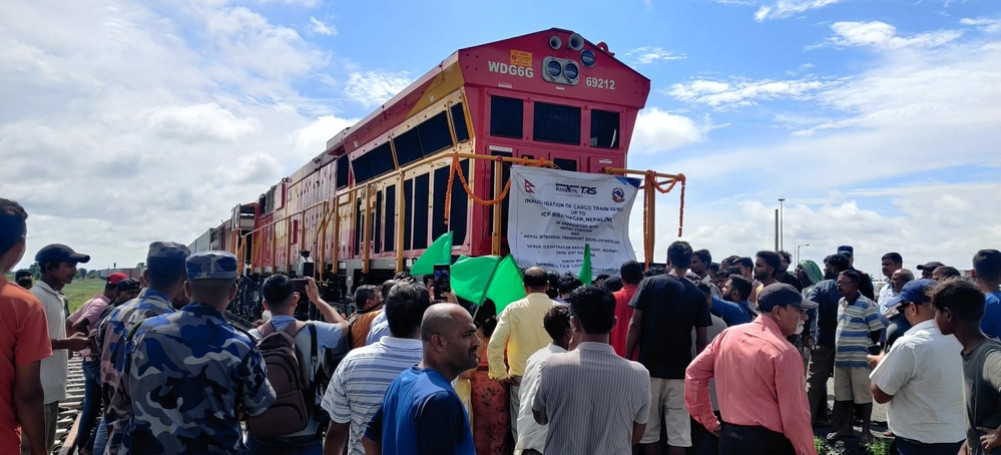
The launch of the cargo train is expected to reduce transportation costs in industries in eastern Nepal by up to 40 percent, which will have a major impact on production costs.
We use Google Cloud Translation Services. Google requires we provide the following disclaimer relating to use of this service:
This service may contain translations powered by Google. Google disclaims all warranties related to the translations, expressed or implied, including any warranties of accuracy, reliability, and any implied warranties of merchantability, fitness for a particular purpose, and noninfringement.
Raw materials imported from third countries can now be brought directly from the Kolkata port of India to Biratnagar customs by rail.
The first such cargo train service officially launched under the Nepal-India transit arrangement came into operation on Friday. The first train carrying 40 40-foot capacity containers, which left Kolkata on Friday midnight, arrived in Biratnagar on Monday afternoon.
This service is seen as the beginning of a structural change in the transportation system for the industrial sector of eastern Nepal. Containers carrying raw materials for Swastik Oil Industries were sent from Kolkata to Biratnagar under the service. Nepali Consul General in Kolkata, Jhakka Prasad Acharya, officials of Kolkata Customs, Kolkata Port and Indian Container Corporation Limited (CONCOR) jointly flagged off the train by showing the green flag.
According to Consul General Acharya, after the Indian government recently made the necessary policy arrangements, direct rail transport from Kolkata to Biratnagar has become possible for the first time. ‘The train left on Friday midnight.’ It reached Biratnagar on Monday afternoon,’ he said. ‘After the arrival of the train, the infrastructure that was inaugurated about two years ago but was unused will now be put to commercial use.’ According to him, the Indian side says that the service will be regular if sufficient cargo is ensured.
An Electronic Cargo Tracking System (ECTS) has been installed in all containers on the train. It is believed that this will increase security and transparency as the status of the transport can be monitored in real time.
The cargo train service from Bathnaha, India to the Integrated Check Post (ICP) in Biratnagar was jointly inaugurated by the then Prime Minister Pushpa Kamal Dahal and Indian Prime Minister Narendra Modi from New Delhi on 18 Jestha 2080. After the inauguration, a train came to Biratnagar as a test. Since then, the rail service has been completely suspended.
Even though the railway line was built, there was no legal and customs arrangement to bring cargo containers from third countries directly from Kolkata port to Biratnagar. Therefore, even though there was a railway line, industrialists were not able to take advantage of it.
This obstacle was removed only after the Indian government made the necessary policy amendments under the Nepal-India Transit Agreement. India's Central Board of Indirect Taxes and Customs (CBIC) had amended the ECTS rules on 4 November 2025 and allowed cargo to be brought to Biratnagar by rail from Kolkata, Haldia and Visakhapatnam ports.
Then, on 26 February 2026, Kolkata Customs made procedural arrangements to transport cargo by rail to Biratnagar via the Indian customs yard in Jogbani. 'As a result, the first commercial train has now been sent to Biratnagar,' said Consul General Acharya.
Nepal and India had agreed in 2061 BS to build an 18.7-km cargo railway from Bathanaha in Bihar to Katahari in Morang. Accordingly, in the first phase, a 7.6-km railway has been built from Bathanaha to the Nepal Customs Yard at Biratnagar ICP.
Even though the infrastructure was ready, the industrialists and businessmen were not able to get the expected benefits as the operation process remained in limbo for a long time. Raw materials required for most of the industries operating in the Sunsari-Morang Industrial Corridor enter Nepal via the Kolkata port in India. More than 300 trucks and containers enter Nepal daily from the Biratnagar border. Industrialists believe that the cost will be significantly reduced after this transportation starts by rail.
According to Nandakishore Rathi, President of the Morang Industry Organization, it is estimated that the cost of transportation by rail will be reduced by about 40 percent compared to road transportation. ‘This is a great achievement for the industry of eastern Nepal,’ said Rathi, ‘if the service is now operational regularly, the production cost of the industry is likely to decrease.’ According to a previous study, it was estimated that transporting industrial raw materials from Kolkata to Biratnagar by rail would cost only about two rupees per kilogram. This is about 40 percent less than the cost of transporting them by truck or container.’
Pawan Sharda, president of the Confederation of Nepalese Industries, Koshi, expected that transporting goods by rail would improve time, cost and safety simultaneously. ‘Compared to road, goods are safer.’ Sharda said, ‘The detention and delay charges incurred when containers are stopped at the port will also decrease.’ According to him, this will make a significant contribution to increasing the competitiveness of industries in eastern Nepal.’
Although the arrival of the first train is a positive start, industrialists are more concerned about whether the service will be regular or not. They say the future of the service will depend on sufficient cargo, a fixed schedule and ease of customs procedures. According to Anupam Rathi, president of the Morang Industry and Trade Association, this will save both transportation costs and time for businesses and industries when importing raw materials. ‘This could also be effective for exports in the future,’ said Rathi, ‘it is easier and cheaper to send by rail than by truck.’
Consul General Acharya said that the service will be regular if sufficient cargo comes from businesses. ‘The biggest challenge now is to ensure regularity,’ he said, ‘if the service becomes regular, most of the industrial raw materials coming from Kolkata Port can be brought to Biratnagar by rail.’