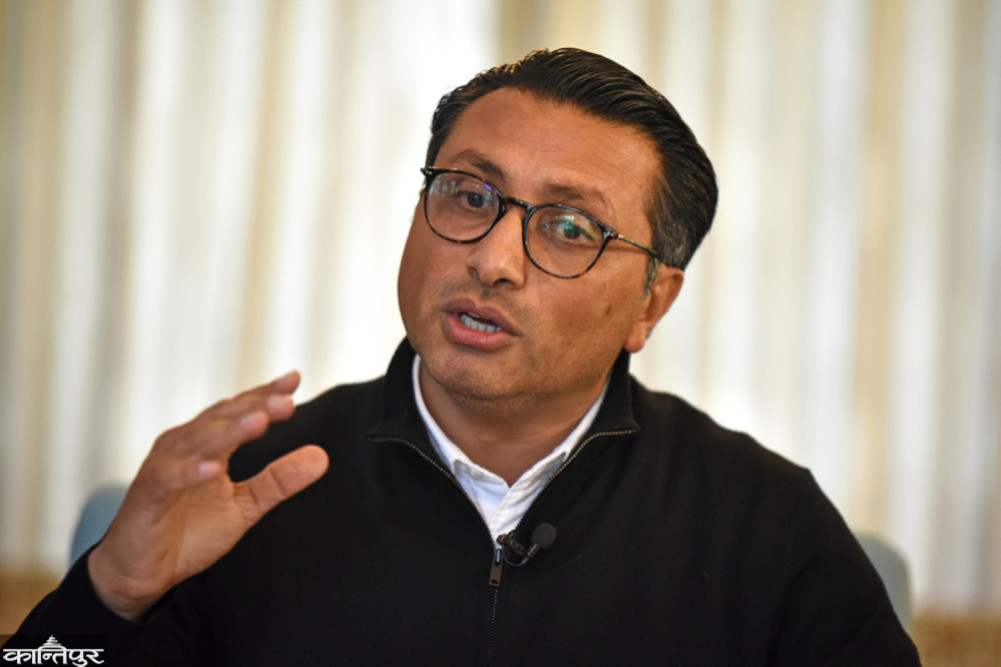
Finance Minister Wagle, who has set a target of collecting Rs. 1.4 trillion in revenue in the upcoming budget, has already instructed the revenue administration to work towards collecting nearly Rs. 1 trillion in arrears from revenue.
We use Google Cloud Translation Services. Google requires we provide the following disclaimer relating to use of this service:
This service may contain translations powered by Google. Google disclaims all warranties related to the translations, expressed or implied, including any warranties of accuracy, reliability, and any implied warranties of merchantability, fitness for a particular purpose, and noninfringement.
Finance Minister Swarnim Wagle has relied heavily on arrears to meet the revenue collection target set in the budget for the upcoming fiscal year. Finance Minister Wagle, who has set a target of collecting Rs 1.4 trillion in revenue in the upcoming budget, has already instructed the revenue administration to collect about Rs 1 trillion from arrears.
In addition, when the revenue distributed to the provinces and local levels is added, the central government must collect more than Rs 1.5 trillion in revenue. Out of this, Rs 1.4 trillion 5 billion will come to the federal government after distribution to the provinces and municipalities.
The government has set a target of increasing revenue by about 20 percent next year compared to the current fiscal year. For that, Finance Minister Wagle has taken the revenue in arrears due to legal complications (cases) as the main basis. He has given a deadline of six months for the payment of arrears in the upcoming budget. ‘The target is to collect at least more than Rs 1 trillion from arrears,’ said a senior official of the Finance Ministry, ‘that possibility has been seen.’
Under this facility, a provision has been made in the budget to withdraw pending cases by paying one percent more on the arrears determined by the tax office. Section 46 of the financial bill provides for the withdrawal of cases pending before the Internal Revenue Department for administrative review or any other judicial body and the payment of the value-added tax, income tax and excise duty amount determined from such determination and the additional amount of one percent thereof by the middle of the coming Poush. The financial bill states that the amount paid within that time will be waived off the fees, additional charges, fines, interest and late fees.
The government has set a target of collecting Rs 145.31 billion in revenue in the coming fiscal year. According to a Finance Ministry source, the arrears also depend on that. Uttar Kumar Khatri, Chief of the Revenue Management Division of the Finance Ministry, said that concessions have been given to pay the arrears for various reasons. ‘This facility does not reduce the initial tax amount, the tax assessed amount must be paid,’ he said, ‘but the arrangement has been made to pay the amount by adding one percent to the initially assessed tax amount, which has been exempted from additional fees and fines.’
Khatri said that the aim of this is to bring those in the informal sector to the formal sector. ‘We have introduced a scheme to pay the tax assessed amount once and pay an additional one percent to the arrears, delinquencies and cases that have been pending for a long time,’ he said, ‘Such a scheme used to come before. But now it is more convenient than before.’
According to the bill, in a pending case, if the Internal Revenue Department or office has been allowed to appeal to the Supreme Court or rehear the case or if the application for appeal or rehearing the case is pending, the concerned taxpayer can withdraw such a case by submitting the disputed tax amount and an additional amount of one percent to the department or the concerned office by Poush Masant 2083.
The Department of Internal Revenue has stated that there are currently 1,311 cases in arrears of revenue. From the previous year, 1,381 cases were transferred to the current fiscal year. Of which 396 cases were added in the current fiscal year. After that, the total number of cases reached 1,777. Of these, 466 cases were finalized this year, the department has stated. The number of cases pending to be finalized is 1,311 and the amount to be recovered is about 172.33 billion rupees. This amount is after all fees, additional charges, fines, interest and late fees. However, taxpayers who pay within the next Push will have to pay only one percent more on the initial tax. Since all the remaining fees and fines will be waived, the tax officer says that it is unlikely that all the 2020 crores mentioned will be recovered.
The number of cases transferred from the fiscal year 2080/81 to last year was 1,742. To this, 741 cases were added in the fiscal year 2081/82. Of these, 1,102 applications were dismissed that year, the department said.
The Finance Bill states that even in cases where permission to appeal to the Supreme Court or to re-examine the case has not been obtained but the tax has not been re-assessed by the concerned office, if the person concerned submits the disputed tax amount and an additional amount of one percent thereof by mid-2083, the fees, additional fees, fines, interest and late fees incurred on it will be waived.
Despite anything written elsewhere, the bill states that the aforementioned exemption provision will not apply to persons involved in the business of providing telecommunications services. Officials of the Internal Revenue Department say that some taxpayers have started coming to the office to pay taxes under this facility.
Information Officer of the Internal Revenue Department, Keshav Raghuvanshi, said that some taxpayers have started coming to the office to take advantage of the facility as per the exemption given by the government. ‘Taxpayers have started coming to the department to withdraw their cases by paying a one percent fee,’ he said, ‘and the number is increasing.’
The government’s provision on collecting old arrears included in the economic ordinance will benefit industrialists and businessmen, said Araniko Rajbhandari, chairman of the Tax and Revenue Committee of the Federation of Nepalese Chambers of Commerce and Industry. ‘For various reasons, some have not been able to pay taxes, income tax and excise duty on time,’ he said. ‘On the other hand, when the government unilaterally determines taxes and imposes fines, the amount to be paid increases.
In such a situation, the government’s decision will benefit businessmen who are sitting there thinking that they cannot pay the amount.’ Rajbhandari claims that this decision will benefit businessmen. He said that it is a good thing that the government is bringing an act on debt recovery that the private sector has been raising. ‘It will benefit all businessmen, from small to big,’ he said.