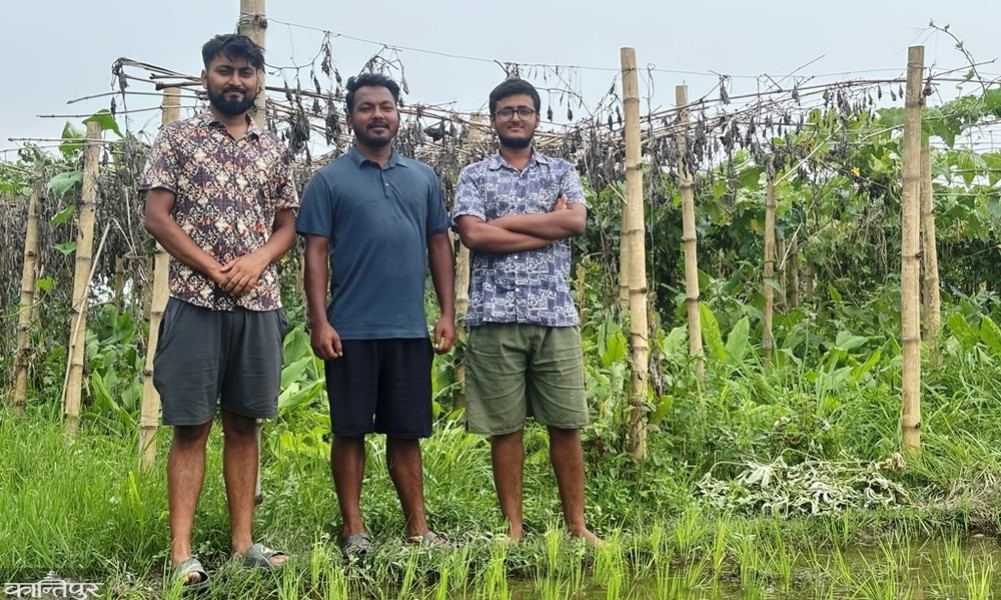
Out of the five bighas, three bighas are planted with fruits such as mango, litchi, mango, plum, banana, papaya, custard apple, jamun and groundnut. The remaining two bighas are used for growing seasonal vegetables completely free of pesticides.
We use Google Cloud Translation Services. Google requires we provide the following disclaimer relating to use of this service:
This service may contain translations powered by Google. Google disclaims all warranties related to the translations, expressed or implied, including any warranties of accuracy, reliability, and any implied warranties of merchantability, fitness for a particular purpose, and noninfringement.
Even while studying agriculture in Sunsari, 25-year-old Revati Dahal from Biratnagar-1, Morang, had no plans to pursue agriculture. Her dream was to become a 'boss' after completing her civil service exams.
When she entered the camp, Revati, who had a civil service preparation book in her hand, threw away the book when she left the camp and decided to pursue agriculture. 'I had a dream of becoming a boss after completing my civil service exams,' she said. 'I gave up that dream and chose agriculture.' Her acquaintance with natural farming activist Madhav Dhungel especially attracted her to agriculture. After that, she joined the Natural Agriculture and Herbs Cooperative Society in Kauchhe, Sindhuli for some time. About 9 bighas of land were being cultivated in a multi-level garden system. She spent about one and a half years there.
There, 16 young people farmed collectively. All of them were owners and workers themselves. They ate collectively, worked together. From services to facilities to responsibilities, everyone was equal. But, why? Slowly, one after another, the youth group started leaving. After most of them left, Revati did not stop. ‘I don’t know why others left,’ she said. ‘I left for personal reasons.’
Then she joined an NGO working in the field of education. The organization prioritized practical learning over book knowledge. It was the kind of work she wanted. The salary was also sufficient. But, after about 10 months, she could not stay there either. Her attention was drawn back to agriculture, that too, towards natural farming.
After leaving her job, she was unemployed for some time. She left Kathmandu on Bhadra 22, before the Genji Movement started. His plan was to return to his village and engage in agriculture. However, finding suitable land for farming was not easy. He searched for about two months from Biratnagar to Biratchowk, but he did not find the land he wanted. He talked to many landowners. However, he did not reach a conclusion. After not getting the land, he decided to leave agriculture and return to work. A job offer also came from an NGO working in agriculture. In fact, that organization was trying to connect him. He was returning after reaching Kathmandu and giving an interview. The job was almost certain. At that time, a landowner called him. He informed him that he was ready to give the land on lease. As soon as he hung up the phone, Revati sent an email to the organization where he had interviewed, saying, "Sorry, I cannot join your organization."
He got five bighas of land on lease for 10 years in Gramthan-1 Lakhantari, Morang. Then, his classmate from the agriculture campus, Abin Chaudhary, and school friend Deep Khatiwada gradually joined him.
Abin Chaudhary, 28, of Agnisair Krishnaswaran Rural Municipality-5 in Saptari, had studied agriculture with Revati. He had earlier promised Revati, ‘If agriculture is done, remember me.’
Without saying a word, Revati remembered him first. After being offered natural farming, he also quit his job.
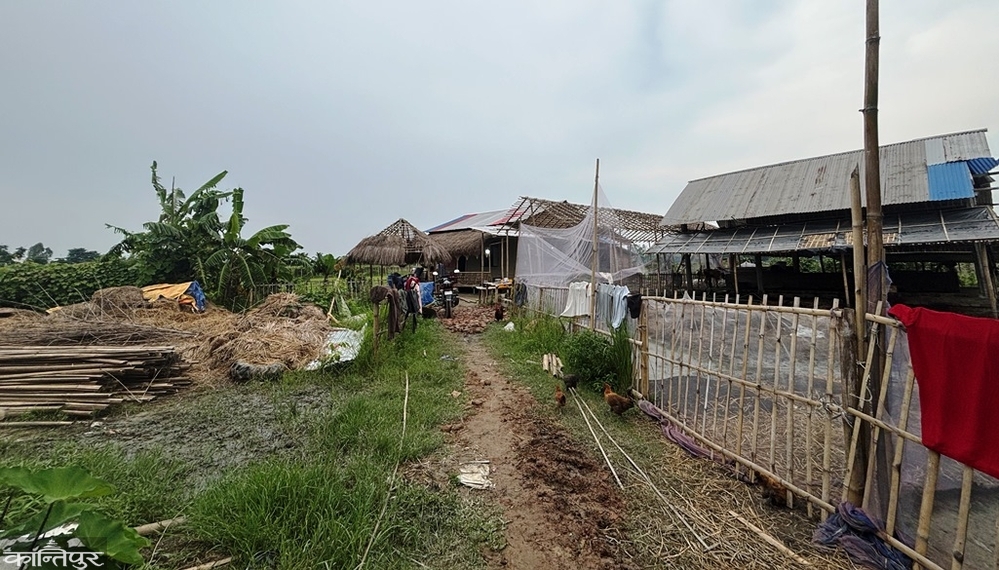
He immediately came to Morang after resigning from a private school in Lahan. ‘My daughter was born in Mangsir, our lease agreement was signed in Poush,’ Abin recalled.
Meanwhile, Revati met her school friend Deep Khatiwada. Electronics engineer Deep was working at an organization called ‘Gadget White’ in Kathmandu. Revati told him the plan for natural farming and urged them to work together. Deep asked for 2 months . After the third month, he also joined . He also decided to quit his job and engage in agriculture .
These three young people have been carrying out their own kind of 'rebellion' in agriculture for eight months now . They have invested eight lakh rupees each and have started 'Hello Kranti Krishi Farm' . 'All three of us were in search of happiness,' said Revati, 'that search brought us here.'
They practice natural farming . They accept that they can earn more by using chemical pesticides . However, they understand that they will not get the satisfaction they are looking for . 'You might have earned a lot of money by farming using pesticides,' says Revati, 'but you would not have been happy . Natural farming may give less income, but it has given us a happiness that cannot be bought.'
After starting farming, they grew organic vegetables as their first product a month ago. Instead of sending them to the market, they sold them at the consumer's home. 'We do not send our products to the market,' said Abin. 'We are working on the concept of family farmers.' Their slogan is, 'We grow healthy vegetables for your family.'
Out of the five bighas, three bighas are planted with fruits such as mango, litchi, mango, plum, banana, papaya, sitaphal, jamun and bhunikathar. The remaining two bighas are completely pesticide-free seasonal vegetables. In the long term, they plan to develop this area as a fruit garden. They have set a goal to connect it with agri-tourism, operate homestays, and eventually develop it as an agricultural research center. ‘We plan to develop it as a research center in the future,’ Deep said of the future plans.