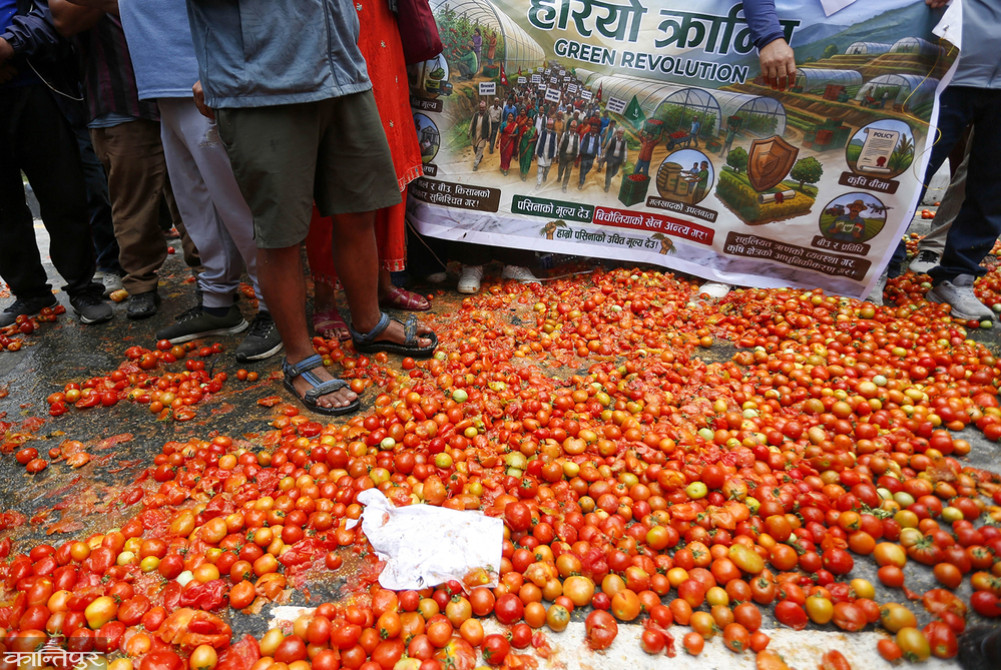
Farmers producing tomatoes through tunnel farming around Kathmandu protested at Maitighar on Wednesday. Agriculture Minister Geeta Kumari Chaudhary has claimed that a solution will be found within three days.
We use Google Cloud Translation Services. Google requires we provide the following disclaimer relating to use of this service:
This service may contain translations powered by Google. Google disclaims all warranties related to the translations, expressed or implied, including any warranties of accuracy, reliability, and any implied warranties of merchantability, fitness for a particular purpose, and noninfringement.
Farmers protested by throwing tomatoes at their homes on Wednesday, saying they were getting only Rs. 8 per kilo while tomatoes were being sold in the market for Rs. 50 to 60 per kilo.
Farmers producing tomatoes through tunnel farming around Kathmandu have been protesting at Maitghar under the leadership of the Young Farmers Network, demanding that the government control the influence of middlemen in the market.
After the Ministry of Agriculture and Livestock Development discussed with the farmers and promised to study the price gap and find a solution, they suspended the protest for three days, Young Farmers Network Chairman Shriram Ghimire told Kantipur.
Wholesalers are buying a 25-kilogram crate of tomatoes from farmers for 180 to 200 rupees. Accordingly, farmers are getting only about 8 rupees per kilogram. But consumers have to buy these same tomatoes in the market for a minimum of 45 to 60 rupees, according to Ghimire. “We are selling the tomatoes we produce for 8 rupees per kilogram, consumers have to pay up to 60 rupees. The government should find out where the middleman money is going,” he told Kantipur on Wednesday after the talks at the ministry.
Ghimire claims that the main reason for the price difference in the market is the import of Indian tomatoes and the manipulation of middlemen. Although about 86 tons of tomatoes are consumed daily in the Kathmandu Valley, the production coming from the valley and surrounding districts cannot meet that demand at this time.
‘The production does not exceed 15-16 tons per day within the valley. The quantity coming from the surrounding districts is also limited. After that, the government should clarify where the tomatoes coming to the market come from,’ Ghimire said. Minister for Agriculture, Forestry and Environment Geeta Kumari Chaudhary said that the current problem is related to seasonality and market management.
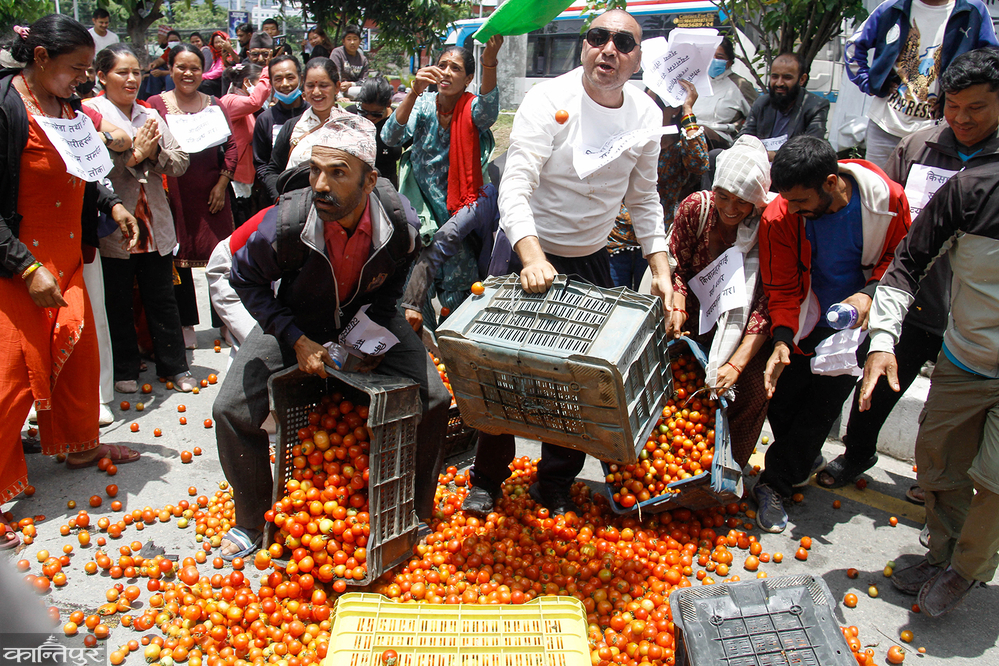
Agriculture Minister Chaudhary said that due to the planting in Asar-Sarawak, farmers send ripe tomatoes to the market at once, transportation is affected due to road blockage due to incessant rains, and there is not enough capacity to store local products, which has created a situation where prices have fallen. ‘The price of tomatoes decreases every year during this season.’ During planting, farmers send tomatoes to the market at once. The continuous rains have also affected the supply management due to the disruption of roads between Pokhara and Narayangadh. As a result, the market is unbalanced when tomatoes that should be exported to those cities arrive in Kathmandu at this time,' Minister Chaudhary told Kantipur.
Chaudhary said that the Kalimati Fruit and Vegetable Development Committee has started a study on the role of middlemen in farmers not getting the right price for their produce. 'There have been complaints that farmers are not getting the right price due to middlemen.' We have given the responsibility to the Kalimati Fruit and Vegetable Market Development Committee and the Department of Agriculture to study it. We will take the necessary decision after studying the actual situation,' she said.
Minister Chaudhary said that the government is also preparing to work together on options to take farmers' products to other potential markets, including the Terai markets. ‘There has been a verbal agreement to coordinate with the farmers on which markets they can send tomatoes to and move forward with the work,’ she said.
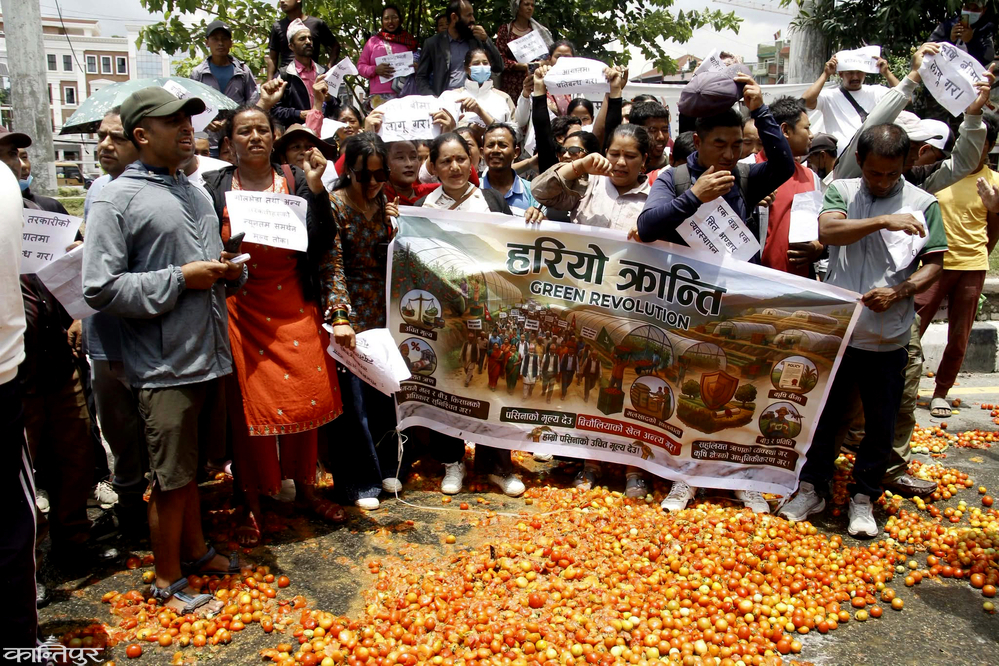
Farmers have demanded a minimum price for vegetables including tomatoes. But Minister Chaudhary clarified that there is no written agreement on the farmers’ demand for price adjustment within 72 hours. ‘There is no written agreement. They have put forward their demands. We have started coordinating with the relevant bodies from today. A decision will be made after the study,’ she said.
Chairman Ghimire said that no further discussion is needed, but a decision is needed. ‘This issue has been discussed for decades. Now farmers need a decision, not a discussion. If the government does not take a concrete decision within three days, we will go on strike again,’ he said.
Commercial farmers from areas like Tarkeshwor, Kageshwori Manohara, Shankharapur, Kirtipur, Bhaktapur and other areas of Kathmandu Valley participated in the movement. Most of the farmers have been practicing commercial farming using tunnel technology.