During this period, out of the 73 trading days the market was open, the NEPSE fell on 47 days and rose on 26 days.
We use Google Cloud Translation Services. Google requires we provide the following disclaimer relating to use of this service:
This service may contain translations powered by Google. Google disclaims all warranties related to the translations, expressed or implied, including any warranties of accuracy, reliability, and any implied warranties of merchantability, fitness for a particular purpose, and noninfringement.
The stock market has been in a state of disarray in the 109 days since the Rashtriya Swayamsevak Sangh (RSS) led the government with a near two-thirds majority. During this period, out of the 73 trading days that the market was open, the NEPSE has fallen on 47 days and increased on 26 days. Investors expected that the formation of a new government would have a positive impact on the stock market due to the end of political instability and the establishment of policy stability. But contrary to expectations, the stock market continued to decline, where investor confidence failed to increase.
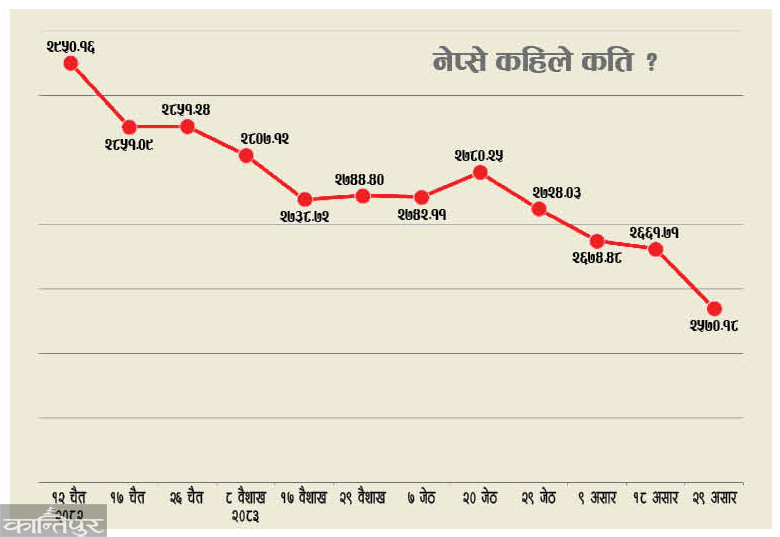
The NEPSE index on March 12 was at 2,950 points. On March 13, Balendra Shah became the Prime Minister. Since then, the NEPSE has fallen by 380 points till now (June 29). While the NEPSE has been falling frequently, it has fallen to 2,570 points by Monday. This also confirms that investor confidence has not increased.
During this period, along with the NEPSE index, the size of the stock market and the total market capitalization have also shrunk by about 6 trillion. The total market capitalization, which was Rs 500.9 billion on Chaitra 12, has fallen to Rs 4.416 billion as of Monday. The total market capitalization is calculated by multiplying the number of shares of a listed company by the share price. Total market capitalization shows the value of shareholders' assets. When the NEPSE index falls, capitalization also decreases, and when it rises, the value of investors' assets decreases. In the last three and a half months, the NEPSE index has fallen by 380 points on most days of the market. When the NEPSE falls, the value of investors' assets also decreases.
Although the state's policy is currently favorable to the stock market, there are doubts about the government's activities and investors' fears persist, the NEPSE has not been able to grow, said Narendra Raj Sijapati, former president of the Stock Brokers Association. 'After the formation of the new government, an investigation was started against some big businessmen, saying that they would maintain good governance. Those transactions were mainly related to the stock market. This mainly increased fear among big investors,' he said. 'Due to that fear, big investors have not been able to enter the market. This is the main reason why the market has not grown.'' Sijapati said that even though Nepalis want good governance in the country, there is still hope that the government will not take action against them or their people in their area. ''The collection of property details started by the government has also created fear in the stock market,'' he added. ''Recently, the court has asked not to proceed with the investigation of property details. But the fear among citizens remains as to when the government will start the investigation.'' He said that the market has not grown as investors are in a state of fear and panic and they have not expanded their investments.'' As of Monday, 7.986 million people have opened demat accounts for share trading. Of these, 4.7 million have opened a trading management system (TMS) for online trading in the secondary market. Of these, only about 400,000 are active investors. Generally, Nepal Stock Exchange Nepse defines active investors as investors who buy or sell shares at least once a year.
The number of active investors also depends on the direction of the stock market. Generally, active investors increase when the market rises and decrease when it falls. Currently, the number of active investors has also decreased due to the decline in the market, according to NEPSE.
Tara Fullel, President of the Nepal Stock Investors Association, argues that the market is continuously falling because the government has failed to meet investor expectations. ‘The expectations that investors had of the government have not been fulfilled. There has been only panic,’ he said, ‘Not only is there more liquidity, lower interest rates, but the policies are also market-friendly. But investor confidence has not increased.’
Although the new government is expected to be stable, there is an expectation of policy stability and a positive impact on the stock market, the market has not been able to grow because trust in the government has not increased, he argues. The government has also lost a large amount of revenue due to the decline in the stock market. Compared to the eleven months of the last fiscal year (from Shrawan to Jestha), the capital gains tax (CGT) has decreased by about 37 percent in the same period of the current fiscal year.
Accordingly, the government received Rs 15.36 billion CGT from the stock market in 11 months of the last fiscal year. In the same period of the current fiscal year, the government has received only Rs 9.64 billion CGT under this heading.
Since capital tax is a tax levied on profits, it increases when the market increases and decreases when it decreases. This year, as the market decreased, capital gains tax has also decreased, according to Nepse spokesperson Murahari Parajuli. ‘As the market decreased, capital gains tax has also decreased this year compared to last year,’ he said. ‘Usually, when the market decreases, the transaction amount also decreases and increases when it increases. Now, as the transaction amount also decreases, the profit of the shareholders has also decreased, so the tax has also decreased.’
Subash Chandra Dhungana, a stock investor and former member of the Rashtriya Swayamsevak Sangh (RSS) Monetary and Capital Market Department, said that the market has fallen due to investors not being able to rely on the existing policies of the state and the government. ‘After the 21 Falgun elections, Nepse had increased by 9 percent in the 11 trading days when the government was not formed. At that time, there was expectation towards the new government,' he said, 'The stock market did not recover in the trading days after Prime Minister Balendra Shah took oath. The trading volume and market capitalization also decreased significantly. Accordingly, the average trading volume before the formation of the government was Rs 13 billion, but now it has decreased to Rs 5.6 billion.'
Even though the government increased the capital gains tax through the budget, investors could not be reassured as there was still uncertainty about whether it would be final or not. 'This time the tax came in a different way. Investors could not take that positively either,' he said, 'That is why the NEPSE fell by about 80 points in the three days after the monetary policy was issued.'
Dhungana said that due to these various reasons, investors were wondering whether the stock market was not the government's priority, and their confidence could not increase. 'Investors are in a wait-and-see situation. They could not take risks,' he added.
Along with this, the NEPSE continued to decline on Monday. Accordingly, the NEPSE fell by 30.67 points on Monday. The NEPSE, which fell by only one point last Friday, saw its highest decline on Monday. The overall index fell by 1.17 percent on Monday compared to the previous day, dropping to 6,570.18 points, the lowest in about 7 months. Earlier, on 9 Pus 2082, the NEPSE was at 2,585.87 points. The overall NEPSE saw its highest decline after the indices of all 13 subgroups that traded on Monday declined.
Similarly, the number of companies listed on the NEPSE as of mid-Baisakh last year was 294. Among the listed companies, 133 are banks and financial institutions and insurance companies. 103 are hydropower companies, 28 are manufacturing and processing industries, 9 hotels, 7 investment companies, 4 are trading companies, and 10 are from other groups. The number of companies listed in Baisakh 2082 was 271.
Among the listed companies, banks and financial institutions and insurance companies account for 50.7 percent of the stock market capitalization. The share of hydropower companies is 17.5 percent, investment companies 6.9 percent, manufacturing and processing industries 8.8 percent, trading institutions 4.6 percent, hotels 3.3 percent, and other groups of companies 8.3 percent.