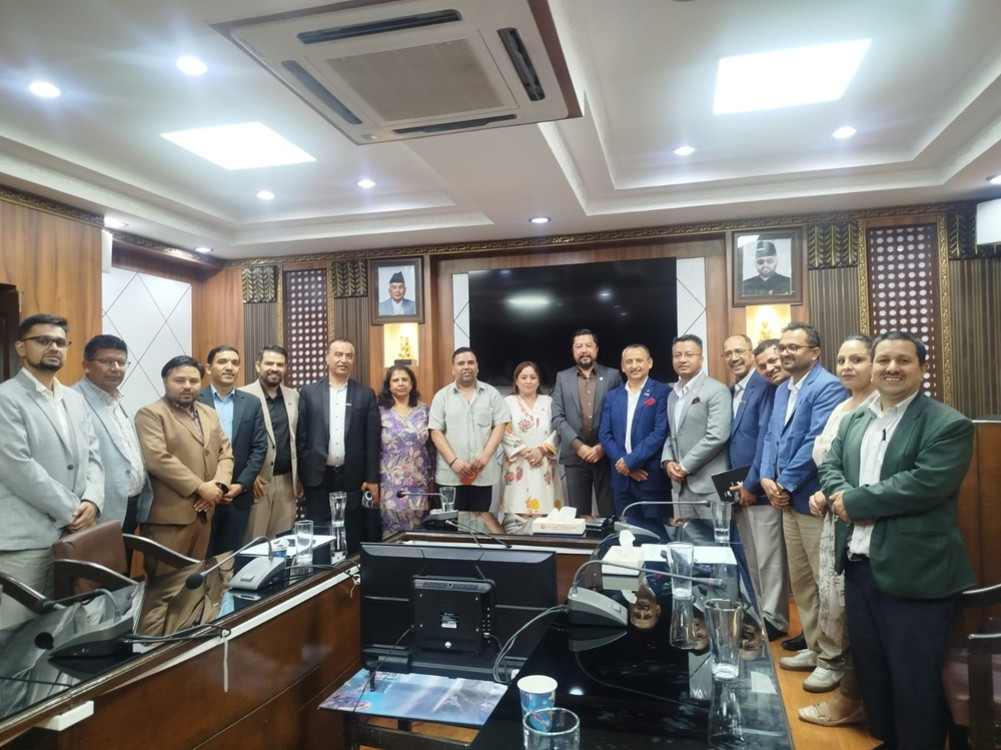
In a comprehensive discussion on energy issues, IPPAN has proposed solutions to address the problems seen in energy development and expansion, including policy and implementation issues.
We use Google Cloud Translation Services. Google requires we provide the following disclaimer relating to use of this service:
This service may contain translations powered by Google. Google disclaims all warranties related to the translations, expressed or implied, including any warranties of accuracy, reliability, and any implied warranties of merchantability, fitness for a particular purpose, and noninfringement.
Independent Power Producers Association of Nepal (IPPAN) has submitted a 38-point demand to Energy, Water Resources and Irrigation Minister Biraj Bhakta Shrestha, including immediate increase in private sector participation in electricity trading and construction of transmission lines.
On Monday, the Energy Minister held a comprehensive discussion on energy issues at a program organized to congratulate the newly elected working committee of IPPAN. IPPAN proposed to address the problems seen in energy development and expansion, including policy and implementation issues.
Energy Minister Shrestha, while comprehensively analyzing the contribution made by the energy sector to Nepal, urged to look at 'economic engineering' with the perspective of macroeconomic development. ‘The energy sector has made a huge contribution to the economic and social sectors, it is now necessary to analyze it comprehensively,’ he said, ‘It is necessary to analyze the contribution made by energy in every sector in an integrated manner.’
Stating that the ministry has taken the lead in energy development with broad participation of stakeholders, he said that a high-level committee should be formed to include the private sector and move forward with a clear line of action. ‘The issue of increasing the participation of the private sector in the electricity trade has progressed a lot. Even though a lot of budget has been allocated for the construction of transmission lines this year, there is no way to do it without attracting the private sector from next year,’ he said, ‘The energy sector has had to go to Singha Durbar to solve policy and implementation problems rather than making projects. The ministry has to form a high-level committee with a clear line of action to solve this problem through methods.’
He argued that a committee should be formed jointly between the government and the private sector on the electricity trade market. He also informed that the Ministry of Energy has proposed to the Ministry of Foreign Affairs to have an energy attaché in India for electricity trade.
Stating that the ministry has moved forward to make the Electricity Bill an umbrella act covering all energy-related issues, Minister Shrestha said that there is no room for making excuses for the current government and that the government has moved forward to make a breakthrough in the energy sector through methods and practices. He argued that the private sector should now focus on electricity trade, transmission, distribution, market and consumption along with production. ‘Now we should move forward towards comprehensive and integrated development by studying integrated business management and integrated system management.’ He said, ‘The government should identify the current policy gap and move forward through collaboration between the private sector and the government.’
IPPAN Chairman Dangi has said that if the government solves the problems seen in the current energy situation, the private sector is ready to achieve the government’s production target of 30,000 MW within 10 years. He said that the 205th meeting of the newly elected working committee of IPPAN held on Asad 19 and 20, 2083 had issued a 50-point declaration and that if the points mentioned in the declaration are addressed in a timely manner, the private sector is ready to move forward with full commitment to meet the government’s national target of 30,000 MW production, energy exports, consumption growth, green development and economic prosperity.’
Thanking the government for including issues that were expected to be resolved through the policy, budget and 100-point action plan, including the pending PPAs below 10 MW, the private sector being allowed to trade electricity and transmission lines and setting wheeling charges, he said that projects were being cancelled, capacity additions were being blocked through the Electricity Power and Energy Schedule Determination Method-2083, and the RCOD deadline was not being extended.
The Nepal Electricity Authority (NEA) was informed that the Ministry of Forests and Environment had not done the PPAs and that the Ministry of Environment and Forests had delayed the project, but it was not fair to cancel the permit for two years, saying that the private sector was ready to cooperate with the government and that a high-level committee should be formed to resolve all the problems.
Urging that the IPO/rights issue, which has been stalled since 2080 Jestha and the share dematerialization process, which has been stalled since 2081 Magh, should be started immediately and that initiatives should be taken to end the practice of forcibly implementing dual IGs against the law, he said that the private sector will continue to engage in the energy sector in a dignified and professional manner and that IPPAN will not protect anyone from doing wrong and corrupt things.