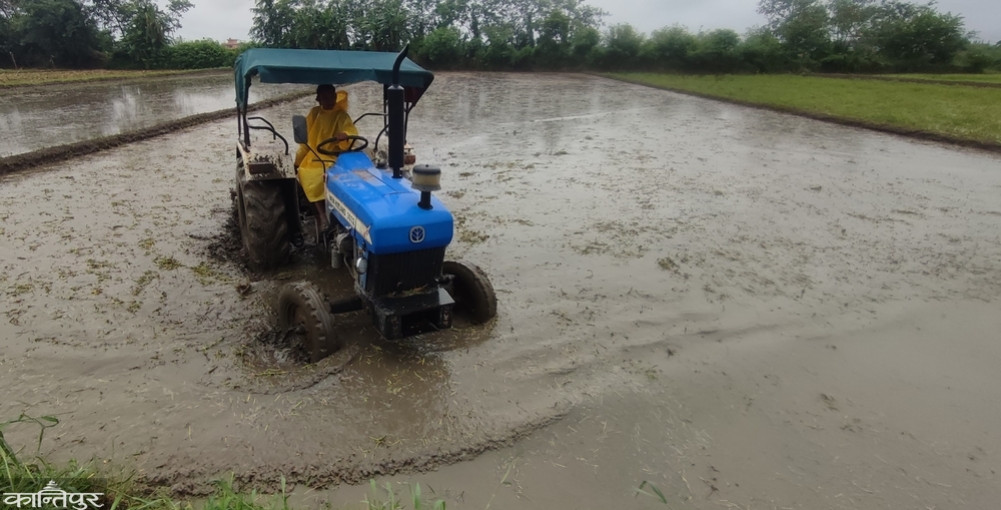
Chandraprasad Adhikari and Chhabilal Nyaupane of Bharatpur have been cultivating crops using organic methods without chemical fertilizers or pesticides for many years, and have been achieving good yields.
We use Google Cloud Translation Services. Google requires we provide the following disclaimer relating to use of this service:
This service may contain translations powered by Google. Google disclaims all warranties related to the translations, expressed or implied, including any warranties of accuracy, reliability, and any implied warranties of merchantability, fitness for a particular purpose, and noninfringement.
Bharatpur farmers Chandraprasad Adhikari and Chhabilal Neupane are currently busy planting rice. Adhikari, from Fulbari Shripur in Bharatpur Metropolitan City–15, will finish planting rice on four and a half bighas within two or three days.
Farmers often face difficulties obtaining chemical fertilizers like urea and DAP during rice planting and seedling growth. But Adhikari and Neupane have no such worries.
Adhikari has been practicing organic farming without chemical fertilizers or pesticides. He has been involved in this since 2046 BS (1989/90 AD). In the beginning, he used manure, green manure like dhaincha, and sesame, but now, Adhikari says, he does not need to apply any fertilizer to his rice. Sometimes, whether he applies fertilizer or not, the rice grows so vigorously that it falls over. “After planting rice, I haven’t used any kind of fertilizer,” Adhikari said.
After harvesting rice, Chandraprasad grows vegetables. He says the fertilizer applied for vegetable farming is sufficient for the rice as well. He only applies vermicompost to the seedbed for rice seedlings. For vegetable farming, he applies vermicompost, cow dung, and chicken manure to the fields in Kartik (October/November), which also benefits the rice. He says maintaining soil fertility without chemical fertilizers or pesticides has been advantageous. “The yield is good. Weeds cause a lot of problems in carrot and beetroot farming. Otherwise, there are no other difficulties,” Adhikari said.
Chhabilal Neupane of Shukranagar, Bharatpur–25, plants rice on ten and a half out of his sixteen bighas of land. He, too, does not have the hassle of sourcing chemical fertilizers or pesticides. Neupane has been practicing organic farming for over fourteen years. Rice requires fertilizer, but he does not have to wander the markets looking for it. “I have planted dhaincha in the fields. At planting time, I simply plow the dhaincha into the soil. Once it decomposes in the mud, it serves as excellent fertilizer,” Neupane said. He also sprinkles powdered mustard cake as fertilizer in his rice fields. He has already collected fifteen quintals of mustard cake from the local cooperative’s oil mill specifically for his rice crop.
“I am not worried about finding fertilizer. I am busy clearing the field ridges and arranging irrigation turns,” Neupane said. He explained that the belief that farming is impossible without chemical fertilizers and pesticides has prevented Nepali farmers from adopting organic agriculture. “If we just improve our cattle sheds, the manure and urine from the sheds are more than enough for farming. The government should encourage farmers in this direction,” Neupane urged.
Neupane, who is also involved in campaigns to promote organic agriculture and provides training to farmers, says that if the government allocated even 20 percent of the budget it spends on chemical fertilizer subsidies to promote organic agriculture, it would yield fruitful results. He claims that if cattle sheds are improved and cow dung and urine are properly used, there will be no shortage of fertilizer.
He said that with proper management, one adult cow or buffalo can produce enough manure for one and a half bighas of land. Chandraprasad Adhikari of Fulbari Shripur, who is also the president of the Chitwan District Organic Association, said that farmers are confused due to the lack of incentive policies. “Weeds and pests are a nuisance. The misconception that yields are lower forces farmers to use chemical fertilizers and pesticides,” Adhikari said.