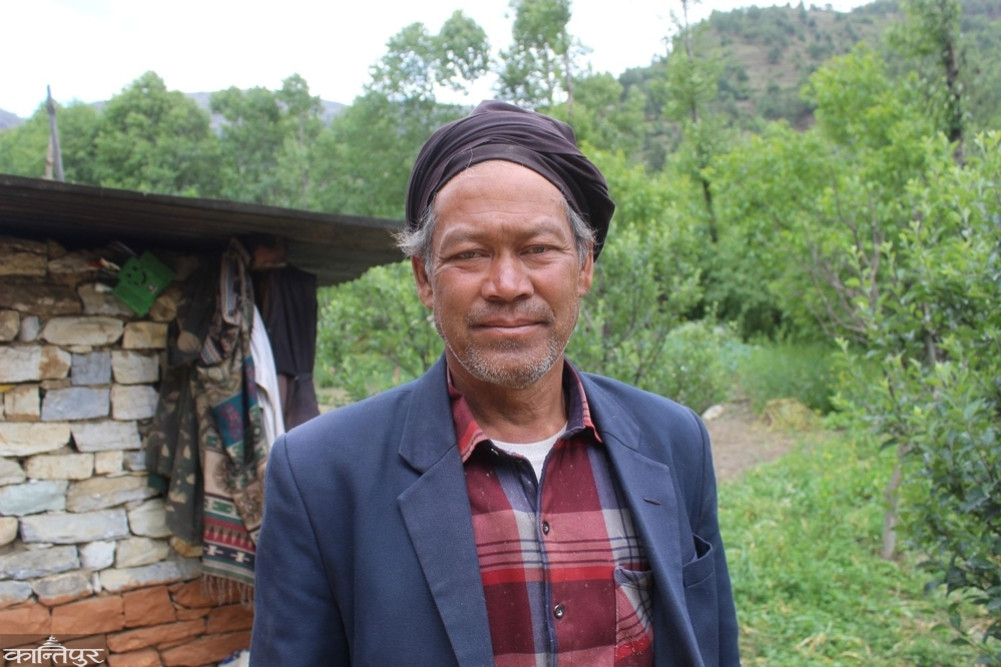
After processing, locals in Jumla and other districts of Karnali, where shilajit is collected by climbing cliffs, have started earning hundreds of thousands, but the risks and challenges remain unchanged.
We use Google Cloud Translation Services. Google requires we provide the following disclaimer relating to use of this service:
This service may contain translations powered by Google. Google disclaims all warranties related to the translations, expressed or implied, including any warranties of accuracy, reliability, and any implied warranties of merchantability, fitness for a particular purpose, and noninfringement.
The Himalayas of Karnali appear harsh from a distance. The bare rocks, towering cliffs, and snow-covered peaks not only showcase the grandeur of nature but also carry stories of struggle. Nestled in this rugged terrain is a black treasure preserved by nature for thousands of years—Shilajit.
Some call it the sweat of the mountains, others a natural gift filled with medicinal properties. But for many families in Jumla, Shilajit has become the foundation for survival and a means to run their households.
On the morning of Jestha 15, 61-year-old Bhaktabahadur Kathayat of Shantinagar, Chandannath Municipality–3, set out from his home. He carried neither a large bag on his shoulder nor any modern equipment. What he did have was years of experience, the courage to face risks, and the responsibility of his family.
His destination was a Himalayan cliff rarely reached by people. He spent nearly two weeks searching for Shilajit among the high rocks and narrow crevices. When he returned home on Jestha 30, his body was exhausted, but his face reflected satisfaction. The reason: the 10 kilograms of Shilajit he collected earned him an income of 1,008,000 rupees this year. This earning will cover his family’s expenses for the entire year. “When hanging on the cliff, there’s no time to look down,” says Bhaktabahadur. “If you make one mistake, there may be no way home. But when I think of my family’s needs, responsibility feels greater than fear.”
Having collected Shilajit since 2056 BS, he is now one of the experienced collectors in Jumla. After spending more than two decades on the Himalayan cliffs, he has learned through experience which crevice of which rock yields the best Shilajit, which season is suitable, and how to extract it safely.
According to him, selling Shilajit in its raw form does not fetch its true value. Shilajit, which sells for about 42,000 rupees per kilogram raw, sells for more than double after cleaning, processing, and packaging. If he had sold the 10 kilograms of Shilajit he collected this year in raw form, he would have received only about 420,000 rupees. By processing and selling it, he earned more than 1 million rupees from the same product. “If Karnali’s natural products can be brought to market as processed goods rather than raw materials, both farmers and collectors can get better prices,” he says.
This year, along with Bhaktabahadur, five other collectors also climbed the cliffs. They too collected about 10 kilograms of Shilajit each and earned hundreds of thousands of rupees. In Karnali, where it is difficult to sustain a livelihood year-round with only agricultural production, Shilajit is becoming a reliable source of income for many families. According to Dalbahadur Budha of Tila Rural Municipality–7, Shilajit holds the potential to change many lives. “As hard as it is to climb the cliffs, the reward is just as sweet,” he says.
Shilajit is found naturally on the high Himalayan cliffs of Jumla, Humla, Mugu, and Dolpa. Believed to be formed over thousands of years through the natural process of decomposition of plants and minerals, this substance has been used in Ayurveda since ancient times. Locally, it is consumed mixed with milk for joint pain, arthritis, and physical weakness. However, experts advise that it should be used only on the recommendation of a physician or Ayurvedic specialist.
Currently, Shilajit collected in Jumla is being sold at high prices in major cities across the country, including Kathmandu. Traders have also been exporting it to India. The Organic Mini Market operated by Chandannath Multipurpose Cooperative has been selling processed and packaged Shilajit for the past seven years. According to the cooperative’s manager, Raju Bohora, when Shilajit is purchased from local collectors, processed, and sent to market, collectors receive comparatively better prices. But along with the potential, there are also significant challenges.
There are no clear standards for Shilajit collection. There are insufficient measures for risk management. Laboratories for quality testing are limited. The processes for branding and certification required to reach the international market are also weak. As a result, collectors who risk their lives remain the weakest link in the market chain.
Locals believe that if local governments, the provincial government, and the private sector can invest together in sustainable collection, scientific testing, quality certification, branding, and export management, Shilajit could become a new foundation for Karnali’s economy. Amid growing global interest in natural and herbal products, Bhaktabahadur says this “black gold” hidden in the lap of the Himalayas has strong potential to give Karnali a new economic identity. “The black color of Shilajit on my hands is not just dust from the rocks. It is the mark of years of struggle. It is not only the wrinkles of age, but also a witness to the ongoing struggle with the mountains,” he said. “Every drop of Shilajit picked from the cliffs is tied to the dreams of a family.” He says the rocks of Karnali conceal priceless treasures within themselves.