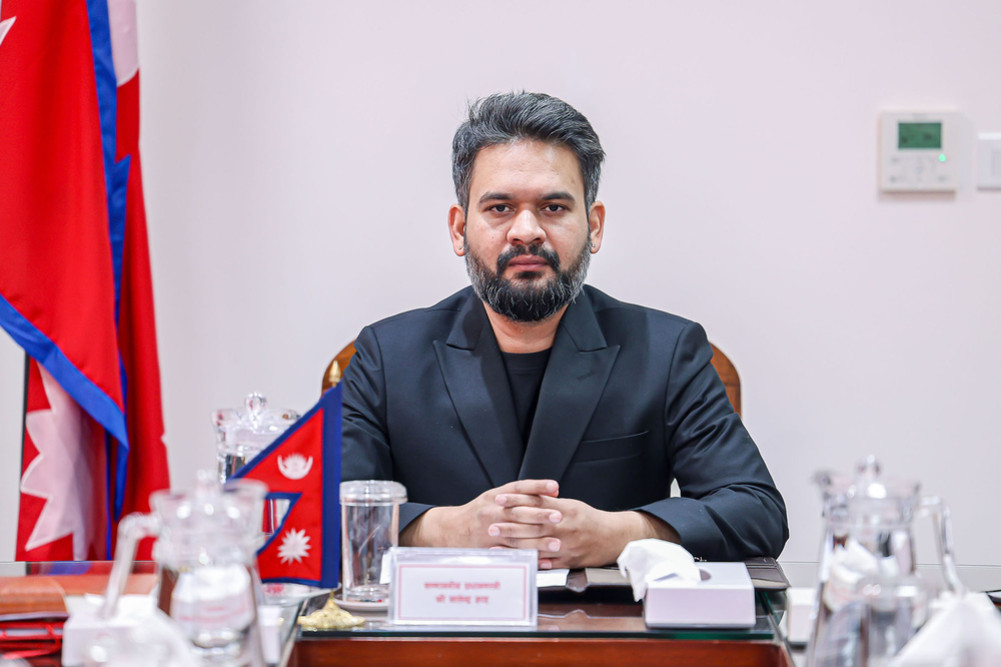
According to the promoters, Prime Minister Shah discussed the problems faced by energy producers with Energy Minister Biraj Bhakta Shrestha, Secretary Sarita Duwadi, Acting Executive Director of Nepal Electricity Authority Dirghayu Kumar Shrestha, among others, and also pledged to provide a solution.
We use Google Cloud Translation Services. Google requires we provide the following disclaimer relating to use of this service:
This service may contain translations powered by Google. Google disclaims all warranties related to the translations, expressed or implied, including any warranties of accuracy, reliability, and any implied warranties of merchantability, fitness for a particular purpose, and noninfringement.
Prime Minister Balen Shah has met with independent power producers. On Friday, as part of a series of meetings with diplomats and representatives from the private sector following his first hundred days in office, Prime Minister Shah held discussions with independent power producers.
At the meeting, Prime Minister Shah described himself as a promoter who has taken a keen interest in electricity trade. According to the promoters, Prime Minister Shah also pledged to resolve the issues faced by power producers after holding discussions with Minister for Energy Biraj Bhakta Shrestha, Secretary Sarita Duwadi, Acting Executive Director of Nepal Electricity Authority Dirghayu Kumar Shrestha, and others.
Senior Vice President of the Independent Power Producers’ Association, Nepal (IPPAN), Uttam Bhloan Lama, former president Ganesh Karki, vice presidents Susan Karmacharya, Uttarkumar Shrestha, Him Pathak, and General Secretary T.N. Acharya were present at the meeting. Lama, IPPAN’s senior vice president, stated that the discussion with the Prime Minister covered not only the problems but also their solutions.
“We discussed the entire ecosystem related to the energy sector, from electricity generation, licensing, transmission lines, and electricity trade to data centers, for nearly an hour and a quarter,” he said. “We discussed the government’s 30,000 MW production target, investment, management, and the problems that may arise during implementation.”
Lama also said that the Prime Minister showed interest in how electricity trade could contribute more revenue to the government, how the Authority could be made more effective, and how the work could benefit the general public as a whole.
 From Shrawan to Chaitra of the current fiscal year, Nepal sold electricity worth NPR 20.4156 billion in external markets. During the same period, it purchased electricity worth NPR 7.39 billion from India. So far, only the Nepal Electricity Authority has been trading electricity in the country.
The Authority had already established a subsidiary, Nepal Power Trading Company Limited (NPTC), in 2016 to buy and sell electricity. However, it has not yet been able to conduct trade. Meanwhile, the private sector has complained that, despite applying for licenses to trade electricity, they have not been granted permission.
IPPAN submitted its demands and suggestions to the Prime Minister in writing under various headings, including Power Purchase Agreement (PPA) and its improvement, final commercial operation date (RCOD), policy and legal reforms, investment and financial reforms, transmission and infrastructure development, consumption and energy diversification, environmental and social responsibility, and others.
The last time a PPA was opened was in 2022 for 1,500 MW. Since then, PPAs have been closed. Although PPAs for run-of-river hydropower projects up to 10 MW were being done automatically, this was also halted through the current fiscal year’s budget. However, the government has adopted a policy to conduct PPAs for projects up to 10 MW in the upcoming fiscal year’s budget.
According to IPPAN, out of Nepal’s total installed capacity of 4,300 MW, the private sector has contributed 3,500 MW. IPPAN also stated its full commitment to the government’s policy and program targets for the next decade: producing 30,000 MW, expanding energy exports, increasing consumption, and building a green economy. IPPAN further stated that private sector investment and project implementation have been seriously affected by PPA obstacles, delays in forest and land approvals, lack of transmission infrastructure, obstacles in IPO/rights and share dematerialization, multi-agency hassles, and policy uncertainty.
IPPAN stated that policy and legal reforms are needed to achieve the government’s declared energy targets and to make private sector investment secure, rapid, and result-oriented. It also demanded the immediate opening of PPAs for projects with a combined capacity of 16,000 MW that have applied but are currently on hold.
IPPAN’s former president Karki said that the discussion with the Prime Minister was positive. “We had a positive discussion with the Prime Minister and his advisors,” he said. “We requested solutions to the problems we have been facing, from electricity trade to opening up transmission lines. The Prime Minister expressed his commitment to move forward to provide a way out.” Karki also said that discussions would be held with the minister, secretary, and the Authority’s MD, among others.
A 47-point list of demands and suggestions, including take-and-pay PPA, contingency, electricity trade licenses, and ‘sunset law’, was submitted to the Prime Minister. In addition, Lama said that Prime Minister Shah also requested further study and suggestions on other unresolved issues related to the energy sector, including how to open up electricity trade.
IPPAN also stated that more than NPR 6 trillion in investment will be required to produce 30,000 MW of electricity in the next decade. For this, it suggested that a policy should be adopted to ensure that banks and financial institutions invest 20 percent in the energy sector within 10 years. It also requested a realistic review of the PPA rate, which has remained unchanged since 2011, based on the dollar exchange rate, equipment price increases, and the Nepal Rastra Bank’s price index.
At the meeting, Prime Minister Shah stated that the energy sector is an important foundation for Nepal’s economic transformation, job creation, industrialization, and green development. The Prime Minister’s Secretariat said that the energy sector will also play a significant role in promoting Nepal’s export trade.
The government clarified that it has taken seriously the issues raised by IPPAN regarding the problems, opportunities, and challenges in the production and promotion of energy in Nepal.
Shah also assured IPPAN officials that, in coordination with the Ministry of Energy, Water Resources and Irrigation, the Nepal Electricity Authority, and other concerned stakeholders, necessary facilitation and solutions would be pursued. According to the Prime Minister’s Secretariat, the discussion covered topics such as the energy sector, hydropower development, private sector investment in energy, environment, promotion of industry and business, and, through these, the development of the country’s economy.
Prime Minister Shah’s chief advisor Kumar Ben, principal private secretary Subash Sharma, and private secretary Naveen Bhandari were present at the discussion.