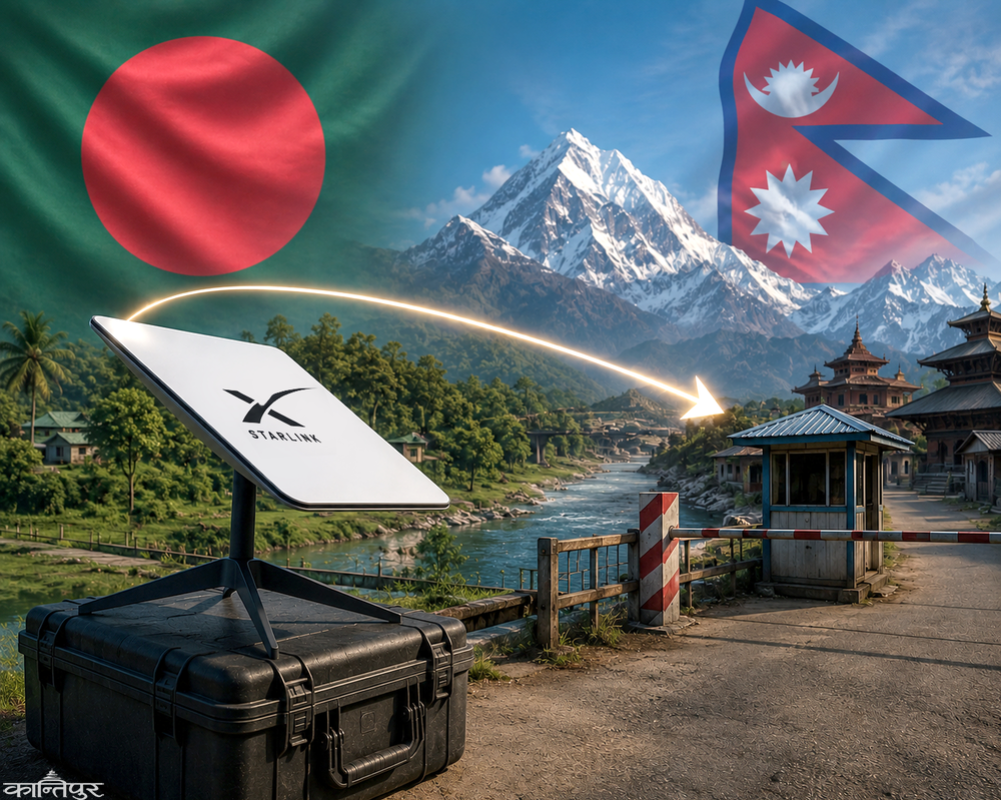
Bangladesh expected to become the main ‘transit hub’ for satellite internet for landlocked countries like Nepal and Bhutan
We use Google Cloud Translation Services. Google requires we provide the following disclaimer relating to use of this service:
This service may contain translations powered by Google. Google disclaims all warranties related to the translations, expressed or implied, including any warranties of accuracy, reliability, and any implied warranties of merchantability, fitness for a particular purpose, and noninfringement.
Bangladesh has formally granted permission to Starlink, the satellite internet service provider of the American space company SpaceX, to export bandwidth to the South Asian country. The Bangladesh Telecommunication Regulatory Commission (BTRC) has approved Starlink to use its infrastructure to carry cross-border internet traffic.
With this decision, Bangladesh is now expected to become the main ‘transit hub’ for satellite internet for landlocked countries like Nepal and Bhutan. According to the permission granted by Bangladesh, Starlink will be able to send international bandwidth received via the country’s submarine cable to Nepal via satellite.
In this process, Bangladesh has arranged to send ‘unfiltered’ bandwidth, as mentioned in a report by the local Daily Star. According to satellite expert and Managing Director of Puku Dot SH, Mustafa Mahmud Hossain, if the Government of Nepal grants approval, Nepali users will be able to easily use Starlink’s internet service. He described this process as a ‘bent pipe with foreign anchors’ structure.
“From the Starlink dish (terminal) at the Nepali user’s home, the signal is sent to a satellite flying 550 kilometers above,” he told Kantipur, “Technically, apart from the customer’s dish, no other hardware, gateway, or server is required on Nepal’s soil.”
Starlink must be officially registered and obtain permission to provide services directly to customers within Nepal. Without permission, it is not allowed to sell internet services directly to customers or to downlink satellite signals within Nepal’s borders, clarified Pradeep Paudyal, Assistant Spokesperson of the Telecommunications Authority.Indian media have described Starlink’s initiative in Bangladesh as a ‘masterstroke’. The company has been struggling for the past four years to obtain permission to expand its services in India. As Starlink’s service has been delayed in India due to strict data security and frequency allocation regulations, the company’s strategy to enter the region by using Bangladesh as a ‘data trampoline’ is considered a major success for Musk. Experts also point out that Bangladesh has been able to negotiate strongly to earn foreign currency by exporting bandwidth.
Starlink has shown interest in expanding its services in Nepal for a long time. Recently, the company’s director, Rebika Hunter, visited Kathmandu and met with Minister for Communications and Information Technology, Bikram Timilsina. In the meeting, Hunter expressed her desire to obtain permission to operate internet services in Nepal. However, she complained that she had not been able to obtain permission due to Nepal’s existing policy and legal complexities.
Starlink CEO Elon Musk himself expressed his desire to provide Starlink service at the summit of Everest during a virtual conversation with then Prime Minister KP Sharma Oli. Meanwhile, in recent years, there have also been complaints that Starlink’s internet is being used illegally in the Himalayan region.
Starlink must be officially registered and obtain permission to provide services directly to customers within Nepal. Without permission, it is not allowed to sell internet services directly to customers or to downlink satellite signals within Nepal’s borders, clarified Pradeep Paudyal, Assistant Spokesperson of the Telecommunications Authority. However, internet service providers here are allowed to purchase bandwidth from any satellite telecommunications service provider and sell it.
“Which country or company Nepali internet service providers buy bandwidth from is their business decision,” said Paudyal, “Since the Government of Nepal has not restricted operators from bringing in bandwidth from external sources, Bangladesh’s new decision has created an additional option for Nepali operators.”
Even now, some service providers in Nepal have been purchasing bandwidth from foreign satellite service providers and selling it in Nepal. So far, two companies have obtained licenses related to Global Mobile Personal Communications (GMPCS) for this purpose.
Sanepa-based Constellation Pvt. Ltd. and Kamaladi-based i4 Technologies have obtained GMPCS licenses. Since 2002, Constellation has been providing internet and satellite phone services in Nepal by obtaining satellite bandwidth and services from Thuraya Satellite Telecommunications Company of the United Arab Emirates (UAE), and i4 Technologies has been doing so from the British satellite telecommunications company ‘Inmarsat’.
“Because satellite phones are being used illegally in Nepal’s Himalayan and high Himalayan regions, our legitimate business has been completely devastated,” said Sanatan Gajurel of Constellation, “In the Everest base camp area, we have supplied only to a limited number of people due to fears of much commotion. But at Base 2 and 3, satellite internet is being openly used illegally.”
Local service providers say that if Starlink does not partner with Nepali service providers and does not obtain a license, it cannot operate services here. According to Nepal’s existing telecommunications policy, the limit for foreign investment in internet services is set at 80 percent. For the remaining 20 percent investment, a local partner is mandatory. However, Starlink has insisted on 100 percent foreign ownership in the company. Due to this foreign investment limit, Starlink has not yet been able to obtain a commercial license in Nepal.
In the meeting with Minister Timilsina, Starlink director Hunter mentioned that discussions had been held with local partners. Some internet service providers and information technology companies have been trying to partner with Starlink. Since the satellites of existing GMPCS service providers are in geostationary orbit 36,000 km above the earth, the fees are expensive. Starlink’s satellites, however, are in low earth orbit at 550 km and the fees are half as expensive. Because it is affordable, experts say tourists coming to Nepal are using Starlink’s service.
In a recent conversation with Kantipur, Minister for Communications Bikram Timilsina said that Starlink could come after registering according to Nepal’s laws and procedures. “It may not be appropriate to amend the law and make special arrangements for just one company,” he said, “Therefore, the government welcomes any company that comes within the scope of existing laws.” He said that while satellite internet is important for geographically remote areas, it is worth considering how economically viable it is.
Another local service provider complained that for the past 3–4 years, tourists have been openly doing TikTok live from Everest base camp, while the Telecommunications Authority remains unaware. According to him, this activity is affecting government revenue collection. “Even though the device and SIM purchased abroad use Nepal’s frequency when operated here, the fees and revenue go to the country where the SIM was purchased,” he said, “If someone engages in illegal activities, it cannot be traced. Therefore, such activities should not be allowed from the perspective of national security and revenue collection.”
After local service providers complained that foreign tourists were openly using the internet in Nepal’s Himalayan regions through satellite SIM cards and devices brought from various countries, the Authority issued a notice last year asking not to do so. Now, with Bangladesh granting Starlink permission to export bandwidth services, Assistant Spokesperson Paudyal of the Authority said there is no immediate risk of an increase in the illegal market in Nepal. “There does not appear to be an immediate increase in risk, but further detailed study is necessary,” he said.
Along with Bangladesh, Bhutan and Sri Lanka have already granted Starlink permission to operate in their markets. In India, Starlink is also moving forward with the process of obtaining security clearance and spectrum allocation for commercial operations. On Starlink’s official map, Nepal’s status is still shown as ‘service start date unknown’. Although Bangladesh’s latest move has opened a technical pathway for Nepal, policy obstacles still remain.